One Story. Many Angles.
Russian coverage reports only an unexplained fire while Ukrainian, Romanian and Bulgarian outlets name Russian drones as the cause.
Ukrainian and Romanian accounts converge on a Russian drone strike that sank the Royad Mammadov, while the Russian source relays only Romanian reports of a fire with no perpetrator named. Bulgarian coverage widens the frame to simultaneous attacks in its own economic zone, naming sea and air drones and quoting crew testimony that the strikes came without warning. Turkish reporting centers mutual accusations between Moscow and Kyiv. The pattern reveals that every national outlet reproduces the attribution line favored by its government or the incident’s location, yet all independently confirm the vessel details, the two fatalities and the rescue of eleven sailors. This leaves the core facts of the sinking corroborated across chains while responsibility remains the single point of outright contradiction. The result is that readers in different countries receive the same casualty numbers but entirely different explanations of why civilian grain shipping is now under direct threat in the Black Sea.
Perspective Analysis
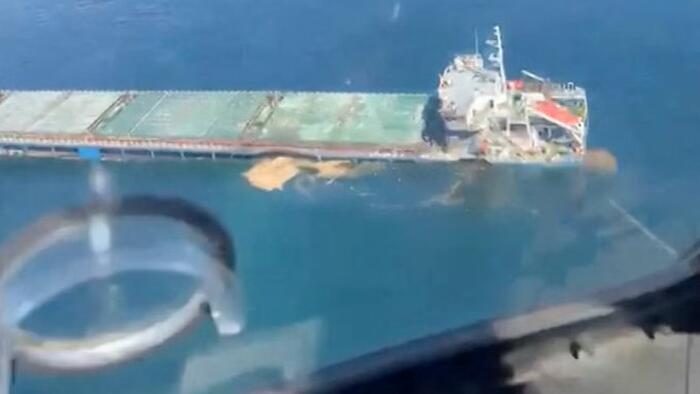
The Turkish-owned dry cargo ship Royad Mammadov left the Ukrainian port of Izmail on 18 September carrying grain bound for the Italian port of Ravenna. Built in 2006 and sailing under the flag of Saint Kitts and Nevis, the vessel was roughly 30 nautical miles south of the Romanian coastal point of Sfantu Gheorghe, inside Romania’s exclusive economic zone but outside its territorial waters, when it caught fire and sank on 5 October. Romanian authorities reported that a drone strike preceded the fire. Two crew members died. Eleven others were rescued. A helicopter winched the injured captain to medical care. Search and rescue vessels from the Romanian Coast Guard and the General Aviation Inspectorate remained on scene.
Ukrainian President Volodymyr Zelenskyy stated that Russian drones had struck the ship. Romanian Interior Ministry statements confirmed the fire, the casualties and the ongoing operation but did not assign responsibility in the first public accounts. The Maritime Coordination Centre in Constanta had received the initial alert at approximately 11:00 local time and designated a Coast Guard vessel as on-scene coordinator. Romanian reporting placed the incident near the Pescarus oil platform. The crew included Azerbaijani and Indian nationals. Vessel tracking data showed the ship’s last port call at Izmail and its planned arrival in Ravenna on 12 October.
Russian coverage described the same vessel and the same location but reported only that a fire had broken out. Parliamentary Gazette relayed Romanian maritime authority information through the TASS wire service and noted that 13 crew members were initially listed as missing and the captain was wounded. The account made no reference to drones or to any external cause. It placed the ship outside Romanian territorial waters and recorded that Romanian vessels had begun search and rescue. The same Russian outlet recalled an earlier incident in August 2026 in which another vessel, the container ship RMS Team, had caught fire after an alleged drone attack while sailing from Turkey to Novorossiysk.
Bulgarian reporting placed the Royad Mammadov sinking inside a wider sequence of strikes that same day. Two additional commercial vessels came under attack inside Bulgaria’s exclusive economic zone roughly 70 nautical miles east of Varna. The Togo-flagged Alfa Watan sustained critical structural damage and sank. The Palau-flagged Able suffered a fire after being hit. Its 18-member crew was evacuated onto the Bulgarian ferry Dioscuria, which happened to be nearby and responded to the explosion. Rescued sailors from Able told Bulgarian journalists that they received no warning and that the strike came from below or from sea drones. Bulgarian Prime Minister Rumen Radev convened security and defense officials, described the attacks as a gross violation of international law and maritime norms, and warned that continued fighting risked expanding the conflict’s geographic reach and raising insurance costs for all Black Sea traffic.
Turkish coverage framed the Royad Mammadov incident as part of overnight drone exchanges in which Russia and Ukraine traded accusations. Anadolu Agency noted the two deaths on the Turkish-owned vessel and the mutual claims without endorsing either side’s account of responsibility.
The physical details of the sinking and the casualty count appear consistently across Romanian, Ukrainian, Bulgarian and Turkish accounts. All four describe the same vessel, the same cargo origin, the same destination, the same location inside Romania’s economic zone, the same fire and sinking sequence, and the same outcome of two deaths and eleven rescues. The Russian account matches the vessel identity, location and fire but stops at those elements.
Accounts diverge sharply on the cause. Ukrainian statements name Russian drones. Bulgarian officials and rescued crew describe drone strikes, including sea drones, and extend the description to simultaneous attacks in Bulgarian waters. Romanian authorities confirm the incident and casualties but, in the published record, stop short of naming the attacker in initial releases. The Russian account contains no reference to drones and presents the event as an unexplained fire reported by Romanian sources. Turkish reporting records the existence of the competing claims.
The divergence follows national vantage points. Outlets based in countries directly affected by the location of the strikes or by the vessel’s cargo origin include the attribution statements made by their own governments or by crews operating in their waters. The single Russian source examined relays only the fire description and omits the drone claims carried by the other four. No outlet in the set contradicts the casualty numbers or the vessel’s basic itinerary. The Bulgarian coverage alone supplies crew testimony that the strikes arrived without warning and specifies sea drones as one vector.
The corroborated elements establish that a civilian grain carrier was lost with fatalities in a busy commercial lane. The disputed element is whether the loss resulted from deliberate attack or from an accidental fire. Independent reporting chains from Romania, Ukraine, Bulgaria and Turkey align on the former while the Russian chain examined aligns only on the physical outcome. The pattern indicates that each national press reproduces the explanatory frame advanced by its government or by the geography of the event itself. Readers limited to one country’s coverage therefore receive identical numbers for deaths and rescues but receive incompatible accounts of why those numbers occurred.
The event raises immediate stakes for Black Sea grain exports. The Royad Mammadov was one of the vessels moving Ukrainian agricultural products after the collapse of earlier corridor arrangements. Its loss, together with the parallel Bulgarian incidents, increases documented risk to commercial traffic in the same waters used by multiple nations’ fleets. European Commission President Ursula von der Leyen stated that commercial ships and their crews were being targeted, that lives had already been lost, and that attacks on civilian shipping were unacceptable. She added that exact circumstances remained under investigation but that the developments were concerning and that the European Union stood in solidarity with its eastern member states.
What to Watch
The accounts that name Russian drones rest on statements from the Ukrainian government and on Romanian and Bulgarian operational reporting that includes crew observations. The account that omits drones rests on the absence of such statements in the Russian source examined. The physical record of the sinking and the deaths is the element that survives across every independent chain. The attribution of responsibility does not.
That’s how the world told the story.
Get our daily open-source intelligence on world events in your inbox — one email a day, up to six stories.
Subscribe freeNo spam. One-click unsubscribe. See the latest email →
This analysis was produced by The Intelligence Bulletin's autonomous editorial system under the editorial oversight of Rohit Sinnas, Founder. How it works →