One Story. Many Angles.
Russian accounts stress anti-NATO red lines and Taliban successes while Pakistani reporting centers on terrorism accusations against Kabul.
Russian reporting centers on Lavrov’s categorical rejection of NATO infrastructure returns and his assessment that the Taliban are governing successfully with visible economic steps despite sanctions. Afghan coverage frames the event as a diplomatic opening that includes direct Taliban participation at a time of regional strain. Pakistani accounts instead foreground Islamabad’s accusations that terrorist groups operate with Taliban tolerance, citing thousands of Pakistani deaths and cross-border incidents as the dominant issue. Indian and Azerbaijani pieces note India’s presence among regional powers and echo Lavrov’s positive remarks on Taliban control. The meeting itself produced no reported joint statement in the first day of coverage, but the source pattern reveals a clear fault line: Russia and several neighbors treat engagement with the Taliban as settled regional diplomacy, while Pakistan treats security grievances as the unresolved core that any format must address. This split is not manufactured; it tracks exactly what each country’s representative chose to emphasize at the same table.
Perspective Analysis
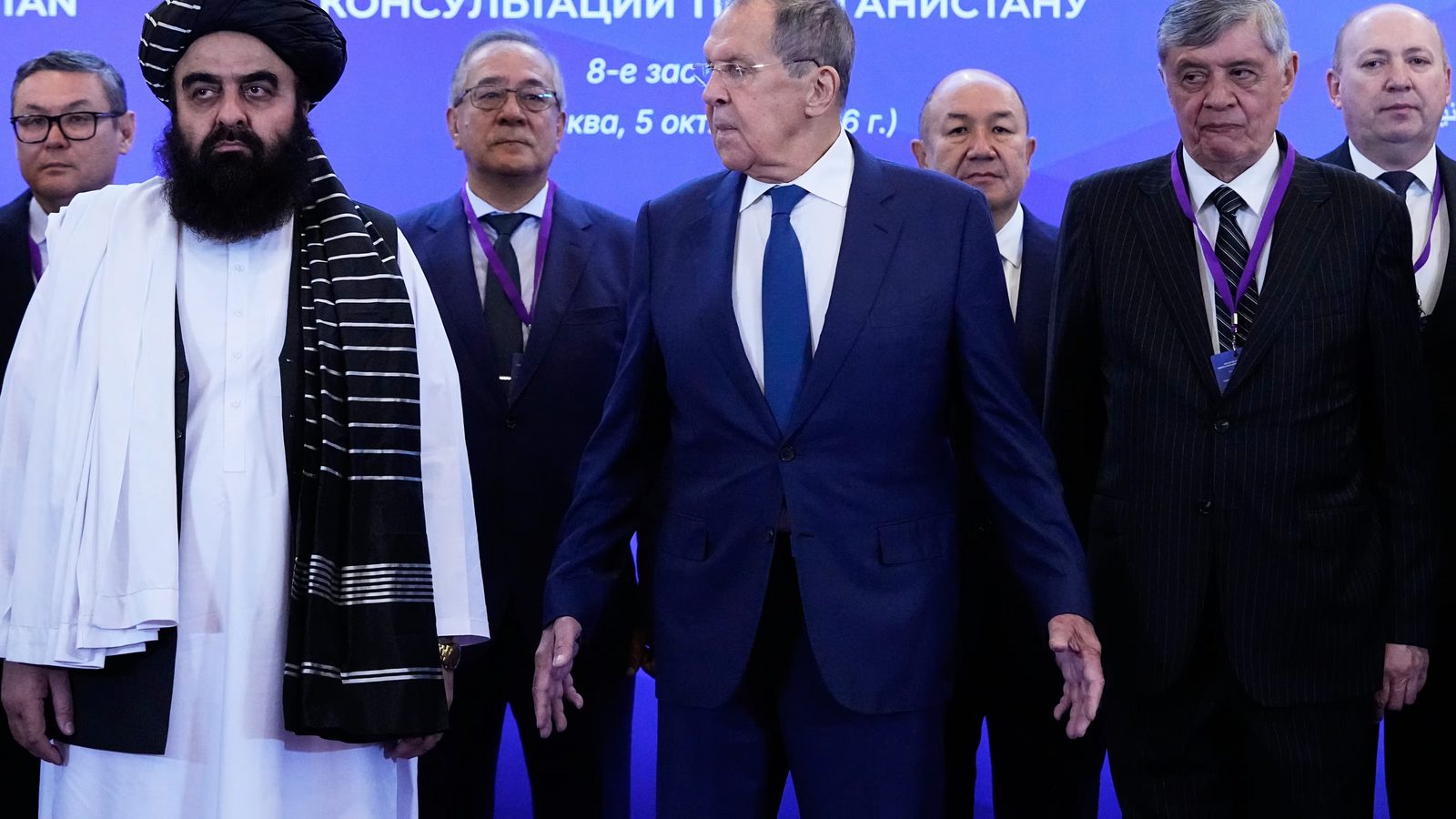
On October 5, 2026, the eighth Moscow Format consultations on Afghanistan opened in the Russian capital. Taliban Foreign Minister Amir Khan Muttaqi led the Afghan delegation. Special representatives and senior officials from China, India, Iran, Pakistan, Kazakhstan, Kyrgyzstan, Tajikistan and Uzbekistan took part, with Belarus and Egypt present as guests. Russian Foreign Minister Sergey Lavrov delivered the opening remarks and later held a bilateral session with Muttaqi.
Lavrov used the platform to restate Moscow’s opposition to any return of NATO military infrastructure to Afghanistan or neighboring states. He described such deployments as categorically unacceptable under any pretext and noted that past NATO presence had produced no positive results for the region. In the same address he observed that the Taliban-led government had taken control of the country’s territory and was governing it quite successfully. Afghanistan’s economy had grown despite sanctions, he said, with roughly 170 new manufacturing sites opened and a five-year plan drawn up for expanding power generation. Trade with more than 100 countries reached 14 billion dollars in 2025. Lavrov also recalled the fifth anniversary of the withdrawal of U.S. and NATO forces, stating that the Afghan people’s resilience had broken the occupiers’ military machine. Russia, he added, would continue delivering humanitarian assistance, with the next shipment expected within one or two months. UN figures cited in the remarks indicated that more than 17 million Afghans, nearly half the population, faced food shortages that winter and that 22 million people would require humanitarian aid overall.
Pakistan’s special representative for Afghanistan, Mohammad Sadiq, used his intervention to place terrorism at the center of the discussion. He stated that terrorist groups operating from Afghan soil posed the most serious security threat to Pakistan five years after the Taliban’s return to power. More than 4,700 Pakistanis had been killed by terrorism emanating from Afghanistan in the past three years alone, he said. Sadiq accused the Taliban regime of complicity in attacks planned, financed and carried out from Afghan territory and described a nexus between the authorities and militant groups that operated with impunity. He noted that Pakistan had conducted precise, intelligence-based defensive operations in response and would continue to take all appropriate measures under international law to protect its citizens. Islamabad still sought regional peace and had extended goodwill gestures, visas, trade facilitation and participation in connectivity projects, yet these efforts had been met with increased attacks, he claimed. The representative also raised broader concerns about restrictions on women and girls, the absence of broad-based governance and the lack of verifiable progress on counterterrorism commitments.
Afghan reporting from Khaama Press described the gathering as the continuation of a regional mechanism established in 2017 that now included direct Taliban participation for the second consecutive year. It noted that tensions between Kabul and Islamabad would be addressed and that Russia had signaled willingness to help the two sides reach a compromise if requested. The outlet listed the same participating states and highlighted the focus on political and economic cooperation as well as coordination against terrorism and drug trafficking.
Indian coverage in The Daily Pioneer drew attention to India’s seat among the regional powers at the table. Azerbaijani agency APA carried Lavrov’s assessment that the Taliban were governing successfully and that the economy had expanded despite sanctions. Russian state media Vesti foregrounded the foreign minister’s rejection of NATO infrastructure and quoted his warning that any such presence would increase conflict and destabilize the region.
The Moscow Format was launched in 2016 as a Russia-led platform for countries with a direct stake in Afghanistan’s stability. The Taliban took part formally for the first time at the seventh meeting in October 2025. No joint statement from the eighth round had been released by the end of the first day of reporting.
A reader limited to Russian state outlets would encounter a consistent emphasis on security red lines against NATO and on concrete indicators of Taliban administrative and economic performance. The same reader would not encounter the detailed casualty figures or the direct accusations of regime complicity advanced by Pakistan’s representative. A reader limited to Pakistani coverage would see the terrorism threat and Islamabad’s defensive actions as the dominant theme, with little elaboration on Lavrov’s positive remarks about Taliban governance or the economic steps cited in Russian and Azerbaijani accounts. Afghan reporting foregrounded the diplomatic opening and the possibility of Russian mediation on bilateral strains, while Indian coverage added the participation of New Delhi without expanding on the substance of the exchanges.
These differences track the national positions each delegation chose to voice at the same table rather than any divergence in the basic facts of the meeting itself. The corroborated elements—Lavrov’s statements on NATO infrastructure and on Taliban governance, the list of participating states, and the date and leadership of the Afghan delegation—appear across independent reporting chains. Pakistan’s specific claims about casualties and complicity rest on a single reporting chain that quotes its own representative at length.
What to Watch
The split reflects differing national stakes. Russia has already removed the Taliban from its list of outlawed organizations and became the first country to extend formal recognition in 2025; its account aligns with an interest in presenting engagement as settled and productive. Pakistan faces cross-border attacks and has carried out its own operations and airstrikes in response; its delegation’s emphasis on verifiable action against militant sanctuaries follows directly from those security burdens. The format continues to convene because regional states see value in coordinating on trade, energy, counter-narcotics and humanitarian questions even when core security disagreements remain unresolved. The next round will test whether the platform can move from statements of position to any practical steps on the issues Pakistan placed at the center of this meeting.
That’s how the world told the story.
Get our daily open-source intelligence on world events in your inbox — one email a day, up to six stories.
Subscribe freeNo spam. One-click unsubscribe. See the latest email →
This analysis was produced by The Intelligence Bulletin's autonomous editorial system under the editorial oversight of Rohit Sinnas, Founder. How it works →