One Story. Many Angles.
Ukrainian and Croatian outlets name the oil hub and its airport supply role; Russian coverage stresses civilian deaths and interceptions without identifying the target.
Reporting across Ukrainian, Russian, Indian, Turkish and Croatian outlets converges on the drone numbers and the burning fuel depot but diverges sharply on framing. Kyiv Post and Index.hr foreground the strike’s success against a key Transneft hub supplying airports, treating the facility’s identification by Russian investigative outlet Astra as evidence of strategic impact. BFM.ru and Daily Sabah relay official Russian tallies of interceptions and the two deaths in Istra and Domodedovo districts, noting airport closures and residential damage without crediting Ukrainian precision. The Hindu records Russian claims of nearly 900 drones downed while adding the unconfirmed depot fire and broader context of reciprocal infrastructure attacks. The pattern reveals that independent Russian sources confirm the target’s importance even as state-aligned coverage avoids naming it, while non-combatant outlets balance both sides’ casualty and success claims without endorsing either narrative of decisive advantage.
Perspective Analysis
Ukrainian long-range drones crossed into Russian airspace overnight on October 5 and into the morning of October 6, 2026, heading for the Moscow region. Moscow Mayor Sergei Sobyanin reported that 650 drones were directed toward the capital. Russian air defenses claimed to have destroyed most of them at distance, with 105 brought down on the approaches to the city itself. Additional interceptions continued into daylight hours. Moscow Oblast Governor Andrei Vorobyov stated that 185 drones were intercepted over his region and that debris fell across sixteen municipalities.
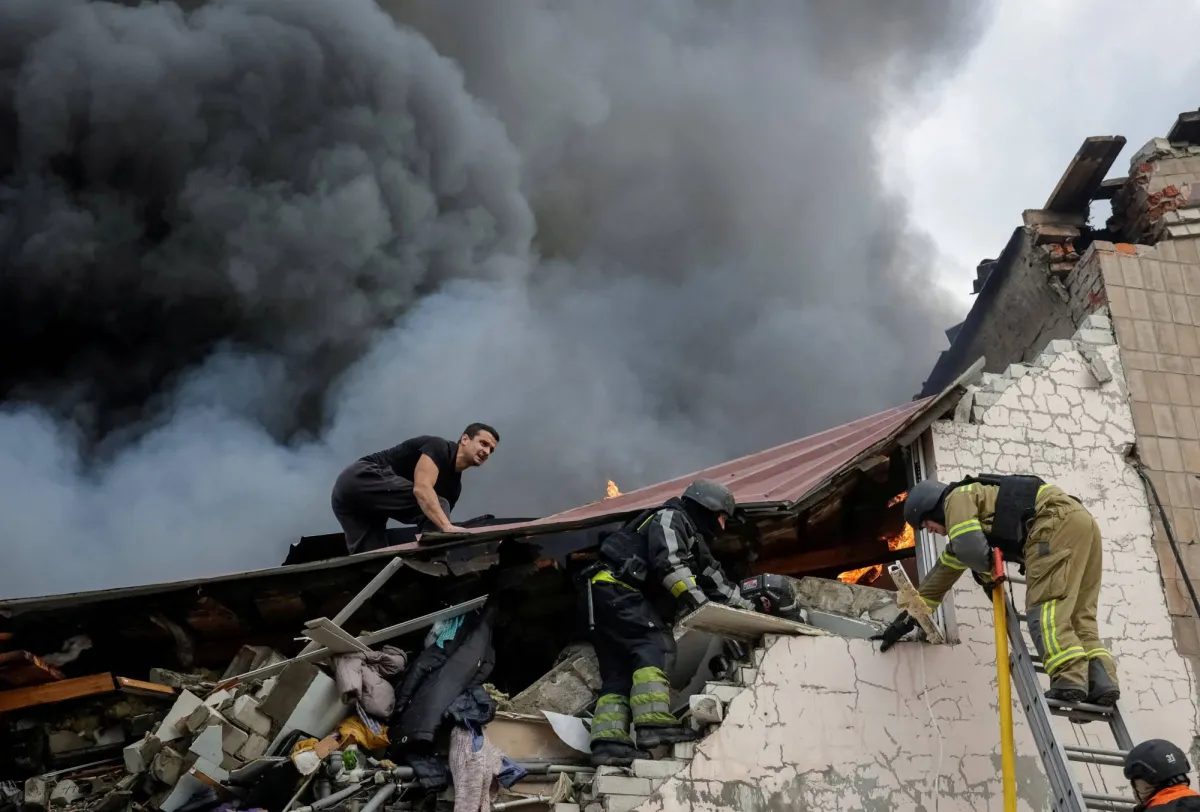
The strikes produced fires and structural damage on the ground. One facility that caught fire was the Volodarskaya Line Production and Dispatch Station near the village of Konstantinovo, roughly forty kilometers from central Moscow. Russian investigative outlet Astra described the site as the largest oil depot in the Moscow region, with capacity to handle up to three million metric tons of petroleum products annually, including aviation fuel, gasoline and diesel. Fuel from the depot reaches Vnukovo, Domodedovo and Sheremetyevo airports through the Transnefteprodukt pipeline system. Video and photographs from the area showed flames and thick smoke rising from the installation.
Vorobyov reported that nine people were injured and two civilians killed by falling debris. The fatalities were a twenty-year-old resident of the settlement of Radumlya in Solnechnogorsk district and a pensioner in the village of Barybino near Domodedovo. Private homes were damaged in Istra, Lobanovo and Radumlya. Daily Sabah, citing regional statements, added that forty-seven residential buildings sustained damage. Airport operations faced restrictions throughout the night; Sheremetyevo, the country’s busiest, suspended takeoffs and landings at times, with flights diverted or delayed.
Russian Defence Ministry statements carried in multiple outlets placed the total number of drones launched across several regions, including occupied Crimea and the Sea of Azov, at nearly nine hundred. Moscow authorities separately confirmed the figure of 650 aimed specifically at the capital area. The attack was described by Russian state media relayed through BFM.ru as one of the largest drone operations against the region in two years.
Ukraine has conducted repeated strikes on Russian oil infrastructure in recent weeks. Kyiv Post noted that the Volodarskaya facility was hit days after another major Transneft site in Samara Oblast was struck, where a fire also broke out. Ukrainian officials have claimed these operations have disabled more than half of Russia’s oil-refining capacity, a figure that has not been independently verified. The strikes occur against the background of Russian attacks on Ukrainian cities and bridges, including recent strikes on Zaporizhzhia.
Coverage of the same night’s events diverged in emphasis once the basic facts of drone numbers and the depot fire were set down. Kyiv Post and Index.hr both identified the Volodarskaya site by name, cited Astra’s reporting on its scale and airport connections, and presented the attack as a deliberate strike on a high-value energy node. Index.hr accompanied its account with video of the blaze. BFM.ru, drawing on official Russian statements, concentrated on the volume of drones, the resulting airport closures, and the personal accounts of residents who spent hours listening to explosions while sheltering. It did not name the specific depot that burned. The Hindu recorded the Russian interception total of nearly nine hundred drones and noted the reported fire at the fuel depot without confirming the target’s identity or strategic role. Daily Sabah placed the Moscow operation alongside separate drone strikes on two commercial ships in the Black Sea off Bulgaria, one of which sank, thereby situating the regional attack inside a wider pattern of maritime and aerial incidents.
The single-source claim that the Volodarskaya depot supplies Moscow’s three main airports rests on Astra’s reporting, carried forward by Kyiv Post and Index.hr. No other outlet in the set confirmed or contradicted that detail. Casualty and interception figures, by contrast, appear consistently across Russian official channels and the outlets that relayed them. The two deaths and nine injuries are attributed directly to Vorobyov in BFM.ru, Daily Sabah and The Hindu. The 650-drone count for the Moscow area originates with Sobyanin and is reproduced without variation in every source examined.
Independent Russian sourcing on the target’s identity and function lends weight to the description of the strike as aimed at energy infrastructure rather than random residential areas. State-aligned Russian coverage, by omitting the depot’s name and purpose while foregrounding civilian harm and defensive success, produces a narrower picture of disruption and loss. Outlets without direct stakes in the conflict, such as The Hindu, preserve both the interception numbers and the fire report side by side, allowing readers to weigh the competing narratives without endorsing either. The Turkish account’s inclusion of the Black Sea ship incidents illustrates how a single night’s events can be connected to parallel theaters when an outlet’s regional focus makes those links salient.
What to Watch
The pattern that emerges is therefore not one of outright contradiction on core facts but of selective foregrounding that shapes what a reader concludes about intent and effect. The corroborated elements—the scale of the drone launch, the fire at a major fuel installation, and the two civilian deaths—stand on multiple independent reporting chains. The strategic character of the target receives its strongest support from the Russian independent source that identified it, not from Ukrainian assertions alone. Continued Ukrainian pressure on Russian refining and storage capacity is likely to keep fuel prices sensitive and to prompt further Russian defensive measures around energy sites, regardless of how any single night’s events are framed in national media.
That’s how the world told the story.
Get our daily open-source intelligence on world events in your inbox — one email a day, up to six stories.
Subscribe freeNo spam. One-click unsubscribe. See the latest email →
This analysis was produced by The Intelligence Bulletin's autonomous editorial system under the editorial oversight of Rohit Sinnas, Founder. How it works →