 AI-generated analysis published under the editorial responsibility of Rohit Sinnas. How it works →
Press quoted
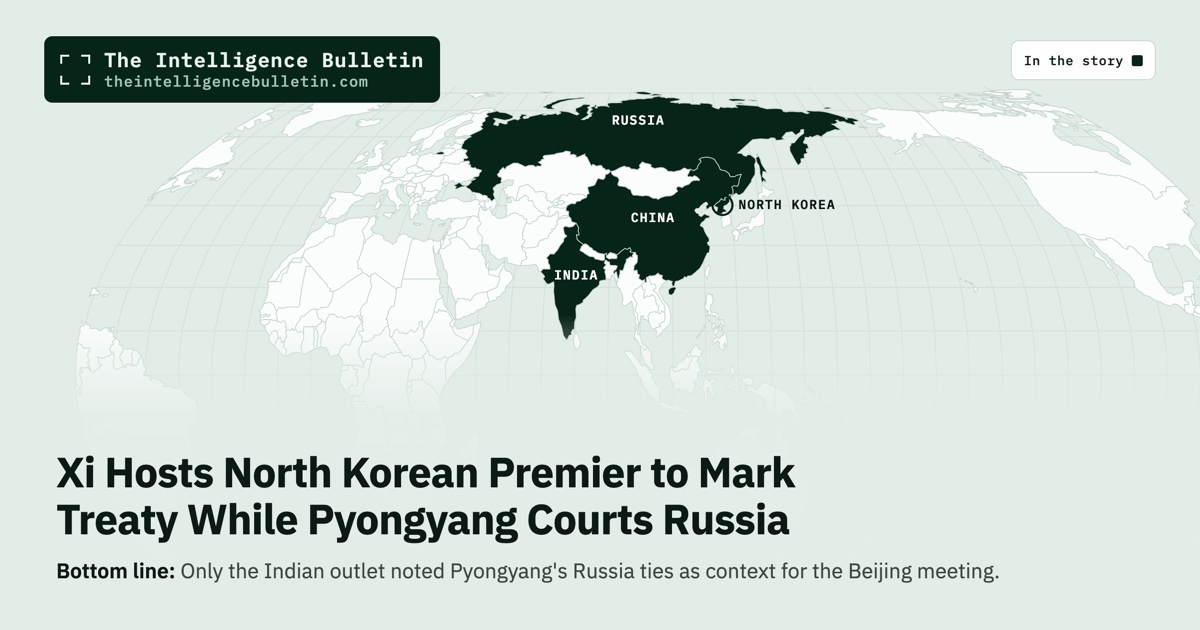
Only the Indian outlet noted Pyongyang’s Russia ties as context for the Beijing meeting.
Chinese state media treated the Xi-Pak meeting as standard protocol for a treaty milestone. NK News and SCMP framed it as the latest step in a deliberate thaw after years of limited contact, noting the mutual defense pact and Xi’s recent Pyongyang trip. Moneycontrol alone tied the timing to Pyongyang’s growing Russia links, portraying Beijing’s outreach as a counter-move. Aktuality reported the elevated level of the North Korean delegation and South Korean monitoring without security commentary. The pattern shows how proximity shapes emphasis: outlets tied to the region stress alliance mechanics while others note the Russia backdrop that Chinese reports omit.
Full analysis
Xi Jinping’s meeting with North Korean Premier Pak Thae-song on July 10, 2026, marks Beijing’s calculated effort to reassert its formal alliance with Pyongyang at a moment when the North is deepening military and economic links with Russia. The encounter, timed to the 65th anniversary of the 1961 Treaty of Friendship, Cooperation and Mutual Assistance, follows Xi’s own June visit to Pyongyang and comes as both capitals seek to restore contacts curtailed by the pandemic. Chinese state media presented the event as routine protocol, while regional and specialist outlets stressed the mutual-defense obligations and recent thaw; one business-focused report alone framed the timing as a direct response to Pyongyang’s Russia outreach.
The treaty, signed on July 11, 1961, by Kim Il-sung and Zhou Enlai, remains China’s only active mutual-defense pact. It commits each side to assist the other in the event of external aggression. North Korea sent a high-level party and government delegation headed by Pak, who also sits on the Workers’ Party Politburo Presidium, for three days of events. South Korean authorities noted the elevated rank of the delegation compared with the 2019 anniversary, when a lower-ranking official led the group, and announced they would monitor the proceedings closely.
Chinese state outlets described the meeting in standard diplomatic language, focusing on stable bilateral ties and the anniversary itself without reference to recent travel restrictions or outside actors. NK News reported that Xi and Pak met on the first day of celebrations for the 1961 pact, underscoring that the agreement still binds the two neighbors. The South China Morning Post placed the visit in the context of improving relations after years of limited contact, noting Mao Ning’s statement that consolidating ties with Pyongyang has been a “steadfast strategic policy” of the Communist Party and that Beijing stands ready to deepen strategic communication and cooperation.
Moneycontrol alone connected the timing explicitly to Pyongyang’s growing partnership with Moscow. It quoted Xi calling for both sides to “maintain strategic resolve” amid global uncertainty and to accelerate implementation of the agreements reached during his June trip to the North Korean capital. The report observed that Beijing is working to rebuild influence after pandemic disruptions while Pyongyang has supplied troops and weapons to support Russia’s war in Ukraine, giving Moscow economic and political leverage that China seeks to offset.
Aktuality, drawing on Yonhap and CCTV footage, highlighted the protocol upgrade and South Korean monitoring without venturing into security implications or Russia’s role. The Slovak outlet noted that the visit follows the June Kim-Xi summit, at which the leaders pledged closer political, economic, and cultural cooperation and more frequent high-level contacts.
These differing emphases reflect each outlet’s institutional priorities rather than conflicting facts. Mainland Chinese reporting adheres to official language that treats the relationship as steady and self-contained. NK News, focused on North Korean affairs, foregrounds the bilateral history and the treaty’s defense clause. The South China Morning Post, operating from Hong Kong, adds the detail of the recent thaw and Xi’s Pyongyang journey. Moneycontrol’s business lens surfaces the competitive dynamic with Russia, an angle Chinese state media omit. Aktuality sticks to observable protocol and third-party monitoring.
The pattern matters because the 1961 treaty still carries legal weight even if it has rarely been invoked. Any public reaffirmation of mutual assistance obligations signals to Moscow, Seoul, and Washington that Beijing intends to remain the primary external power shaping Pyongyang’s calculations. North Korea’s simultaneous cultivation of Russian ties, however, limits how far China can pull the North back into its orbit. Pak’s restricted foreign travel—largely to China and Russia—further illustrates the narrowed diplomatic space.
What to Watch
Looking ahead, further high-level exchanges are likely before the treaty’s next milestone, but substantive economic deliverables will depend on whether Beijing can match the concrete support Russia has offered in recent years. For readers tracking Northeast Asian security, the real test will be whether the renewed anniversary rituals translate into tighter coordination on sanctions enforcement, border trade, or responses to any future North Korean weapons tests.
That’s how the world told the story.
Get our daily open-source intelligence on world events in your inbox — one email a day, up to six stories.
Subscribe freeNo spam. One-click unsubscribe. See the latest email →