 AI-generated analysis published under the editorial responsibility of Rohit Sinnas. How it works →
Press quoted
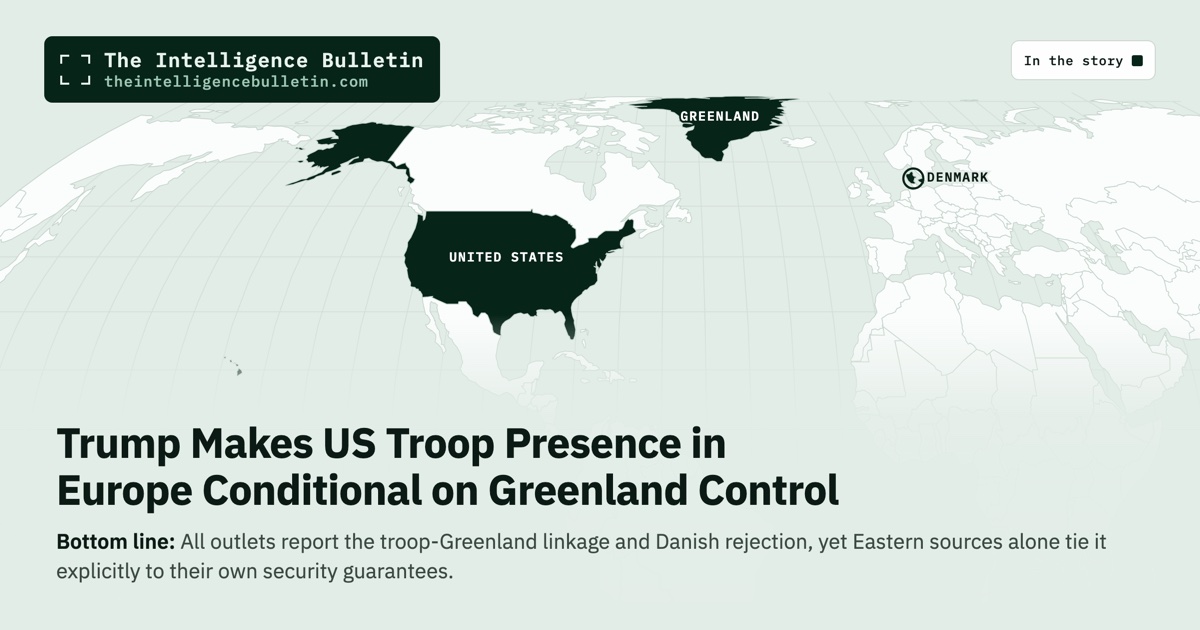
All outlets report the troop-Greenland linkage and Danish rejection, yet Eastern sources alone tie it explicitly to their own security guarantees.
Trump’s explicit conditioning of US military presence in Europe on acquiring Greenland exposes a transactional view of NATO that most European reporting treats as a standing risk rather than isolated bluster. German coverage from Die Zeit presents the linkage as a renewed threat to alliance cohesion, quoting the president directly on Air Force One while noting Denmark’s sharp rejection. British outlet IBTimes amplifies the scale, framing it as a potential full troop pullout that endangers 80,000 service members. Russian state media RIA Novosti highlights the damage to allied expectations at the Ankara summit, citing Politico to underscore shattered trust. Ukrainian outlet RBC Ukraine connects the statement to doubts over long-term US reliability for Eastern flank security, referencing prior reports of planned troop reductions. Czech outlet Týden centers the Danish prime minister’s pledge to defend NATO territory, treating the response itself as the core development. Across these accounts the common thread is not disagreement over facts but a shared recognition that the demand tests whether European allies will accept linkage between their defense and US territorial ambitions in the Arctic.
Full analysis
Trump’s decision to tie any further reduction of American forces in Europe directly to a deal transferring control of Greenland to Washington has crystallized a transactional approach to NATO that European governments now treat as a persistent structural threat rather than episodic rhetoric. The July 9 remarks aboard Air Force One made explicit what had been implied in earlier private exchanges: security guarantees for the continent would hinge on satisfaction of a long-standing territorial demand opposed by Copenhagen. This linkage arrived at the NATO summit in Ankara, where allies had hoped for concrete discussion of defense spending and collective commitments. Instead, the statement reframed the alliance’s core bargain as conditional on one member’s Arctic ambitions.
The precise wording left little room for interpretation. Trump told reporters he had not reached a final decision on additional withdrawals but stressed that “a lot is going to depend on Greenland” and that he might proceed with cuts “if we don’t” secure a favorable arrangement. The comment renewed his assertion that the self-governing Danish territory “should be controlled by the United States, not by Denmark,” citing alleged Chinese and Russian naval activity around the island as justification. These statements built on months of pressure that began in January, when a working group involving the United States, Denmark, and Greenland was established to explore options short of outright sale.
Danish Prime Minister Mette Frederiksen responded immediately and without qualification. Speaking at the same Ankara gathering, she declared Greenland “not for sale” and affirmed that Denmark would defend “every centimeter” of its territory, including the Arctic island, while insisting on respect for the right of Greenlanders to self-determination. Her formulation invoked NATO’s foundational principle of collective defense and positioned the Danish stance as consistent with alliance values rather than obstructionist. Other European voices echoed the rejection. The United Kingdom’s chancellor stated that Greenland’s future rested with its people and Denmark, not the American president. Norway’s foreign minister noted that the issue had not been raised inside the closed leaders’ session and remained an external distraction.
German reporting framed the exchange as a renewed challenge to alliance cohesion, drawing on wire-service accounts of the Air Force One exchange and the Danish rebuttal. The emphasis fell on the direct security implications for European NATO members and the precedent set by conditioning troop levels on a bilateral territorial claim. British coverage placed greater weight on the scale of the potential disruption, noting the roughly 80,000 U.S. service members stationed across the continent and the risk that the threat could affect installations in Germany, Italy, Poland, and elsewhere. The reporting presented the ultimatum as the sharpest escalation in a standoff that had already included tariff threats and public criticism of European defense contributions earlier in the year.
Russian state media highlighted the surprise among allies who had anticipated a more constructive atmosphere at the Ankara summit. Accounts citing Western outlets stressed that pre-summit briefings from U.S. officials had promised dialogue, only for the Greenland demand to dominate early exchanges and leave partners questioning Washington’s reliability. Ukrainian coverage connected the conditional troop statement to earlier indications of planned reductions, underscoring Eastern European concerns about long-term American commitment to the flank facing Russia. The linkage was presented as compounding doubts about whether security assurances would remain insulated from unrelated U.S. priorities.
Czech reporting, by contrast, centered the Danish prime minister’s territorial defense pledge as the primary development, treating the response itself as evidence of resolve within the alliance. This focus reflected a Central European interest in how frontline NATO members articulate sovereignty when pressed by larger partners. Across these accounts, factual agreement on the content of Trump’s remarks and the Danish reply is near total; divergence appears mainly in which consequence receives the most attention—alliance-wide cohesion, troop numbers, shattered summit expectations, or Eastern flank reliability.
What to Watch
The episode tests whether European capitals will absorb the linkage as a one-off negotiating tactic or treat it as evidence that American force posture can be held hostage to Arctic territorial goals. With a U.S.-Denmark-Greenland working group still active and Denmark anticipating some form of resolution by year’s end, the immediate diplomatic channel remains open. Yet the public conditioning of European defense on Greenland control has already prompted European officials to reassess assumptions about the durability of U.S. commitments independent of bilateral disputes. How allies calibrate their own force planning and procurement in response will determine whether the Ankara exchange remains an isolated irritant or accelerates a broader recalibration of transatlantic security arrangements.
That’s how the world told the story.
Get our daily open-source intelligence on world events in your inbox — one email a day, up to six stories.
Subscribe freeNo spam. One-click unsubscribe. See the latest email →