 AI-generated analysis published under the editorial responsibility of Rohit Sinnas. How it works →
Press quoted
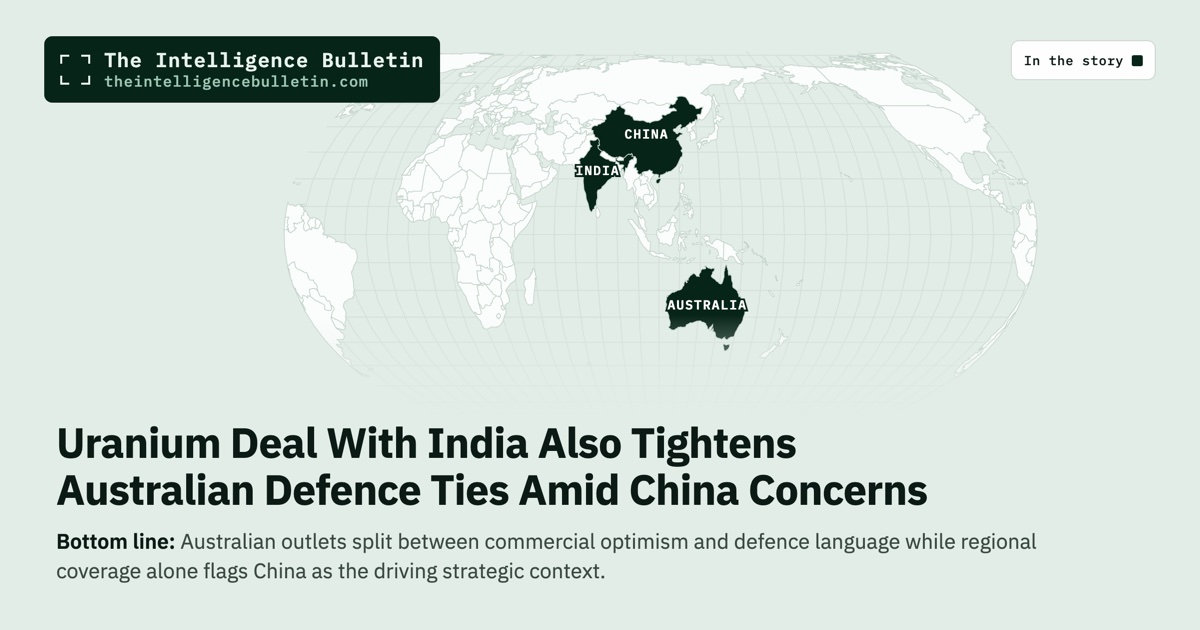
Australian outlets split between commercial optimism and defence language while regional coverage alone flags China as the driving strategic context.
The uranium deal itself is straightforward commercial energy policy, yet the surrounding coverage reveals how different outlets weigh the bilateral relationship’s strategic weight. ABC’s domestic lens stresses Australian mining gains and internal political pushback from the Greens on safeguards, treating the export as a resources-sector win with domestic hurdles. Sydney Sun, reprinting Indian wire copy, foregrounds the defence and maritime elements as the core advance, listing expanded exercises, information sharing and a new annual ministers’ dialogue. Asia News Network, writing from Singapore, places the agreements explicitly against China’s military rise and Quad dynamics, quoting Australian ministers on shared missile concerns and noting India’s desire to diversify away from Russian uranium. Shafaqna’s Reuters-sourced piece stays narrowly on the export mechanics and joint pledges in renewables, omitting defence language entirely. This pattern shows Australian outlets split between commercial optimism and strategic partnership language, while the regional Asian outlet alone supplies the geopolitical anxiety that makes the timing and scope of the deals notable. The consensus across sources is that the civil nuclear step is now operational; the divergence lies in whether that step is presented as routine trade or as one element of tighter Indo-Pacific alignment.
Full analysis
Australia and India’s July 9 agreement to operationalise uranium exports is a narrow commercial step that unlocks Australian resources for India’s civilian nuclear program. The surrounding coverage, however, demonstrates how outlets assign different weights to the same summit, with most treating defence and maritime measures as secondary while one regional perspective correctly identifies them as the primary signal of tightened Indo-Pacific alignment. What is at stake is not simply energy trade but whether Australia is prepared to treat its relationship with India as a durable strategic hedge against Chinese military expansion.
The deal itself allows Australian uranium to reach Indian reactors under existing safeguards that restrict use to peaceful purposes. Australian Prime Minister Anthony Albanese described the step as providing an additional market for the domestic resources sector and helping India increase non-fossil fuel capacity. Indian Prime Minister Narendra Modi, speaking after the Melbourne meeting, called the opportunities historic for meeting India’s rising power demand and supporting its clean-energy transition. Both leaders also announced parallel pledges on renewables, critical minerals and green hydrogen, yet these elements receive uneven emphasis depending on the outlet.
Australia’s public broadcaster ABC framed the announcement principally through the lens of domestic mining interests. Its report highlighted industry welcomes for potential new demand and noted calls from the Minerals Council of Australia to lift state-level bans on uranium mining in New South Wales, Queensland and Western Australia. It also recorded the Greens’ immediate opposition, with Senator David Shoebridge warning of risks that material could be diverted to India’s nuclear weapons program. The piece placed the uranium supply at the centre and treated defence language as background rather than the main event.
By contrast, the Sydney Sun carried reporting from India’s ANI wire service that placed the new Joint Declaration on Defence and Security Cooperation and the Maritime Security Collaboration Roadmap at the forefront. The account listed expanded military exercises, greater interoperability, information sharing, personnel exchanges and a new annual Defence Ministers’ Dialogue as core outcomes of the third India-Australia Annual Summit. It quoted Foreign Secretary Vikram Misri describing the measures as recognition that the partnership must adapt to changing geopolitical realities. The uranium deal appeared among eighteen total outcomes rather than as the lead item.
The Asia News Network report, written from Singapore and drawing on Straits Times coverage, supplied the explicit geopolitical framing missing from the two Australian domestic pieces. It situated the uranium and defence agreements against shared concerns over China’s military rise, noting both countries’ membership in the Quad and quoting Australian Defence Minister Richard Marles on the need to respond to the strategic landscape and China’s growing missile range. The piece added context on India’s desire to diversify uranium sources away from Russia amid trade disruptions and described China as the unspoken factor driving closer ties. It also recorded industry estimates that Australian supplies could help India reach a 100-gigawatt nuclear target by 2047.
Shafaqna English, relying on Reuters copy, produced the narrowest account. Its summary confined itself to the uranium export mechanics and the joint pledges on renewables, critical minerals and green hydrogen. No defence declaration, maritime roadmap or regional security references appeared. The report presented the transaction as routine trade expansion without reference to strategic context.
These differences reveal more than editorial preference. The two Australian outlets split along familiar lines: one prioritising resources policy and internal political debate, the other reproducing Indian framing that elevates strategic partnership language. The regional Asian network alone connected the dots between the deals and concrete anxieties over Chinese capabilities, including a recent Pacific missile test. The Reuters-derived piece, by omitting those connections, effectively presented the summit as a standard bilateral commercial announcement.
The defence elements carry greater long-term weight than the uranium export alone. The new Joint Declaration renews and expands a 2009 security framework, adding commitments across cyber, emerging technologies, counter-terrorism, humanitarian assistance and regional security. The accompanying Maritime Security Collaboration Roadmap focuses on information sharing, capability development and operational coordination, supported by a fresh coast-guard memorandum. Leaders also endorsed an annual ministers’ dialogue and deeper industry-to-industry defence links. These steps build on the 2020 Comprehensive Strategic Partnership and the Mutual Logistics Support Arrangement, moving the relationship from dialogue toward integrated planning.
The uranium component remains contingent on regulatory and production realities. Australia holds roughly one-third of global reserves yet ranks only fourth in production because of state mining bans. Industry sources cited in the coverage indicated the new export arrangements include clearer safeguards, but actual shipments will depend on whether those bans are lifted and on India’s ability to meet Australian non-proliferation conditions. The civil nuclear agreement itself dates to earlier years; the July 9 step was operationalisation rather than a fresh treaty.
What to Watch
What happens next will test whether the defence roadmap produces measurable changes in interoperability and contingency planning. The pattern of coverage suggests Australian domestic audiences will continue to hear the relationship described mainly in trade and resources terms, while regional observers already read the same announcements as incremental tightening of Quad-adjacent coordination. That divergence matters because sustained public support for deeper security ties requires clearer explanation of the strategic drivers. If the defence and maritime measures remain under-emphasised at home, future governments may face greater domestic friction when those commitments require resources or political capital. The July agreements therefore mark not an endpoint but a clearer baseline against which both the pace of implementation and the honesty of public explanation can be judged.
That’s how the world told the story.
Get our daily open-source intelligence on world events in your inbox — one email a day, up to six stories.
Subscribe freeNo spam. One-click unsubscribe. See the latest email →