 AI-generated analysis published under the editorial responsibility of Rohit Sinnas. How it works →
Press quoted
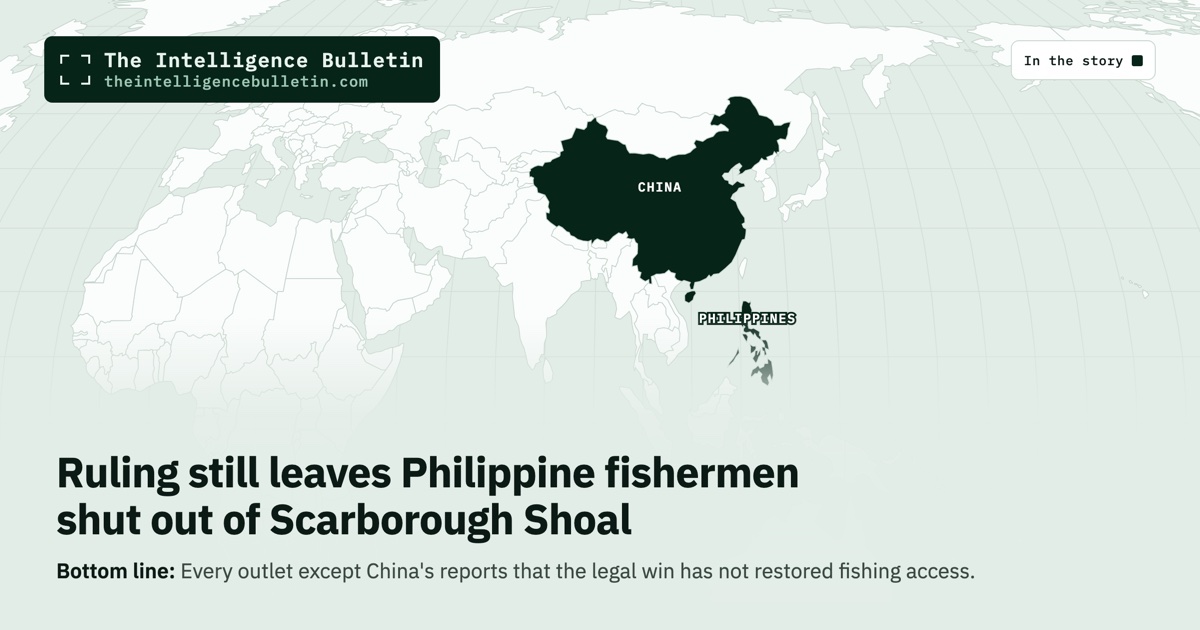
Every outlet except China’s reports that the legal win has not restored fishing access.
The clearest signal across the coverage is that the 2016 ruling functions more as a diplomatic and legal tool than a shield for Philippine fishermen. BusinessWorld and The Straits Times both detail how Chinese coast guard and militia vessels continue to drive boats away from Scarborough Shoal with water cannons and anchor-cutting, leaving fishermen from Masinloc fishing closer to shore and supplementing income with other work. Channel NewsAsia’s expert interview reinforces that the decision clarified international law without altering control on the water. China Daily, timed just before the anniversary, counters with a Ministry-linked report claiming Philippine claims lack historical or legal basis and harm regional stability. Deutsche Welle’s Chinese service records Manila’s foreign minister calling the ruling a binding ‘lamp post’ while noting Beijing’s consistent rejection. The shared thread is enforcement failure; the split is whether that failure is framed as a call for stronger Philippine deterrence or proof that the ruling itself rests on flawed premises.
Full analysis
The 2016 South China Sea arbitration ruling has strengthened the Philippines’ diplomatic hand and drawn new security partners, yet it has done nothing to reopen Scarborough Shoal to the fishermen who once depended on its waters. Ten years later, Chinese coast guard and militia vessels continue to block access with water cannons, anchor-line cutting, and sustained patrols, forcing crews from Masinloc and other Zambales towns to fish closer to shore or abandon the trade.
The Permanent Court of Arbitration decision invalidated China’s nine-dash line claims and found that Beijing had unlawfully barred Filipino fishermen from traditional grounds at Scarborough, known locally as Bajo de Masinloc. Beijing rejected the ruling outright and has maintained effective control since a 2012 standoff. The anniversary events in Manila on July 10, 2026, presented the decision as a binding “lamp post” for international law, but accounts from the water show the gap between legal clarity and daily enforcement.
Fishermen describe the practical result in concrete terms. Leonardo Cuaresma, who heads a Zambales fishermen’s association, recalled that the shoal once yielded catches so dense the fish looked like grains of unhusked rice. Now Chinese vessels routinely order Filipino boats to leave and drive them away. Rony Drio has not returned since a few years ago, when personnel ordered him and another fisherman out of the lagoon; shallow water forced them to carry their boat across sharp coral that cut their feet. Henrilito Empoc has stayed away since 2022 after seeing water cannons deployed and anchor lines severed. Both now fish nearer the coast and supplement income with other work. These details appear in reporting from BusinessWorld and The Straits Times, which draw directly on interviews in Masinloc.
Data on vessel presence underscores the continuity of exclusion. The Asia Maritime Transparency Initiative recorded Chinese coast guard vessels accumulating 933 ship-days around the shoal in the first seven months of 2026, already close to the full-year total for 2025. Six to eight maritime militia vessels maintained a persistent presence closer to the lagoon. Philippine patrols increased, averaging 43 ship-days a month in the first half of the year, but interactions between the two sides reached 112 days in six months. Additional Chinese steps, including a declared marine reserve and floating buoys, prompted Manila to file protests without restoring access.
Chinese state media offered a direct counter during the anniversary period. A report from the China Institute of Marine Affairs under the Ministry of Natural Resources argued that Philippine territorial claims over Huangyan Island and parts of the Nansha Islands lack historical or legal foundation under colonial treaties and post-independence law. It described Manila’s positions as inconsistent, destabilizing to the region, and harmful to the post-World War II order. The piece did not address enforcement of the 2016 ruling but rejected its premises entirely.
Analytical coverage from Singapore outlets framed the same facts differently. The Straits Times noted that the ruling has underpinned Manila’s transparency efforts and expanded defense ties with the United States, Japan, and Australia, yet it has brought fishermen little relief. Channel NewsAsia carried an expert assessment that the decision clarified legal positions under international law even while leaving physical control of the waters unchanged. Deutsche Welle’s Chinese service reported the foreign minister’s remarks on the ruling’s binding character alongside Beijing’s repeated rejection.
The pattern across these accounts points to a consistent outcome: the arbitration functions as a diplomatic asset and legal reference point that has helped Manila attract partners and publicize incidents, but it has not altered the balance of presence at Scarborough Shoal. Philippine officials and analysts call for naval modernization, more joint patrols, drones, and maritime infrastructure to raise the costs of coercion. Fishermen themselves urge continued legal assertions to keep the issue visible to allies. China’s sustained operations indicate it will continue testing limits as long as the immediate costs remain manageable.
What to Watch
The ruling therefore serves interests in Manila and among its partners by preserving a normative benchmark and justifying expanded cooperation. For the coastal communities whose livelihoods depend on the shoal, it remains a distant legal victory whose enforcement depends on factors the tribunal could not supply. Absent a shift in on-water presence or risk calculations, the exclusion documented this anniversary will persist.
That’s how the world told the story.
Get our daily open-source intelligence on world events in your inbox — one email a day, up to six stories.
Subscribe freeNo spam. One-click unsubscribe. See the latest email →