 AI-generated analysis published under the editorial responsibility of Rohit Sinnas. How it works →
Press quoted
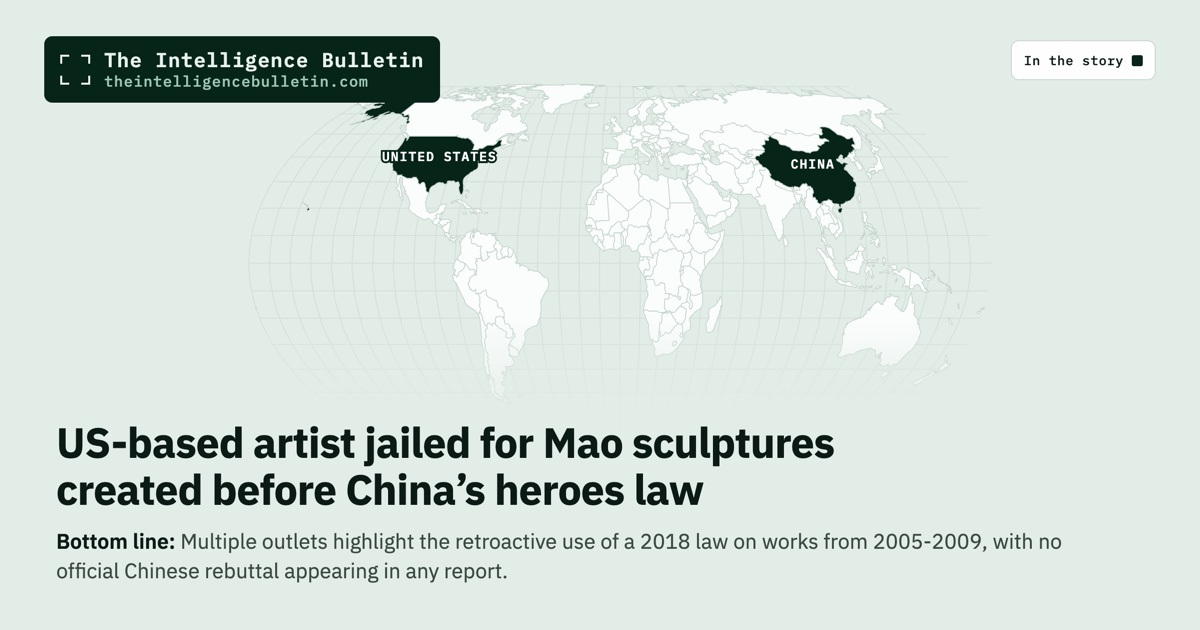
Multiple outlets highlight the retroactive use of a 2018 law on works from 2005-2009, with no official Chinese rebuttal appearing in any report.
The reporting across these outlets converges tightly on the retroactive application of China’s 2018 heroes law to sculptures made years earlier, a detail each outlet draws directly from the artist’s wife and the rights researcher Shane Yi rather than from any official court statement. That convergence makes the personal cost stand out: a family reunion turned into indefinite separation, with exit bans on a US-citizen child and a wife who prepared release clothes only to receive the maximum term. Outlets that open with the family-reunion angle or the US-exile perspective give the case a human scale that the wire-relayed versions treat as secondary to the Amnesty quote on deterrence. The closed-door trial and diplomats barred from entry appear in every account but receive no rebuttal from Chinese authorities in any of the pieces, leaving the rights groups’ framing of retroactivity and artistic freedom as the unchallenged narrative. The pattern shows how a single Reuters-sourced set of facts travels intact while the entry point—personal disappointment, diplomatic exclusion, or European emphasis on expression—shifts with the outlet’s audience and sourcing depth.
Full analysis
Gao Zhen, a 70-year-old sculptor and member of the artistic duo known as the Gao Brothers, was sentenced on August 25, 2026, to three years in prison by the Sanhe City People’s Court in Hebei province. The conviction rested on sculptures he created with his brother Gao Qiang between 2005 and 2009 that depicted Mao Zedong in satirical forms. The works included a bronze statue titled Mao’s Guilt showing the former leader kneeling in a pose of remorse, a series called Miss Mao that caricatured the figure with breasts and an elongated Pinocchio-style nose, and another composition in which Mao-like figures held Jesus Christ at gunpoint. Chinese authorities charged him with infringing upon the reputation of heroes under the Law on the Protection of Heroes and Martyrs that took effect in 2018 and was later strengthened.
Gao had moved to New York in 2022. He was arrested in August 2024 while visiting family in China, specifically at a studio on the outskirts of Beijing. He has remained in custody since, with the sentence counting the roughly two years of pre-trial detention toward the three-year term. His wife, Zhao Yaliang, and their seven-year-old son, a U.S. citizen, have been prevented from leaving China throughout that period. Zhao told reporters she had prepared clothes in anticipation of a possible release after two years and described the outcome as devastating. Gao plans to appeal.
The artworks predate the 2018 statute by more than a decade. Shane Yi of the overseas group Chinese Human Rights Defenders noted that the pieces were produced as far back as 2005, some sixteen years before the law existed. The Gao Brothers rose to prominence in the 1990s and 2000s during a period when their examinations of authoritarianism, censorship, and the Cultural Revolution could be shown both inside China and abroad. Their themes included the 1966-1976 upheaval and, in one piece, a direct reference to the 1989 events at Tiananmen Square.
No official statement from the court or Chinese authorities appeared in any of the reporting. The court did not respond to requests for comment, and multiple accounts noted that Western diplomats were barred from the one-day closed-door trial. Gao’s wife learned of the verdict through his lawyer. The maximum three-year term available under the offense was imposed.
Amnesty International’s China director Sarah Brooks described the sentence as illustrating authorities’ determination to deter independent artistic expression. She stated that no artist should face criminal punishment for work that challenges official narratives or encourages critical reflection on history. The organization characterized the lengthy detention and conviction as an assault on artistic freedom. The UN Human Rights Office expressed concern over the retroactive application of criminal law and the impact on the artist’s family. Yi called for Gao’s immediate and unconditional release, describing the case as a clear violation of freedom of expression.
The five outlets that carried the story within the 24-hour window all drew from the same core set of details supplied by Zhao Yaliang and Yi. Four of them relayed material that originated with Reuters or the Associated Press; only the BBC account showed independent reporting that added the UN statement and referenced an earlier interview with Gao’s brother. The Los Angeles Times piece, written by an AP correspondent, opened with Gao’s U.S. residence and the family’s immigration history before moving to the sentence. The Times of India framed the events around the family reunion that ended in arrest, quoting Zhao’s disappointment after preparing release clothing. The Asahi Shimbun carried a concise Reuters dispatch that placed the sentencing in a regional East Asian context and noted the law’s prior use against other critics of historical figures. Deutsche Welle aggregated AP, Reuters, and dpa copy while foregrounding the artistic-freedom dimension.
These framing choices produced measurable differences in emphasis. A reader of only the Times of India account would encounter the personal rupture of a planned family visit first and the broader rights-group condemnation later. A reader limited to the BBC piece would receive the strongest foregrounding of the closed trial, diplomatic exclusion, and retroactive-law concerns raised by both Amnesty and the UN office. The Los Angeles Times version would leave the strongest impression of exile and diaspora consequences. The Asahi and Deutsche Welle versions, being closer to the original wire texts, would present the same facts with less additional interpretive layering.
No outlet in the set carried a Chinese government or court statement beyond the bare fact of the sentence itself. The absence leaves the rights groups’ characterization of retroactivity and deterrence as the only on-record interpretation available to readers of these reports. The artworks’ dates, the 2018 law’s timeline, the arrest circumstances, the family exit bans, and Amnesty’s specific language on deterrence appear uniformly across all five accounts. That uniformity rests on two named sources—Zhao Yaliang and Shane Yi—rather than on any independent verification by the outlets.
What to Watch
The consistent thread across the reporting is therefore the retroactive reach of the statute and the absence of any counter-narrative from Chinese authorities within these pages. The personal details of Zhao’s preparations and the barred departure of a U.S. citizen child add a concrete dimension to the three-year term that would be harder to grasp from statute language alone. Because the outlets that foregrounded those details still relied on the same two primary voices for the legal timeline and the rights assessment, the differences remain ones of entry point rather than of disputed fact. A reader who encountered only one of the five accounts would miss the precise convergence on the 2005-2009 creation dates and the 2018 law, yet would still receive an accurate core account of the sentence and the family restrictions. The coverage therefore supplies a stable factual spine while varying the human or institutional lens placed around it.
That’s how the world told the story.
Get our daily open-source intelligence on world events in your inbox — one email a day, up to six stories.
Subscribe freeNo spam. One-click unsubscribe. See the latest email →