 AI-generated analysis published under the editorial responsibility of Rohit Sinnas. How it works →
Press quoted
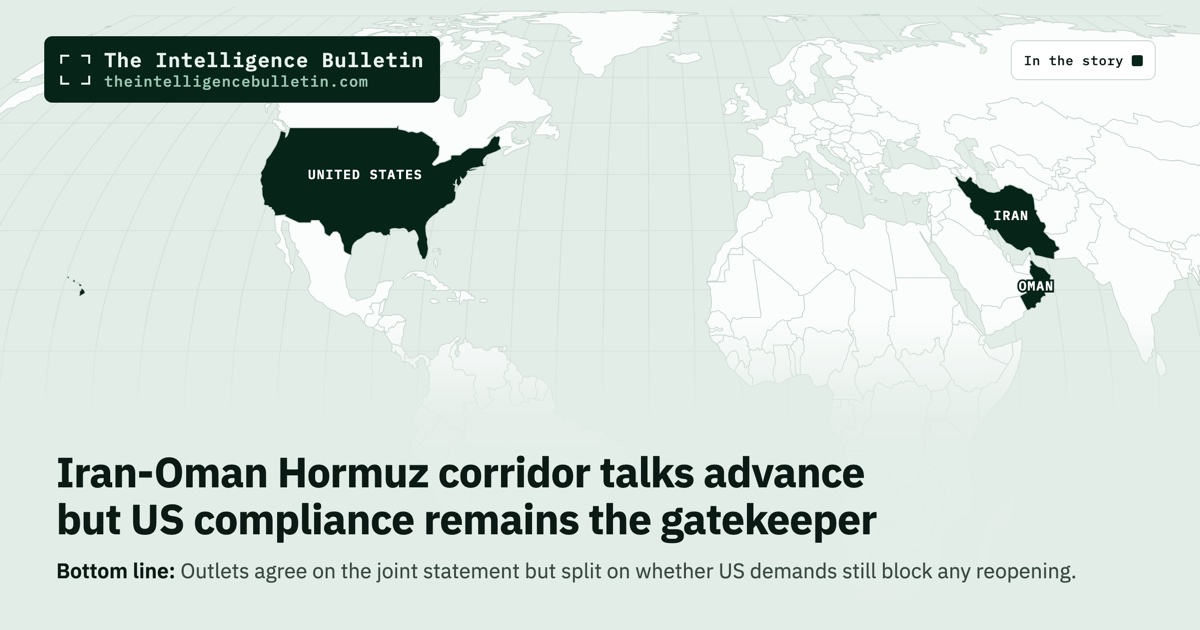
Outlets agree on the joint statement but split on whether US demands still block any reopening.
The reporting converges on the joint statement’s core elements but diverges sharply on context and conditionality. Gulf-focused outlets present the talks as practical steps toward regulated navigation and mine clearance between the two littoral states. Indian coverage adds the downstream energy-security angle and a recent tanker incident off Oman. Canadian and Hong Kong reporting foreground the persistent US-Iran standoff, quoting Iranian Revolutionary Guard statements that any reopening hinges on Washington accepting Tehran’s demands on sanctions and blockades. The Globe and Mail and SCMP both note oil-price movements tied to the diplomacy. What stands out is the absence of any independent verification of the corridor coordinates or timelines beyond the joint statement itself; every outlet ultimately relays the same Oman-shared text while layering its own regional stakes. This produces a consistent factual baseline across five countries alongside clear differences in which constraints receive emphasis. The selected sources contain no Omani domestic reporting, so Oman’s official voice appears only through the shared statement.
Full analysis
Iranian Foreign Minister Abbas Araghchi and Omani Foreign Minister Badr Albusaidi met in Tehran on August 25 and released a joint statement describing a phased framework for a temporary joint navigation corridor through the Strait of Hormuz together with a project to clear mines from the waterway. The statement said the framework could provide a practical and implementable basis for moving forward. Technical negotiations between the two sides will continue with the aim of reaching an agreement on a permanent navigation corridor and future arrangements for managing the strait, alongside establishing a mechanism for exchanging information, managing navigation traffic, and providing related navigational and security services. Both sides affirmed the importance of holding joint discussions with the Gulf littoral states to ensure that any agreement respects the sovereignty of neighbouring countries and adheres to international law.
Omani Foreign Minister Badr Albusaidi posted on X after the meeting that he hoped the countries would soon announce the temporary corridor. Future management of the strait and a permanent solution will follow in due course, he added. The announcement came after US President Donald Trump said on Truth Social that all mines have been removed or detonated from the international waters of the strait according to the US navy, and that Iran had been notified any ship or boat placing new mines would be immediately destroyed.
The Strait of Hormuz became a flashpoint early in the Middle East war. Traffic through the waterway remains largely paralysed six months after the conflict began on February 28 with US and Israeli strikes on Iran. Tehran quickly blockaded the strait while Washington imposed a naval counter-blockade on Iranian ports. The channel normally carries around one-fifth of the world’s oil and liquefied natural gas exports, and the disruption has affected global markets.
Iran and Oman, the two countries that border the strait, have for weeks been discussing the future of navigation through the waterway. Tehran has said the geographical coordinates of a route envisaged by the two countries have been agreed upon. Iranian officials have insisted that the strait will not fully reopen until the United States meets Tehran’s demands, including lifting its naval blockade, dropping oil sanctions and unfreezing assets abroad.
The five articles that covered the meeting all carried the same joint statement issued after the Tehran talks. Al Jazeera and Arab News both presented the announcement as a step toward regulated transit and mine clearance between the two littoral states, with Arab News adding emphasis on the need for further talks with other Gulf coastal states. The Siasat Daily linked the same statement to energy security concerns for South Asia and reported an oil tanker disabled in an attack off Oman’s coast on August 24. It also carried comments from Iranian Deputy Foreign Minister Kazem Gharibabadi describing an understanding on a temporary route in which traffic into the Persian Gulf from the Gulf of Oman would pass entirely through Iranian waters while the outbound route would pass partly through Iranian waters and partly through Oman’s territorial waters, with 30 to 60 days of further talks planned for a permanent and sustainable route.
The Globe and Mail placed the talks inside the broader US-Iran impasse, noting Trump’s statements on the mines and reporting that oil prices fell more than two dollars a barrel to a two-week low after the announcement. The South China Morning Post carried Iranian Revolutionary Guards Corps spokesman Hossein Mohebbi stating that agreements had been reached on the share of each country in the waters of the strait and in its revenues. Mohebbi accused the United States of seeking to obstruct the negotiations and said the strait would not be opened under any circumstances if Washington failed to accept Iran’s conditions.
Every outlet ultimately relayed the Oman-shared joint statement while adding its own surrounding context. No article in the set contained reporting from an Omani domestic outlet, so Oman’s position appears only through the text of the shared statement. The Indian article alone included the tanker incident and the deputy foreign minister’s route details. The Canadian and Hong Kong articles alone carried the Revolutionary Guards comments on revenue shares and explicit US conditionality. The two Gulf articles stayed closest to the operational language of the joint statement itself.
The joint statement supplies the clearest public record of what Iran and Oman agreed to announce together. The Revolutionary Guards remarks, carried in only one outlet, add a sharper Iranian condition but remain a single reporting chain from Iranian state media. Oil price movement appears in two independent accounts. The absence of separate Omani sourcing means readers see Oman’s stance only as it was jointly presented in Tehran.
What to Watch
Technical negotiations are scheduled to continue in the coming weeks. Whether a temporary corridor materialises will depend on whether the two governments can translate the framework into operational coordinates and whether the United States accepts or continues to contest the arrangements Iran has proposed.
That’s how the world told the story.
Get our daily open-source intelligence on world events in your inbox — one email a day, up to six stories.
Subscribe freeNo spam. One-click unsubscribe. See the latest email →