 AI-generated analysis published under the editorial responsibility of Rohit Sinnas. How it works →
Press quoted
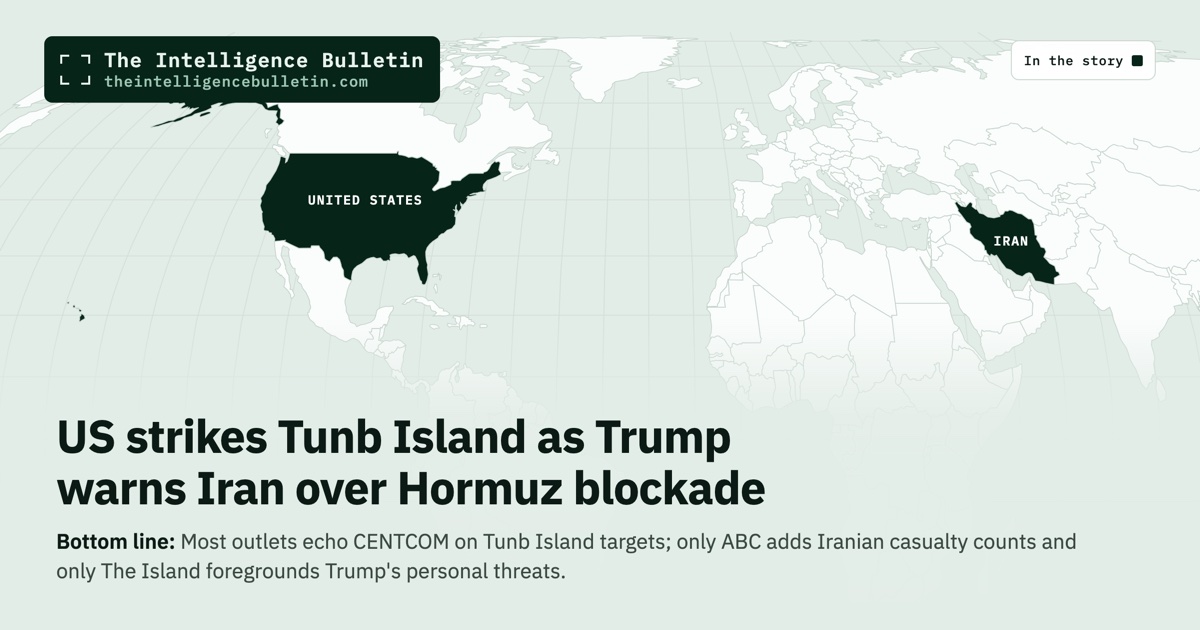
Most outlets echo CENTCOM on Tunb Island targets; only ABC adds Iranian casualty counts and only The Island foregrounds Trump’s personal threats.
Global coverage converges on the core facts of the strikes and their stated purpose of securing Hormuz transit, revealing how distant outlets treat the event as a routine military update rather than a bilateral crisis. Global Times and The Peninsula stick closest to CENTCOM statements detailing Tunb Island targets and precision munitions. ABC News alone incorporates Iranian casualty figures of seven killed and over 260 injured, plus IRGC threats to block energy exports. The Island stands out by centering Trump’s quoted warning that Tehran should ‘better behave’ and his threat of further strikes on infrastructure. Anadolu Agency alone highlights Iranian claims of a strike on Hengam Island instead, underscoring reliance on Tehran’s reporting. This pattern shows outlets outside the direct conflict zone default to official U.S. framing unless local stakes or wire sourcing pull in Iranian details, leaving the escalation’s human and economic costs secondary.
Full analysis
The pattern of reporting on the July 15, 2026, U.S. airstrikes on Greater Tunb Island shows how most international outlets treat a direct challenge to control of the Strait of Hormuz as a contained military development rather than an accelerating confrontation with global economic consequences. Distant coverage defaults to the narrow terms set by U.S. Central Command statements, emphasizing precision targeting of Iranian coastal defenses and cruise-missile sites to protect commercial shipping. Only when local sourcing or regional stakes intervene do reports add Iranian casualty counts, Revolutionary Guard warnings, or conflicting location claims, leaving the human toll and the risk of broader energy disruption as secondary details.
U.S. forces conducted the second daylight wave of strikes that day, following an earlier 90-minute operation against the same island. Central Command described the targets as coastal defense systems and cruise-missile storage and launch sites used to threaten vessels transiting the strait, with the explicit goal of further degrading Iran’s ability to interfere with commercial traffic. No fatalities were reported in the initial U.S. accounts. The action came after Washington reimposed a naval blockade on Iranian ports, reversing a pause that had been part of a short-lived interim deal reached the previous month.
Chinese state media outlet Global Times and Qatari newspaper The Peninsula reported the events almost entirely through this official U.S. lens. Both quoted Central Command directly on the Tunb Island targets and the purpose of protecting Hormuz transit, with minimal additional context. The Peninsula noted strikes on command centers, air defenses, and sites near Bandar Abbas as well, again framed as completed operations to safeguard innocent mariners. These accounts treat the strikes as a technical update on force protection rather than an escalation tied to a specific leader’s rhetoric or Iranian counter-threats.
Australian public broadcaster ABC News departed from that restraint by incorporating Iranian government statements on the human cost. It reported that strikes, including one on a barracks of the 388th Mechanised Infantry Brigade in Sistan and Baluchestan province, killed at least seven troops and injured more than 260 people across the country according to Iranian officials. The same report included the Revolutionary Guard’s threat to halt all regional energy exports through the strait, quoting the statement that “the export of oil and gas from the region will be either for everyone or for no one.” This addition situates the strikes within a cycle of back-and-forth attacks that had already produced more than 30 Iranian deaths in recent days and renewed alerts in Bahrain, Kuwait, and Jordan.
Sri Lankan outlet The Island placed President Trump’s personal warnings at the center of its account. It quoted Trump telling reporters that Iran should “better behave” and warning of further strikes on bridges and power plants unless negotiations resumed. The report framed the Tunb strikes as the second wave conducted during daylight hours and noted Trump’s separate comment that Iran was “not happy right now” and that the United States would decide whether to “settle with them or if we just finish it off.” This emphasis on presidential rhetoric draws the reader’s attention to the personal dimension of decision-making and the possibility of attacks on civilian infrastructure.
Turkish state news agency Anadolu Agency alone foregrounded Iranian-sourced details that contradicted the U.S. account of the location. It reported Iranian claims of a U.S. strike on Hengam Island near the strait rather than Greater Tunb, highlighting Tehran’s version of events over Central Command’s statement. This choice reflects a reliance on Iranian reporting in Middle East coverage and underscores how sourcing can shift the perceived geography and legitimacy of the targets.
The divergence reveals a consistent dynamic: outlets without direct regional exposure or alternative wire sourcing default to the U.S. military’s stated purpose of securing Hormuz transit, while those drawing on Iranian statements or presidential quotes introduce casualty figures, retaliation threats, or alternative locations. The result is that the strikes appear more contained and defensive in most accounts than the combination of Iranian losses, Revolutionary Guard warnings, and explicit threats against infrastructure would suggest. No major outlet in the set examined the broader question of whether repeated daylight operations and blockade enforcement can reopen the strait without drawing in additional actors or triggering wider energy market shocks.
What to Watch
The stakes center on the strait’s role as a chokepoint for a significant share of global oil and gas trade. Continued tit-for-tat exchanges risk further price volatility and supply uncertainty precisely because the military actions remain narrowly framed in most reporting as routine updates rather than steps that could force a larger confrontation. Readers should expect the pattern of limited U.S. strikes paired with Iranian threats to persist until one side calculates that the costs of escalation outweigh the benefits of maintaining pressure on the waterway.
That’s how the world told the story.
Get our daily open-source intelligence on world events in your inbox — one email a day, up to six stories.
Subscribe freeNo spam. One-click unsubscribe. See the latest email →