 AI-generated analysis published under the editorial responsibility of Rohit Sinnas. How it works →
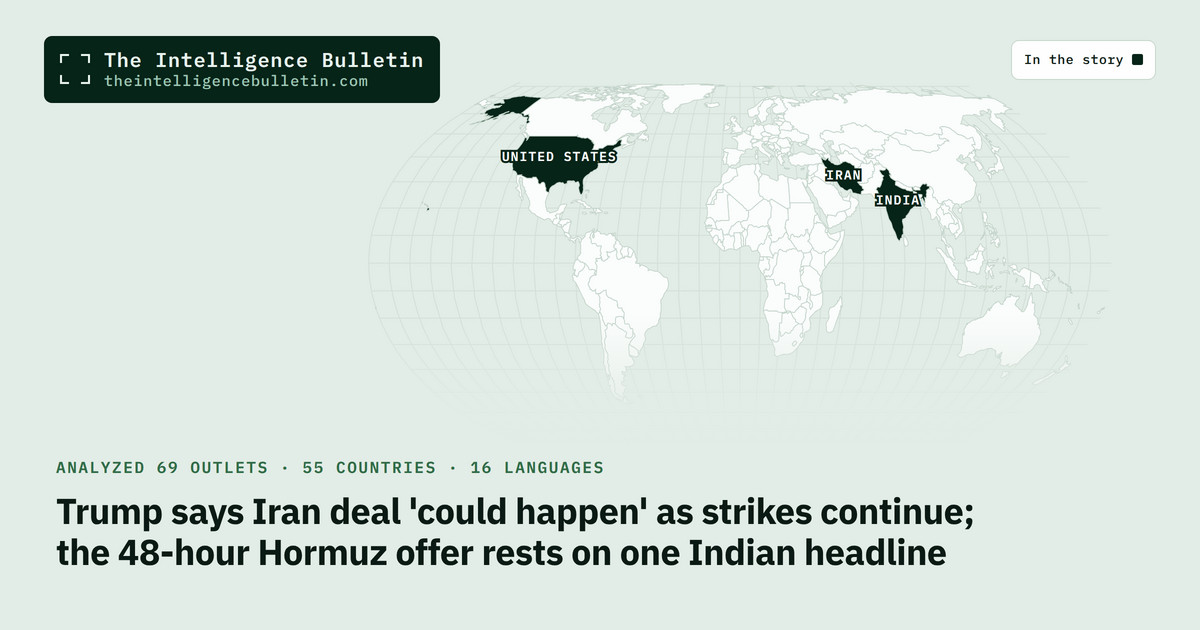
See the 55 countries
Afghanistan, Armenia, Australia, Azerbaijan, Barbados, Belgium, Brazil, Bulgaria, Canada, China, Croatia, Cyprus, Egypt, France, Germany, Ghana, Greece, Hungary, India, Indonesia, Iran, Ireland, Israel, Italy, Japan, Jordan, Kazakhstan, Kenya, Lebanon, Lithuania, Malaysia, New Zealand, Nigeria, Norway, Pakistan, Poland, Qatar, Romania, Russia, Saudi Arabia, Senegal, Serbia, Slovakia, South Africa, South Korea, Spain, Sri Lanka, Suriname, Syria, Tunisia, Turkey, Ukraine, United Arab Emirates, United Kingdom, United States
The US struck Iran’s Qeshm Island again Monday as Trump said a deal ‘could happen’ and Vance reported ‘progress.’ Tehran, via Gulf News, says the naval blockade must be lifted first; the 48-hour Hormuz reopening claim appears only in one Indian headline.
Across the press: Moneycontrol’s headline promises a 48-hour Hormuz reopening no other outlet reports; what is actually corroborated is only Trump’s ‘could happen’ and Vance’s ‘progress.’
Source base: 5 outlets quoted (France, United States, India, Egypt), selected from 69 analyzed. 4 read in full, 1 by its headline only.
- 1 of 5 · Moneycontrol onlyIran offered to unlock or reopen the Strait of Hormuz within 48 hours.Carried only by Moneycontrol’s headline; the article body could not be fetched, and no other selected outlet reports the 48-hour figure.
- 1 of 5 · gulfnews.com onlyTehran insists Washington must lift its naval blockade and meet its demands — including guarantees that commitments will be honored — before an agreement can be reached.Reported by Gulf News, attributing the position to Tehran (AP/AFP inputs).
- 1 of 5 · gulfnews.com onlyOil prices rebounded slightly in early Asian trading on Tuesday after the Qeshm strikes, following Monday’s sharp fall on deal optimism: Brent up 0.5% to $105.25 and WTI up 0.5% to $96.93, after Brent settled 7.63% lower at $104.77 on Monday.Reported by Gulf News (markets, with AP and AFP inputs).
- 2 of 5 · reported separatelyUS strikes on Iran’s Qeshm Island continued on Monday, November 2, as Washington simultaneously signaled diplomatic progress toward a settlement.Reported by Gulf News (citing US officials and US media, with AP and AFP inputs) and by WCBM 680 AM’s Townhall-sourced page (citing initial and local reports, which it says are unclear whether the blasts were incoming or outgoing).
- 3 of 5 · reported separatelyTrump said a deal with Tehran ‘could happen’ and his administration believes a settlement could be reached shortly, with Vance reporting ‘progress’ and no deadlines for resuming strikes.Gulf News (quoting Trump, AP/AFP inputs), WCBM 680 AM (citing Axios on the administration’s confidence and quoting Vance directly), and Moneycontrol’s headline (‘Trump says a deal could happen’).
- Early to mid-NovemberChina’s special envoy travels to Iran, Oman and Saudi Arabia, as Beijing announced, potentially shifting the diplomatic balance.
- The coming daysWhether Netanyahu’s reported push for fresh strikes after the midterms gains traction with Trump, per Gulf News.
- AnsweredNo decision has been announced: Gulf News reports Trump ‘has not committed to further military action’ and WCBM quotes him as ‘in no rush,’ while Dostor’s analyst predicts strikes will come if talks fail, with their timing still unannounced.
- Still openDid the Tehran meeting produce any concrete commitment from Iran on reopening the Strait of Hormuz, or only an agreement to continue consultations? · What nuclear concessions, if any, would Iran make, when its seven conditions as listed by Al Jazeera include no nuclear concession while Axios-sourced reporting says Washington insists concessions are the price of resumed talks?
- 03 Nov · US strikes Iran s Qeshm Island on midterm eve — Washington says defensive, Tehran s media report unexplained explosions
- 01 Nov · Al-Araby Al-Jadeed reports a US delegation bound for Doha; Araghchi tells IRNA no talks are planned
- 28 Oct · Qatar tells Iran to reopen Hormuz and show good faith; Tehran calls the same talks very good
- 27 Oct · US ready to strike Iran in 96 hours—but Netanyahu pushed first, and Trump refused
Full analysis
What happened Why it matters How each country tells it Where accounts conflict Room for disagreement Our assessment Sources and evidence
What happened
On Monday, November 2, the US military struck Iran’s Qeshm Island again, and on the same day President Trump said a deal with Tehran "could happen." The two facts sit side by side in the reporting, and the tension between them is the whole story.
Gulf News, running AP and AFP, reports a US official described the Qeshm attack as defensive, aimed at Iranian forces using surface-to-air missiles against US assets. WCBM 680 AM’s Townhall-sourced page leads with the explosions instead: eyewitnesses in Qeshm City reported five to six consecutive blasts around 12:14 a.m. local time, with "intense shaking" and suspected missile strikes. The same page reports it is "yet unclear if the explosions are the results of outgoing or incoming strikes," and carries IRGC claims that it downed two American MQM-170 drones in the same vicinity — claims Gulf News says the US military has not confirmed. Iranian state media reported five explosions on the island and residents sighted two aircraft overhead, according to Gulf News.
The diplomatic signals are the part of the story that survives scrutiny across independent reporting chains. Trump’s "could happen" line is carried by Gulf News, by WCBM, and in Moneycontrol’s headline. Vice President JD Vance told reporters he and Trump "feel pretty good about the prospect of reaching a settlement," that "we made some progress and we will see if we can make some more," and that "we haven’t set deadlines" for resuming strikes. WCBM carries the fuller quote: "We want to make sure the Iranians don’t rebuild or try to rebuild their nuclear program. We do think there is a pathway there, but it requires a firm and verifiable commitment that they don’t rebuild their nuclear program."
Tehran’s position reaches the reader only through Gulf News: Tehran insists Washington must lift its naval blockade and meet its demands before an agreement, and is seeking guarantees that Washington will honor its commitments. The specific claim that Iran offered to unlock the Strait of Hormuz within 48 hours appears nowhere else: it rides on Moneycontrol’s headline alone, and the article’s body could not be fetched, so what backs the figure cannot be read.
The strikes and the talk both land one day before US midterm elections. Gulf News reports Israeli Prime Minister Netanyahu urged Trump to launch another wave of strikes after the vote, and that Trump has not committed to further military action. Qatari mediators held two rounds of talks with Iranian officials last week, reportedly focused on Iran stopping attacks in the Strait in exchange for the US lifting its blockade on Iranian ports, with further talks planned.
Why it matters
The Strait of Hormuz is the world’s most important oil chokepoint, and the market is pricing the talks in real time. Gulf News reports Brent crude settled 7.63 percent lower on Monday, to $104.77 a barrel, on optimism over a possible diplomatic breakthrough — then edged back up 0.5 percent to $105.25 in early Asian trading Tuesday as word of the Qeshm strikes spread. WTI gained 0.5 percent to $96.93. That swing is the practical weight of every headline in this cluster: a material chunk of the world’s oil price is now moving on whether the 48-hour offer is real.
For Iran, the need for a settlement has a domestic face. The NCRI roundup — an exile opposition outlet that does not report the strikes or the deal talk as news — documents record annual inflation of 76.8 percent in October, the highest in its entire available series, protests by retirees, farmers and environmental activists across nine provinces, and a government forecast of a daily gas shortfall of 100 million to 250 million cubic meters this winter, attributed to war damage. The naval blockade compounds that squeeze: it is both Iran’s leverage and Iran’s vulnerability, the pressure point Tehran demands be lifted first.
For Washington, the political calendar is inescapable. The strikes fell on midterm eve, and Dostor’s commentary piece — built around a former US military intelligence commander interviewed on Al-Qahera Al-Ekhbaria — argues the diplomacy is tactical, that the air campaign destroyed Iranian capability without achieving strategic victory, and that Trump will strike again if talks fail. Gulf News carries regional cautions that push the other way: the UAE’s Anwar Gargash said the Emirates hopes for a diplomatic breakthrough but remains "braced for the worst," and Egypt’s foreign minister warned another escalation would be more dangerous and destructive.
How each country tells it
- National Council of Resistance of Iran (NCRI) · France · original reportingAn exile-opposition news roundup that touches the US-Iran conflict only obliquely — through domestic protests, prison accounts, record inflation and a Reuters-sourced tanker item — and notes merely that ‘diplomatic contacts continue’ amid divided official positions.
- WCBM 680 AM (Baltimore) · United States · carries TownhallA talk-radio news page that leads with unconfirmed Qeshm explosions and then pivots to the administration’s own settlement optimism, relaying Axios’s report that a deal ‘could be made shortly’ plus Vance’s ‘we made some progress’ and Trump’s ‘in no rush’ line.
- gulfnews.com · United Arab Emirates · wire copyA compiled regional-security and oil roundup that brackets the Qeshm strikes with diplomatic signals, Tehran’s conditions, Gulf states’ warnings that they are ‘braced for the worst’, China’s planned envoy, and Tuesday’s oil-price rebound.
- Moneycontrol · IndiaIts headline alone frames the Hormuz offer and Trump’s line as an oil-market question — ‘major breakthrough or another false dawn?’ — the trader’s skepticism of an importing economy that needs supply certainty.
- Dostor · Egypt · opinionAn Arabic commentary piece that keeps negotiation and military threat in the same breath, asking what Trump intends next and answering through a former US military-intelligence commander interviewed on Al-Qahera Al-Ekhbaria.
Where accounts conflict
The central conflict is the 48-hour figure itself. Moneycontrol’s headline states that Iran offered to unlock Hormuz within 48 hours. No other outlet in the set carries the number, and Moneycontrol’s article body could not be fetched, so the source and context for the claim cannot be examined. Against it sits the position Gulf News attributes to Tehran — that Washington must lift the naval blockade before an agreement — which a unilateral Iranian reopening within 48 hours would seem to require moving ahead of, unless both sides moved simultaneously.
A second conflict runs through the strike reporting. Gulf News, citing US officials and US media, describes the Qeshm attack as "limited" and "defensive." WCBM’s Townhall piece presents the explosions as unresolved — whether they were outgoing or incoming is unclear — and relays unconfirmed IRGC claims of downed American drones that Gulf News notes the US military has not confirmed. The two accounts describe the same night but disagree on what kind of event it was.
Room for disagreement
The strongest case that this is a genuine breakthrough rather than another false dawn rests on the convergence that does hold: Trump’s "could happen" is carried by three independent outlets, Vance’s "progress" by two, and the US struck Qeshm Island yet described the attack as defensive and limited. Dostor’s analyst argues the diplomacy is tactical and Trump will strike again if talks fail, but the more pointed challenge to doubt about the 48-hour offer is that Moneycontrol is an established financial outlet whose headline must reflect its body; the failure to fetch that body is a limitation of this research pass, not evidence the claim is false. The body may contain a sourced Iranian offer that the wire-service roundups simply had not yet carried at the time they were fetched.
Our assessment
Likely that the 48-hour Hormuz figure as reported is not yet a firm Iranian commitment — the evidence for it is one unreadable headline, and the condition Gulf News attributes to Tehran cuts against a unilateral reopening. The more solid finding is the diplomatic momentum: Trump’s "could happen" and Vance’s "progress" cross independent reporting chains, and both sides’ conditions — blockade lifted for Tehran, verifiable nuclear commitment for Washington — are on the table, reported through separate outlets but nowhere yet reported as bridged. The likelier near-term path is continued talks with strikes as leverage, not a settlement inside 48 hours, and the oil market’s rebound Tuesday after Monday’s 7.63 percent fall suggests traders read it the same way.
What would change this: if a second independent outlet, or the Moneycontrol body once readable, confirms the 48-hour offer with visible sourcing.
Sources and evidence
Press quoted
- Did Iran actually offer to reopen the Strait of Hormuz within 48 hours, and on what terms, given that only Moneycontrol’s headline carries the figure and its body could not be read, while Gulf News reports talks focused on stopping Hormuz attacks in exchange for lifting the blockade with no 48-hour figure?
- Can the two sides’ stated conditions be reconciled — Washington’s demand for a firm, verifiable commitment that Iran not rebuild its nuclear program against Tehran’s demand that the naval blockade be lifted and its conditions met first?
- Will the US resume larger-scale strikes after the November 3 midterms if no deal is reached, given that Dostor’s analyst predicts Trump will strike if talks fail and Gulf News reports Netanyahu pushing for fresh strikes?
That’s how the world told the story.
Get our daily open-source intelligence on world events in your inbox — one email a day, up to six stories.
Subscribe freeNo spam. One-click unsubscribe. See the latest email →