 AI-generated analysis published under the editorial responsibility of Rohit Sinnas. How it works →
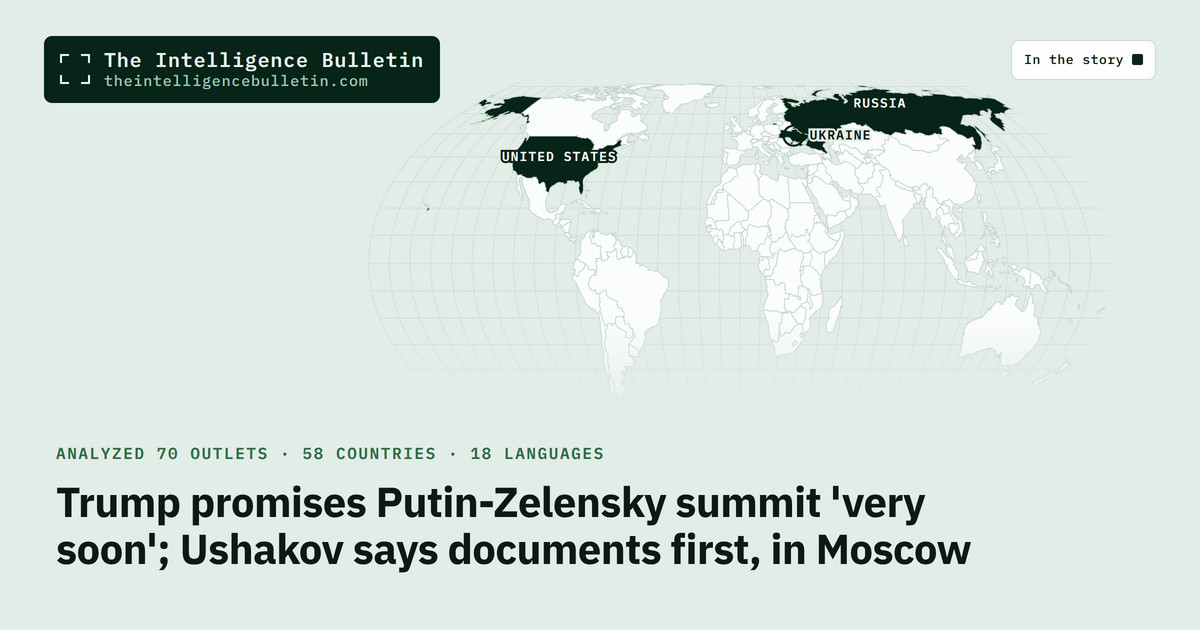
See the 58 countries
Albania, Argentina, Australia, Austria, Azerbaijan, Barbados, Belarus, Belgium, Brunei, Bulgaria, Canada, China, Croatia, Cuba, Czech Republic, Denmark, Egypt, Finland, France, Germany, Ghana, Greece, India, Indonesia, Ireland, Israel, Italy, Kazakhstan, Kenya, Kyrgyzstan, Latvia, Lebanon, Lithuania, Macedonia, Nigeria, Norway, Pakistan, Poland, Portugal, Qatar, Republic of the Congo, Romania, Russia, Serbia, Slovakia, Somalia, South Africa, South Sudan, Sri Lanka, Switzerland, Syria, Tajikistan, Turkey, Ukraine, United Arab Emirates, United Kingdom, United States, Vietnam
Putin, through Ushakov, says he will receive Zelensky in Moscow with security guaranteed, but only after negotiators finish documents for a settlement. Trump promises a Putin-Zelensky meeting ‘very soon’; the Kremlin’s conditions and Washington’s timeline cannot both be the near-term plan.
Across the press: Bloknot and Korrespondent report Ushakov’s documents-first, Moscow-only conditions, while Hürriyet, Hindustan Times and Pro TV relay Trump’s ‘very soon’ — no outlet flags the contradiction.
Source base: 5 outlets read in full (Russia, Ukraine, Turkey, India, Romania), selected from 70 analyzed.
- 2 of 5 · reported separatelyVladimir Putin has repeated, through Yuri Ushakov, that he is ready to receive Volodymyr Zelensky in Moscow and guarantee his security.Ushakov, quoted by Bloknot and Korrespondent.
- 2 of 5 · reported separatelyFinnish President Alexander Stubb and Norwegian Prime Minister Jonas Gahr Støre conveyed to Putin that Zelensky wants direct talks.Ushakov, quoted independently by Bloknot and Korrespondent.
- 3 of 5 · reported separatelyThe Kremlin will only support a Putin-Zelensky meeting after negotiators produce documents for a long-term settlement, and it maintains the meeting should happen in Moscow.Ushakov via Bloknot and Korrespondent; Știrile Pro TV separately reports the Kremlin has refused a meeting anywhere but Moscow.
- 3 of 5 · reported separatelyDonald Trump said a meeting between Putin and Zelensky will be set up ‘very soon’.Trump to reporters, as reported by Hürriyet Daily News, Hindustan Times and Știrile Pro TV.
- 4 of 5 · reported separatelyA trilateral Russia-Ukraine-US negotiation round is being prepared for November, with the Kremlin pointing to Abu Dhabi.Ushakov via Bloknot; Zelensky and the Kremlin via Hürriyet Daily News and Știrile Pro TV; Korrespondent notes Ukrainian preparations.
- NovemberThe trilateral Russia-Ukraine-US round, which Zelensky says will address territorial questions at leaders’ level and technical issues in working groups; watch whether Abu Dhabi is confirmed and at what level.
- Within daysWhether the Oleshky humanitarian truce continues to hold, as a test of the confidence-building measures the wider talks would need.
- Still openIs the November trilateral meeting now confirmed by all three governments, and on what agenda and venue: Abu Dhabi expert-level or a leaders-level format? · Does Russia acknowledge the overnight missile barrage on Kyiv that followed the talks, and how does it square that strike with its stated readiness to resume negotiations?
- 27 Oct · Støre says allies coordinated before Putin call; Frederiksen on TV2 says not with us
- 22 Oct · Putin Accepts Trilateral Ukraine Talks Around November 10, but Kremlin Transcript Omits Abu Dhabi Venue Others Report
- 22 Oct · A Russian missile barrage hits Kyiv as Zelensky offers the frontline freeze Washington wanted
Full analysis
What happened Why it matters How each country tells it Where accounts conflict Room for disagreement Our assessment Sources and evidence
What happened
On Tuesday 27 October, Vladimir Putin spent about ninety minutes on the phone with Finnish President Alexander Stubb and Norwegian Prime Minister Jonas Gahr Støre, the call that set up the week’s central question: whether a war now in its fifth year is about to produce a face-to-face meeting between the Russian and Ukrainian presidents. Afterwards, Putin’s foreign-policy aide Yuri Ushakov said the two Nordic leaders had conveyed that Volodymyr Zelensky is actively interested in a direct conversation with the Russian leader. Putin, Ushakov said, repeated that if Zelensky wants direct talks he should come to Moscow, where his security would be guaranteed. The same Ushakov statement appears in the Russian outlet Bloknot, which presents it as the Kremlin’s own account, and in the Ukrainian outlet Korrespondent, which reports the identical words as a "cynical refusal."
Both outlets also carry the sequencing the Kremlin attaches to the invitation. A leaders’ meeting, Ushakov said, would make sense only after the negotiation process ends with the production of documents for a long-term settlement in Ukraine; negotiators would then report the documents to the two leaders, who would be prepared to sign them. Ushakov added that Moscow still considers Zelensky illegitimate, a point Korrespondent notes he raised immediately. Știrile Pro TV adds the venue condition: the Kremlin has so far refused any Putin-Zelensky meeting anywhere but Moscow.
The next day, Wednesday 28 October, Donald Trump described a different timetable. "There’ll be a meeting set up very soon and I think a lot of progress could be made," he told reporters, as carried by Hürriyet Daily News, Hindustan Times and Știrile Pro TV. Hindustan Times records his answer on timing — "over the next not too long" — and his hedge that "it could be done not necessarily through a meeting." He was speaking after returning from two Texas campaign rallies, with Secretary of State Marco Rubio and envoy Steve Witkoff, and said they had discussed Russia and the Iran war.
Zelensky’s stated position sits between the two. Korrespondent reports he spoke to Stubb and Støre immediately after their call with Putin. Știrile Pro TV quotes him from a national television interview saying Ukraine is ready to discuss territorial questions at leaders’ level while technical issues belong to technical groups, all of it discussable in November. Hürriyet Daily News reports he said a trilateral meeting between Kyiv, Washington and Moscow would take place in November to restart stalled peace talks.
That trilateral is the concrete mechanism around which the invitations turn. TIB reported on 22 October that Putin told Witkoff in St Petersburg Russia is ready in principle to resume trilateral Russia–US–Ukraine talks around 10 November, with Ushakov saying a round could be held in Abu Dhabi at expert level. The Kremlin now points to Abu Dhabi for the November round, Bloknot reports, and Korrespondent confirms Ukraine is preparing for the trilateral. Bloknot also records Ushakov saying Stubb and Støre kept contact with Witkoff before and after his St Petersburg meetings. The diplomacy is running in parallel with a localized truce: Hürriyet Daily News reports the humanitarian pause in the Russian-occupied city of Oleshky, announced by Melania Trump, appeared to be holding on 27 October, with neither side reporting violations hours after it began.
The European dimension is already fractured. TIB reported on 27 October that Denmark’s Mette Frederiksen publicly called the Stubb-Støre initiative a "solo run." Ushakov, in Bloknot’s account, called the reaction of several European states to the phone call "very symptomatic and revealing" — the Kremlin registering the Western split in real time.
Why it matters
The weight of this is not the invitation itself but the order of operations. Ushakov’s conditions are specific and repeated across two independent reporting chains: documents first, then leaders, in Moscow. Trump’s announcement contains no venue, no date and no named Russian commitment. If Washington proceeds as though a summit is imminent while Moscow proceeds as though one awaits a written settlement, the two tracks collide at the November trilateral in Abu Dhabi, the only event both sides describe as next.
A leaders’ meeting would change the character of the war’s diplomacy. The fighting has moved to partial truces — the Oleshky humanitarian pause holding through 27 October is the test case — but the unresolved territorial questions, which Zelensky says must be handled at leaders’ level, have never been put between the two presidents directly. Putin has not met Zelensky for talks since ordering the February 2022 invasion, and the Kremlin’s insistence on treating him as illegitimate has blocked the channel. An actual summit, even one the Kremlin frames as a signing ceremony for negotiators’ documents, would end that block, which is why the sequencing dispute matters as much as the meeting.
For Europe, the Stubb-Støre channel is both an opening and a stress test. Finland and Norway carried Zelensky’s message to Putin with Ukraine’s coordination, but Denmark’s prime minister called it a solo run, and Ushakov’s public relish of that reaction shows Moscow has read the disunity as leverage. The peace process now runs through Washington, Abu Dhabi, Helsinki and Oslo, not through the capitals that were excluded or excluded themselves, and whether Western policy fragments further will shape the terms of any settlement.
For Trump, a breakthrough would land a week before US midterm elections, with his party on the defensive over energy prices that the Iran war has pushed up. Hindustan Times reports he has expressed frustration with Zelensky over attacks on Russian energy infrastructure, blaming him for contributing to higher US prices. A summit announcement is political product as much as diplomatic progress, which is precisely why its gap from the Kremlin’s stated terms matters: a "very soon" that does not materialize becomes a liability of its own.
How each country tells it
- Bloknot · Russia · original reportingReports Ushakov’s readout as authoritative, presenting Putin as willing to receive Zelensky in Moscow and guarantee his security while repeating that Moscow considers him illegitimate and that a leaders’ meeting would come only after negotiators prepare documents.
- Korrespondent · Ukraine · original reportingFrames the same Ushakov statement as the Kremlin’s ‘cynical refusal’ of Zelensky’s desire for direct talks, immediately noting that Moscow considers him ‘illegitimate’ and conditions a leaders’ meeting on post-negotiation documents.
- Hürriyet Daily News · Turkey · wire copyAn interested broker’s read centered on Trump’s announcement that Putin-Zelensky talks will be set up ‘very soon’, with background on the Oleshky truce and stalled diplomacy.
- Hindustan Times · IndiaA non-aligned Global South framing of Trump’s ‘peace push’ as promising progress, adding Trump’s frustration with Zelensky and his party’s domestic election stakes.
- Știrile Pro TV · RomaniaAn eastern-flank EU/NATO neighbour’s report that leads with Trump’s ‘very soon’, then gives Zelensky’s readiness to discuss and the Kremlin’s insistence that a Putin-Zelensky meeting can happen only in Moscow.
Where accounts conflict
The one conflict that changes the story is the one no outlet in this set names. Trump, as reported by Hürriyet Daily News, Hindustan Times and Știrile Pro TV, says a Putin-Zelensky meeting will be set up "very soon," and Hindustan Times adds his "over the next not too long" and the escape hatch that progress could come "not necessarily through a meeting." Ushakov, as reported by Bloknot and Korrespondent, says a leaders’ meeting should follow the negotiators’ documents and be held in Moscow. The two accounts cannot both describe the near-term plan: either a summit is imminent on Washington’s timetable, or it waits on documents the negotiators have not yet produced, in a city the Kremlin says is the only option. Trump’s version rests on his own assertion to reporters, with no Russian counterpart named; Ushakov’s rests on the Kremlin’s on-record terms, repeated across two outlets with opposite audiences. None of the five reports sets the two statements against each other.
Room for disagreement
The strongest case against calling the summit unlikely is that the two statements may describe two stages of the same sequence, not competing plans. Trump’s "very soon" is indefinite — Hindustan Times records his "over the next not too long" and his fallback to a non-meeting format — and the November trilateral in Abu Dhabi could produce the documents Ushakov demands within weeks, after which a Moscow meeting would satisfy both lines. Zelensky’s own framing supports the urgency: he says territorial questions must be handled at leaders’ level, which argues that leaders will have to meet sooner rather than later, and Știrile Pro TV reports Ukraine’s readiness to discuss those questions in November. On this reading, Ushakov’s conditions are a negotiating posture, not a veto, and the Oleshky truce holding through 27 October shows the parties can translate agreements into practice quickly. Trump also has reason to be confident in private: he said Rubio and Witkoff had discussed Russia with him on the Texas trip, and the trilateral track has already produced a Kremlin acceptance in principle, as TIB reported on 22 October. A summit announced "very soon" could simply be the leaders’ session of a process already in motion.
Our assessment
A Putin-Zelensky summit in the next few weeks is unlikely. The decisive fact is that every account of the Kremlin’s position — Bloknot’s and Korrespondent’s, for audiences that want opposite things — carries the same sequencing: negotiators finish documents for a long-term settlement, then the two leaders meet, in Moscow. Trump’s "very soon" names no such documents, no Moscow venue and no Russian counterpart; the only corroborated next step is the November trilateral round in Abu Dhabi. The warrant is the convergence across independent reporting chains: the Kremlin’s conditions are stated through two outlets with opposing editorial postures, while Trump’s promise rests on his own words to reporters, relayed by three outlets in the same agency-based account. The interests line up with the facts. Trump, a week from midterms and under pressure on energy prices he has tied to Zelensky, has every incentive to announce progress before it exists. The Kremlin, whose aide repeats the illegitimacy charge and the Moscow-only condition, has every incentive to keep the summit on its terms and to let European anger over the Nordic channel work in its favor. The most likely near-term event is the trilateral in November at working or expert level; a leaders’ meeting waits on what those negotiators produce.
What would change this: a Kremlin confirmation, from Ushakov or the presidency, that a Putin-Zelensky meeting has been agreed for a specific date and venue, or the November round producing documents far faster than either side now publicly allows.
Sources and evidence
Press quoted
- Does Volodymyr Zelensky or his office accept Vladimir Putin’s reported invitation to come to Moscow, and does Kyiv still insist on a neutral venue?
- Can Donald Trump’s ‘very soon’ leaders’ meeting be reconciled with Yuri Ushakov’s stated preconditions that such a meeting should follow negotiators’ documents and take place in Moscow?
- Do any European governments or EU/NATO bodies now support the Finnish-Norwegian channel and a possible Putin-Zelensky meeting in Moscow, or has Washington’s announcement left Europe outside the process?
That’s how the world told the story.
Get our daily open-source intelligence on world events in your inbox — one email a day, up to six stories.
Subscribe freeNo spam. One-click unsubscribe. See the latest email →