 AI-generated analysis published under the editorial responsibility of Rohit Sinnas. How it works →
Press quoted
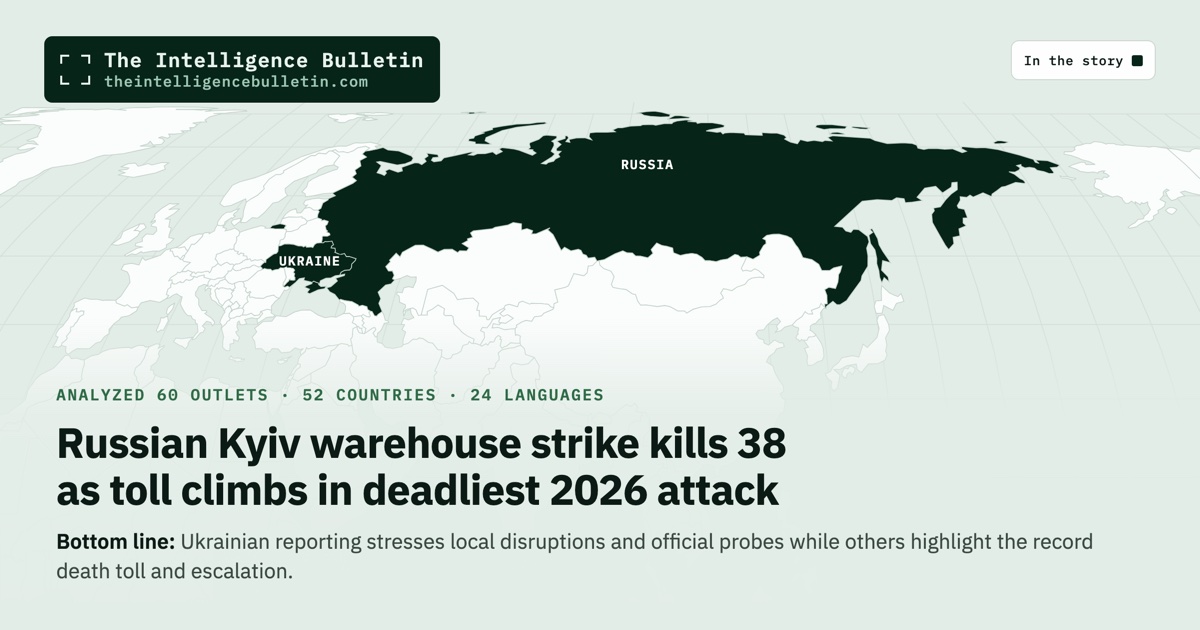
Ukrainian reporting stresses local disruptions and official probes while others highlight the record death toll and escalation.
The selected reporting converges on the core facts of a Russian drone or missile strike hitting a munitions warehouse near Kyiv, with the death toll climbing from initial reports of 27 to 38 and the incident labeled the war’s deadliest single attack of 2026. Ukrainian outlet ZN.ua stands apart by anchoring the story in immediate local consequences—the detonation, blocked Kyiv-Chop highway and evacuation of 200 residents—while foregrounding domestic accountability through criminal proceedings against officials for alleged negligence. German, US, Qatari and Australian coverage instead emphasizes the rising casualty count and Russian responsibility, treating the event as a sharp escalation metric rather than a site-specific emergency. This split reveals how proximity shapes emphasis: the Ukrainian source alone supplies details of traffic disruption and internal investigations that other outlets omit, even as all chains agree the warehouse contained ammunition and the strike originated from Russian forces. The absence of any Russian outlet in the set leaves official Moscow statements visible only through the Ukrainian and international relays that carried them. The pattern shows a factual consensus on attribution and scale alongside a clear divide between domestic disruption reporting and international body-count framing.
Full analysis
Russian forces struck a warehouse on the outskirts of Kyiv on 29 August 2026. The site held ammunition, and the impact set off a chain of secondary detonations that killed civilians in the surrounding area. Ukrainian officials placed the final death toll at 38, describing the strike as the single deadliest Russian attack on Ukraine in 2026. Initial reports had put the number at 27 before it climbed through the following day. The warehouse sat near the Kyiv-Chop highway, and traffic on that route was halted while emergency crews worked.
Ukrainian reporting from the scene recorded that a drone delivered the strike. The resulting blast forced the evacuation of roughly 200 residents and prompted authorities to open criminal proceedings against local officials on suspicion of negligence in protecting the site. The same account noted that the enterprise functioned as a storage point for military supplies, which explains the scale of the secondary explosions. International outlets carrying statements from Ukrainian authorities described the target in similar terms as a munitions depot or warehouse, confirming the presence of ammunition without adding independent verification of its contents.
The death toll figure originated with Ukrainian emergency services and was carried forward by multiple independent reporting chains. News4JAX and the Australian Financial Review both cited Ukrainian authorities when they recorded 38 dead and labeled the attack the deadliest of the year to date. Al Jazeera published an earlier count of at least 27 while the scene was still being cleared. Rhein-Neckar-Zeitung reported dozens killed in its initial dispatch. The convergence on Russian responsibility for the strike and on the munitions stored at the site appears across the Ukrainian, German, American, Qatari and Australian accounts examined.
A reader who followed only the Ukrainian source would learn that traffic on the Kyiv-Chop route remained blocked hours after the blast and that prosecutors had opened cases against officials for possible failures in evacuation planning or site security. That same reader would not encounter the explicit framing of the incident as a new record in annual casualties. A reader limited to the German, American, Australian or Qatari accounts would register the rising body count and the description of the strike as an escalation metric but would miss the blocked highway, the evacuation of 200 people and the domestic negligence inquiries. Those details appear only in the ZN.ua dispatch and are absent from the other four pieces.
The four non-Ukrainian outlets align closely with one another on the core sequence: a Russian strike, a munitions site, civilian deaths that increased over roughly 24 hours, and the yearly record. Three of them trace directly or indirectly to the same agency copy, which accounts for the similarity in phrasing around the death toll and the “deadliest attack this year” description. The German piece situates the event inside the longer war without adding new local particulars. The Australian and American pieces treat the number 38 as the central development. Al Jazeera foregrounds civilian impact at the lower initial count.
The Ukrainian account supplies the only on-record mention of criminal proceedings against officials. That claim stands as single-source within the set examined. The other outlets do not contradict it; they simply do not report it. The absence of any Russian outlet from the selected coverage means statements from Moscow appear only where Ukrainian or international pieces chose to include them, which was sparingly and without direct quotation in the material reviewed.
What to Watch
The convergence on the strike’s origin, the nature of the target and the final casualty total provides the strongest ground for treating those elements as the settled spine of the event. The divergence in emphasis tracks the location of the reporting: proximity yields operational consequences and internal accountability questions, while distance yields a focus on cumulative human cost and strategic implication. A reader assembling the picture from all five accounts therefore receives both the immediate disruption on the ground and the wider measure of the attack’s place in the year’s fighting. The single-source detail on the negligence probes adds a layer of domestic response that the toll-focused accounts leave unaddressed, yet it does not alter the corroborated facts about what struck the warehouse or how many people died.
That’s how the world told the story.
Get our daily open-source intelligence on world events in your inbox — one email a day, up to six stories.
Subscribe freeNo spam. One-click unsubscribe. See the latest email →