 AI-generated analysis published under the editorial responsibility of Rohit Sinnas. How it works →
Press quoted
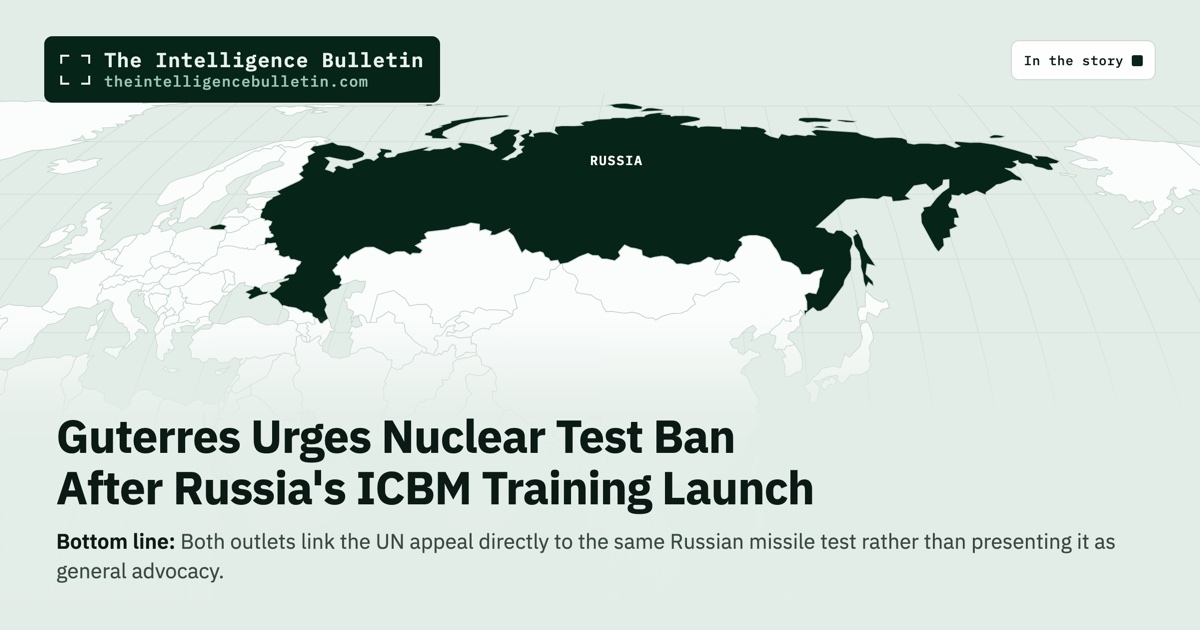
Both outlets link the UN appeal directly to the same Russian missile test rather than presenting it as general advocacy.
The two outlets frame the UN appeal as a direct response to a Russian missile test rather than a standalone disarmament initiative. Both quote Guterres identically on shattered trust and the arms race, tying the statement to the same Russian Defence Ministry launch details from Plesetsk to Kura. The Pakistani outlet alone adds surrounding conflicts including US-Iran tensions and the Russia-Ukraine war as context for the timing, while the Turkish agency sticks closely to the CTBT’s ratification barriers and the nine holdout nations. Coverage converges on the factual sequence: UN statement plus Russian test announcement. No outlet from a principal nuclear power appears in the set, leaving the Russian position visible only through its ministry statement as carried by these intermediaries. The reporting shows the appeal as reactive diplomacy rather than proactive norm enforcement, with the missile test serving as the immediate trigger across both accounts.
Full analysis
The core facts in both accounts trace to the same two public statements. On 29 August 2026, UN Secretary-General António Guterres posted on X that nuclear tests shatter trust, fuel a nuclear arms race and betray communities still living with the legacy of past tests. He called on states possessing nuclear weapons to maintain existing moratoria and bring the Comprehensive Nuclear-Test-Ban Treaty into force. The same day the Russian Defence Ministry announced a training launch of a mobile solid-fuel intercontinental ballistic missile from the Plesetsk Cosmodrome in the Arkhangelsk region; the missile reached its designated target at the Kura training ground in Kamchatka. Moscow described the exercise as a check of the system’s tactical, technical and flight characteristics.
The Comprehensive Nuclear-Test-Ban Treaty was adopted in 1996 to establish a legally binding prohibition on all nuclear test explosions. It has never entered into full legal force because nine Annex 2 states have not ratified it: the United States, Russia, China, Iran, Israel, Egypt, India, Pakistan and North Korea. The treaty requires ratification by all those states.
The News International ran the material under the headline “Why is the UN chief calling for a global nuclear test ban?” Its version, credited to reporter Aqsa Qaddus Tahir, opens with the treaty’s purpose and then places Guterres’s appeal inside a list of ongoing conflicts that includes the US-Iran confrontation and the Russia-Ukraine war. The piece states that the UN chief’s plea came after Russia conducted the ICBM launch, quotes the full X post, and notes that the CTBT remains without full legal force. No additional reporting on the missile test or on any of the listed conflicts appears beyond the ministry announcement and the Guterres post.
Anadolu Agency published under the headline “UN chief says nuclear tests ‘shatter trust,’ wants global test ban.” Its account leads with Guterres’s X post verbatim, then records the Russian Defence Ministry announcement of the Plesetsk launch and its successful impact at Kura. It states that the exercise was intended to confirm the missile system’s characteristics, repeats the nine Annex 2 holdout countries by name, and explains that entry into force still depends on their ratifications. The article does not mention any wider conflicts.
Both pieces therefore rest on the identical public statements and supply the same technical details of the launch site, target range and stated purpose. The single measurable divergence lies in the surrounding sentences each outlet chose to add or omit. The Pakistani outlet alone inserted references to the US-Iran situation and the Russia-Ukraine war as possible context for the timing of the appeal. The Turkish agency confined itself to the treaty’s ratification mechanics and the precise sequence of the Russian announcement.
No outlet from any of the nine Annex 2 states appears in the set. The Russian position reaches readers only through the ministry statement as relayed by these two intermediaries; no Russian domestic coverage was included. The UN itself issued the statement directly on X, yet neither article quotes any further UN documentation or official beyond that post.
The two mastheads therefore performed different editorial operations on the same dispatch. One used the material to illustrate a wider pattern of international tension; the other used it to restate the treaty’s long-standing legal obstacle. A reader who encountered only the Pakistani version would learn that the appeal occurred against a backdrop of multiple active confrontations. A reader who encountered only the Anadolu version would learn the exact list of countries still required for the treaty to become binding law. Both versions contain the Guterres quote and the Russian launch details in full.
What to Watch
The pattern shows how a single international statement travels when no nuclear-weapon state reports it directly. The two intermediaries selected different local hooks—one conflict environment, one treaty architecture—while leaving the core facts unchanged. That selection determines what a distant reader first associates with the appeal: either a reaction to immediate crises or a reminder of a 30-year ratification deadlock. The next development most likely to alter that picture would be an on-record comment from one of the nine holdout governments, none of which is represented in the current coverage.
That’s how the world told the story.
Get our daily open-source intelligence on world events in your inbox — one email a day, up to six stories.
Subscribe freeNo spam. One-click unsubscribe. See the latest email →