 AI-generated analysis published under the editorial responsibility of Rohit Sinnas. How it works →
Press quoted
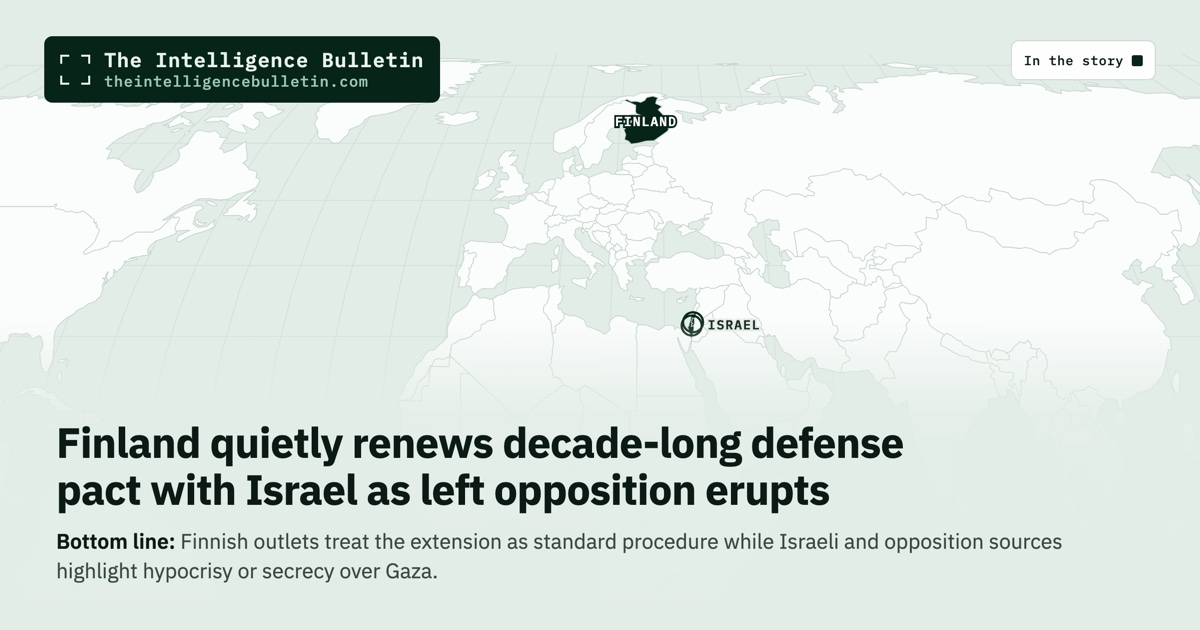
Finnish outlets treat the extension as standard procedure while Israeli and opposition sources highlight hypocrisy or secrecy over Gaza.
The reporting across these outlets reveals a straightforward bilateral security arrangement treated as unremarkable policy in Finnish sources but reframed as evidence of duplicity or secrecy elsewhere. Yle reports the extension as a factual administrative step, noting the Defense Ministry’s failure to inform the Foreign Ministry or announce it publicly, while placing the timing against the backdrop of Gaza casualties and international allegations against Israel. Helsinki Times focuses on domestic opposition fury, quoting Green League and Left Alliance leaders who label the move a historic shame and demand parliamentary answers on who approved it. Ynetnews casts the same facts as Finnish hypocrisy, highlighting the David’s Sling purchase and criticism of Israel on Gaza while strategic ties deepen. Azernews and the New York Post relay the core details with minimal added framing, the latter emphasizing the left backlash for a US audience. The convergence on the pact’s existence and lack of announcement is clear, yet the sources diverge sharply on whether secrecy reflects normal procedure or deliberate concealment tied to Gaza. Israeli commentary treats European criticism and continued procurement as proof that rhetoric diverges from interests; Finnish government voices insist capability needs dictate choices independent of politics. This pattern shows how one country’s routine defense housekeeping becomes another’s story of inconsistency or shame depending on the outlet’s vantage.
Full analysis
Finland and Israel extended an existing memorandum of understanding on defense industry cooperation that had first been signed in 2013 and renewed in 2019. The new version, proposed by Finland in early 2024, runs until 2034 and lengthens the renewal cycle from five years to ten. The document covers joint research, development and procurement of military equipment. It also establishes a coordination group that meets at least once a year, with Finland’s representative drawn from the Defense Ministry’s resources policy department. The Defense Ministry approved the extension in late 2024 but made no public announcement of the step.
Finland is already acquiring Israel’s David’s Sling air-defense system under an earlier decision taken by the previous government. The purchase, valued at approximately 317 million euros, is scheduled to enter service next year. Defense Minister Antti Häkkänen described the memorandum as one of forty similar cooperation documents Finland maintains with countries where it conducts defense trade. He stated that the arrangement simply supports existing procurement projects and contains no dramatic shift in policy. Commander of the Defense Forces Janne Jaakkola added that operational information obtained through the partnership has proven valuable and that David’s Sling performed best among the systems evaluated on capability grounds.
The extension occurred while Israel’s military campaign in Gaza continued. By early 2024 that campaign had already produced tens of thousands of Palestinian deaths. Finnish public broadcaster Yle placed the timing of the renewal against this backdrop and noted that Finland’s Defense Ministry had not referred the matter to the Foreign Ministry in the manner of the 2019 renewal. An Israeli Defense Ministry statement included in the memorandum text described the relationship as resting on common values and developing into a unique partnership, with Finland positioned as Israel’s gateway to NATO and European markets.
Left-wing opposition parties reacted sharply once the extension became known. Green League chair Sofia Virta called the government’s approach a historic shame and argued that demands for pressure on Israel had instead produced deeper cooperation. Left Alliance chair Minja Koskela described the silence surrounding the decision as unsurprising given what she termed an intolerably shameful line and announced plans to submit parliamentary questions on who within the government had been informed. Both parties linked the memorandum to other recent Finnish moves, including the decision not to renew multi-year funding for UNRWA.
Israeli coverage framed the same facts differently. Ynetnews presented the extension and the David’s Sling purchase as evidence of a double game, noting that Finnish criticism of Israel’s Gaza operations, including accusations of genocide, continued even as defense ties were placed on a longer-term footing. The report highlighted the gap between public diplomatic messaging and the strategic decision to maintain procurement from Israeli suppliers.
Azernews carried a concise account of the memorandum’s scope and the David’s Sling purchase without additional commentary on either Finnish domestic reactions or Israeli interpretations. The New York Post similarly relayed the extension and the opposition response, foregrounding the left-wing backlash for its American readership.
The accounts converge on several core elements. Multiple independent reporting chains confirm that the memorandum was extended until 2034, that the Defense Ministry issued no public notice, and that Finland is proceeding with the David’s Sling acquisition. They also agree that opposition parties condemned the move in strong terms. Where the sources diverge is in the significance attached to the absence of announcement and to the broader context of the Gaza war. Yle treats the lack of public notice as an administrative detail while recording the surrounding allegations against Israel. Helsinki Times centers the opposition statements that portray the extension as deliberate concealment. Ynetnews treats the combination of criticism and continued procurement as proof that European rhetoric does not constrain strategic interests. Finnish government voices insist that procurement decisions rest on military performance and cost rather than political alignment.
A reader limited to one national outlet would therefore receive different impressions of motive. Finnish government-aligned or public-broadcast reporting presents the extension as ordinary housekeeping among long-standing partners. Opposition-focused reporting emphasizes secrecy and timing during an ongoing conflict. Israeli reporting stresses inconsistency between stated positions and actual purchases. The underlying transaction itself appears in every account that covered the story.
What to Watch
The most substantiated reading is that Finland completed a standard administrative renewal of an existing framework because it judged the resulting access to technology and information useful for its own defense needs. The government statements on file name capability and cost as the decision criteria and place the memorandum alongside forty comparable arrangements. The opposition criticism, while politically coherent, rests on an interpretation of silence as concealment rather than on any documented deviation from normal procedure. The Israeli framing correctly notes the continued procurement but does not demonstrate that Finnish officials altered their public stance on Gaza to accommodate the deal. The pattern across the five outlets shows routine defense cooperation surviving European political criticism of Israel, a separation of security interests from diplomatic rhetoric that predates this particular renewal and is unlikely to change while Finland continues to assess Israeli systems as superior on technical grounds.
That’s how the world told the story.
Get our daily open-source intelligence on world events in your inbox — one email a day, up to six stories.
Subscribe freeNo spam. One-click unsubscribe. See the latest email →