 AI-generated analysis published under the editorial responsibility of Rohit Sinnas. How it works →
See the 60 countries
Argentina, Armenia, Austria, Azerbaijan, Bangladesh, Bosnia and Herzegovina, Brazil, Bulgaria, Chile, China, Colombia, Croatia, Cyprus, Czech Republic, Denmark, Egypt, Estonia, Finland, France, Germany, Ghana, Greece, Indonesia, Ireland, Israel, Italy, Japan, Jordan, Kazakhstan, Kyrgyzstan, Latvia, Libya, Lithuania, Macedonia, Mexico, Moldova, Norway, Pakistan, Paraguay, Poland, Portugal, Qatar, Romania, Russia, Serbia, Slovakia, Slovenia, South Africa, Spain, Sri Lanka, Switzerland, Taiwan, Thailand, Turkey, Tuvalu, Ukraine, United Kingdom, United States, Vietnam, Yemen
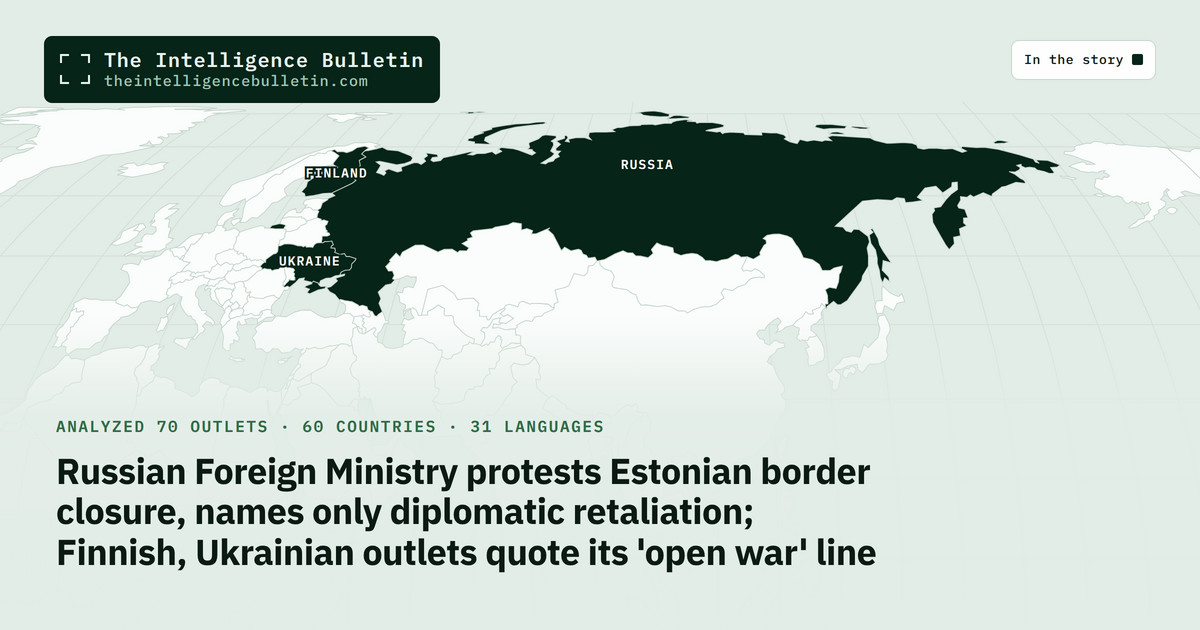
Russia’s Foreign Ministry summoned Estonia’s chargé on November 23 to protest Tallinn’s December 1 border closure and arson accusation, reserving unspecified political-diplomatic measures. It accuses Estonia of letting Ukrainian drones overfly it; Estonia denies this. Iltalehti and H.ua report an ‘open war’ warning.
Across the press: Iltalehti and H.ua attribute an ‘open war’ warning to Russia’s Foreign Ministry; Xinhua and URA.RU, quoting the ministry’s text at length, carry no such phrase.
Source base: 5 outlets read in full (Russia, Lithuania, Finland, Ukraine, China), selected from 70 analyzed.
- DisputedThe November incident at Estonian drone maker Threod Systems, which Estonia’s security service attributes to the GRU, was an attempted arson.Source: H.ua, 15min and the Russian ministry text quoted by Xinhua describe a failed arson; Iltalehti alone says the factory was hit by a drone strike.
- Denied on the recordMoscow accused Estonia of allowing Ukrainian drones to use its airspace to attack Russia; Estonia says it has never allowed and will never allow its territory to be used for another country’s military operations.Source: Russian Foreign Ministry, per URA.RU, H.ua and Iltalehti; the Estonian denial is reported by Iltalehti, H.ua and 15min.
- 5 of 5 · reported separatelyOn November 23 Russia’s Foreign Ministry summoned Estonia’s chargé d’affaires, Marek Ühtegi, and protested Tallinn’s accusation over the failed arson near Tallinn and its decision to close the land border crossings from December 1.Russian Foreign Ministry statement, carried by Xinhua and URA.RU; Iltalehti and H.ua report the summons independently; 15min relays the statement.
- 3 of 5 · reported separatelyThe ministry said Estonia’s actions were on the brink of, or risked, unleashing ‘open war’ with Russia.Iltalehti and H.ua attribute the phrase to the ministry’s statement; 15min carries it only in its headline; the ministry passages quoted by Xinhua and URA.RU contain no such wording.
- 3 of 5 · reported separatelyRussia warned that closing the border would ‘boomerang’ on Tallinn and its EU and NATO allies and reserved the right to ‘comprehensive political-diplomatic measures,’ without naming any.Russian Foreign Ministry statement, quoted by Xinhua, URA.RU and 15min.
- December 1, 2026Estonia’s closure of its five road crossings with Russia takes effect, testing whether Moscow follows its protest with concrete steps.
- Whenever Moscow announces themThe ‘comprehensive political-diplomatic measures’ Russia reserved, still unnamed, will show whether its response stays diplomatic or widens.
- About six months after December 1Estonia’s government reviews the border restrictions, with rail freight continuing in the meantime.
- Still openWhat retaliatory diplomatic measures does Moscow intend, beyond the summoning of Estonia s chargé d affaires that Lenta.ru mentions? · Will Tallinn make any exception for Narva and Setomaa residents with relatives, jobs or property across the border, and what concrete support will back Michal s promise to keep border regions viable?
- 20 Nov · Estonia closes Russian border for six months; Moscow s officials attack one arson, Tallinn cites a pattern
- 22 Nov · Drones burn Russian military cargo ship off Finland; Finland s premier backs Kyiv, Russian experts warn of Kaliningrad blockade
- 24 Nov · Finland s military, not Kyiv, names Ukraine as likely attacker of Russian ship towed from Gulf of Finland
Full analysis
What happened Why it matters How each country tells it Where accounts conflict Room for disagreement Our assessment Sources and evidence
What happened
On Monday, November 23, Russia’s Foreign Ministry summoned Estonia’s chargé d’affaires in Moscow, Marek Ühtegi, and lodged what Xinhua’s Moscow dispatch calls a "strong protest." Xinhua quotes the ministry’s website: the protest concerned the "groundless accusation of Russia over the failed arson of a defense-industry enterprise near Tallinn" and the Estonian government’s decision "in this connection" to close crossing points on the border from December 1.
TIB reported on November 20 that Tallinn had decided to shut its land crossings with Russia for six months. H.ua names the five road crossings: Narva-1, Narva-2, Koidula, Luhamaa and Saatse. Rail freight will keep running, and the government will review the restrictions after six months. URA.RU reports that Interior Minister Igor Taro gave Russian intelligence activity as the reason.
The trigger was the November 14 attempted arson at Threod Systems, which H.ua describes as a maker of reconnaissance and combat drones. Estonia’s Internal Security Service says Russia’s GRU military intelligence organized the attempt, and eight residents of Latvia were detained in the case. H.ua also recalls that a building belonging to Milrem Robotics, which supplies ground robots to Ukraine, was set on fire in Tallinn in August.
The ministry’s language was harsh. URA.RU quotes it calling Estonia’s "hasty accusations" baseless and proof of "the rabid Russophobic essence of the Estonian regime." 15min quotes it describing the closure as the "latest anti-Russian trick," one more item on a long list of "hostile actions." Xinhua, URA.RU and 15min all carry the core warning. The closure "will first of all deal another blow to the Estonian economy and boomerang" on Tallinn and on its allies in the EU and NATO. The meeting ended with Russia reserving the right to "comprehensive political-diplomatic measures" to protect its national interests and its citizens. None were named.
The ministry also aired a wider set of grievances. URA.RU lists three: – that Estonia lets Ukrainian drones fly through its airspace; – that Estonia obstructs Russian cargo ships in the Baltic by trying to inspect and detain them; – that Estonia imposed a full ban in October on transit of Russian and Belarusian grain.
H.ua adds pressure on the Russian language and a threat to close the Russian Orthodox Church. It reports Moscow’s claim that evidence of Estonian complicity "was recorded repeatedly."
The "open war" phrase has an uneven trail. Iltalehti reports that the statement said Estonia’s recent actions risk leading to "open war with Russia." H.ua attaches the words to the end of the grievance list: Estonia’s actions are "on the brink of unleashing open war." 15min’s headline reads "you have found yourselves on the threshold of open war with Russia," but the article body as fetched does not quote the phrase. The ministry passages that Xinhua and URA.RU quote at length do not contain it either. In every version that does carry it, the phrase describes Estonia as the party nearing war. None casts it as a Russian pledge to attack.
Estonia answered the drone charge, according to Iltalehti, H.ua and 15min. It said it has never allowed and will never allow its territory to be used for another state’s military operations.
Why it matters
The drone accusation changes the nature of the quarrel. A dispute about a border and a sabotage case becomes a claim that a NATO member is a knowing participant in attacks on Russian soil.
That claim sits on top of real damage to Russian infrastructure. Iltalehti ties Moscow’s charges to Ukrainian strikes on the oil ports of Primorsk and Ust-Luga, and to the November 21 attack on the Sparta II. It cites the Centre for Research on Energy and Clean Air’s estimate that nearly half of Russia’s oil exports left from Baltic ports in 2025. Moscow is not looking for a culprit in a minor theater.
The border is already tightening before the closure. Russia’s Foreign Ministry crisis center, as URA.RU relays it, gives these figures: – On November 22, Estonia let through only 13 trucks at Shumilkino and six at Kunichina Gora. – About 30 vehicles were waiting at Shumilkino. – Estonian officers turned back 40 people at Kunichina Gora in a day. – About 200 people could not cross at Narva-1 because of its limited opening hours.
Those are Moscow’s counts, but they show who feels a closure first: people crossing at Narva and Ivangorod.
The "boomerang" warning is aimed past Tallinn. It addresses the EU and NATO governments that would have to stand behind the closure.
How each country tells it
- URA.RU · Russia · carries Russian Foreign MinistryReports the summons as a protest over Tallinn’s ‘hasty accusations’ and border closure, lists Moscow’s grievances over drone overflights, Baltic cargo inspections and the October grain-transit ban, and adds Foreign Ministry crisis-center figures on truck lines at the Latvian and Estonian crossings.
- 15min · Lithuania · carries Russian Foreign MinistryIts headline casts the event as Moscow telling Estonia it stands ‘on the threshold of open war,’ while the article text quotes the ministry’s charges of ‘fanatical Russophobia,’ the ‘boomerang’ warning to Tallinn’s EU and NATO allies, and the reservation of ‘comprehensive political and diplomatic measures.’
- Iltalehti · Finland · original reportingReports that the ministry warned Estonia’s actions risk ‘open war with Russia,’ then gives most of the piece to FIIA’s Arkady Moshes, who ties Moscow’s charges to Ukraine’s strikes on Baltic oil ports and the Sparta II.
- H.ua · UkraineLeads with Moscow’s claim that Estonia knowingly lets Ukrainian drones cross its territory to strike northwest Russia, and attaches the ‘on the brink of unleashing open war’ phrase to a longer list of grievances over shipping, grain, the Russian language and the Russian Orthodox Church.
- russian.news.cn · China · wire copyA Moscow-datelined dispatch quoting the Foreign Ministry website at length: a ‘strong protest’ over the ‘unfounded accusation’ about the failed arson near Tallinn, the boomerang warning, and the reservation of ‘comprehensive political-diplomatic measures.’
Where accounts conflict
The central factual dispute is the drones. Moscow, per URA.RU, H.ua and Iltalehti, says Estonia lets Ukrainian drones use its airspace. Estonia denies ever doing so. H.ua reports that Kyiv and the Baltic states explain drones straying into NATO airspace as the effect of Russian electronic warfare pushing them off course. Estonia, Latvia and Lithuania jointly rejected the Kremlin’s charge in April. Each side rests on its own assertion, and none of the reporting carries evidence either way.
The Threod incident is described two ways. H.ua and 15min, and the ministry text quoted by Xinhua, call it a failed arson. Iltalehti alone says the factory was hit by a drone strike.
No Estonian outlet is in the source set, so Tallinn’s account reaches readers only secondhand.
Room for disagreement
The strongest case against reading this as routine comes from Iltalehti’s own expert. Arkady Moshes of the Finnish Institute of International Affairs says the situation is "of course not ordinary." In his words, "Russia is practically at war with NATO and the EU. Indirectly, of course, but still."
The evidence supports that reading in places. Estonia attributes two arson attacks on defense firms to Russian actors within three months. Iltalehti reports that on Sunday Moscow made a parallel claim about a suspicious object entering Kaliningrad from Lithuania, which Lithuania denied. A record of accusations against NATO members, built since spring, is the kind of record that can later be cited to justify action.
Our assessment
It is very unlikely that the "open war" language foreshadows Russian military action against Estonia over the border closure. Expect diplomatic and economic retaliation.
The warrant is the ministry’s own text. The passages that Xinhua and URA.RU quote, and that 15min corroborates, name only political-diplomatic measures. The war phrase, as reported, describes Estonia’s conduct rather than a Russian intention. Moshes also says the summons should not be made much of, noting that Finland’s chargé was summoned days earlier when Helsinki stopped issuing visas to athletes.
Moscow benefits from the alarm: the boomerang line asks Estonia’s allies to weigh the cost of backing Tallinn. Headlines in front-line states amplify it.
The drone charge is the part to watch. It is the claim that converts protest into pretext.
What would change this: Moscow naming measures beyond diplomacy, such as action against Estonian shipping or airspace, or formally treating drone overflights as Estonian participation in the war.
Sources and evidence
Press quoted
- What did Tallinn say in response to the summons and the war warning beyond its standing denial on drone overflights? No Estonian outlet is among the selected sources.
- Which ‘comprehensive political-diplomatic measures’ does Moscow have in mind, and will they target Estonia’s allies as the boomerang warning implies?
- Will NATO or EU governments answer a Russian warning of ‘open war’ directed at an alliance member, or treat it, as Moshes suggests, as routine diplomatic pressure?
That’s how the world told the story.
Get our daily open-source intelligence on world events in your inbox — one email a day, up to six stories.
Subscribe freeNo spam. One-click unsubscribe. See the latest email →