 AI-generated analysis published under the editorial responsibility of Rohit Sinnas. How it works →
See the 44 countries
Albania, Argentina, Armenia, Austria, Azerbaijan, Belarus, Belgium, Bulgaria, China, Cyprus, Czech Republic, Egypt, Estonia, Finland, Germany, Greece, Guinea, Hungary, Ireland, Israel, Italy, Kazakhstan, Kyrgyzstan, Latvia, Lithuania, Mexico, Moldova, Montenegro, Norway, Oman, Poland, Portugal, Romania, Russia, Saudi Arabia, Spain, Switzerland, Turkey, Tuvalu, Ukraine, United Kingdom, United States, Venezuela, Vietnam
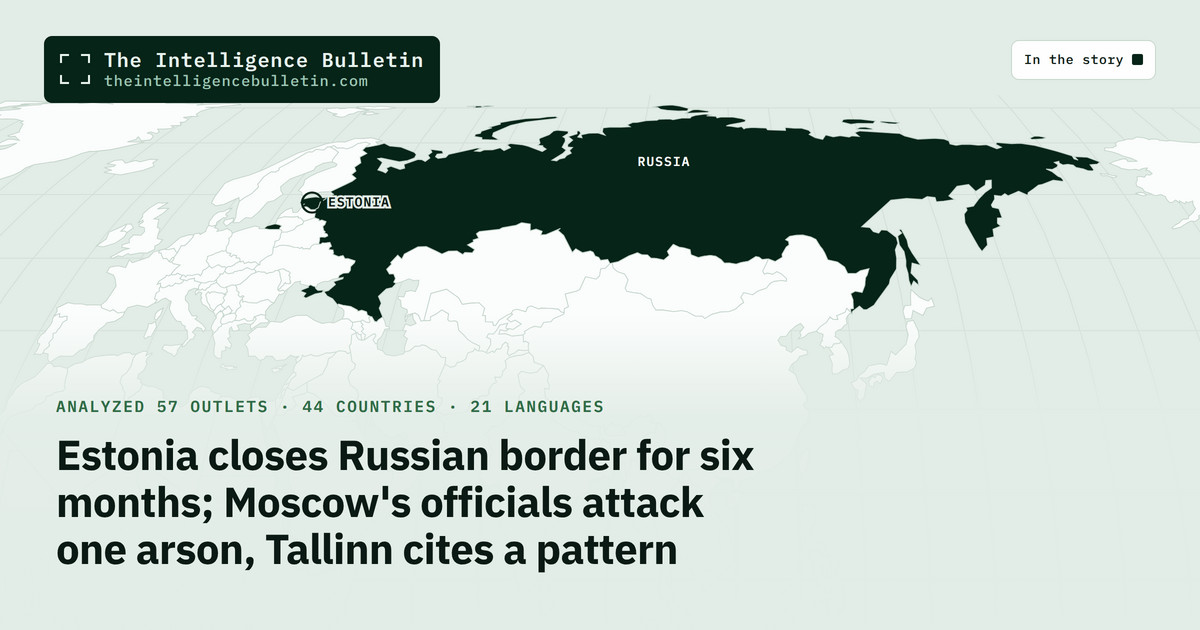
Estonia’s government will shut all land crossings with Russia from December 1 for six months, citing GRU-blamed sabotage, recruitment and sanctions evasion; rail freight continues. Russia’s Foreign Ministry calls the closure confrontational and the GRU accusation unsubstantiated.
Across the press: Zakharova, via TASS, calls one failed arson the pretext; Tallinn’s own release says the closure "is not a response to a single incident."
Source base: 5 outlets read in full (Estonia, Russia, Belgium, Latvia, Kazakhstan), selected from 57 analyzed.
- Denied on the recordRussia’s military intelligence agency, the GRU, ordered the November 14 attempted arson at drone maker Threod Systems in Viimsi, for which eight Latvian nationals were detained.Source: Estonia’s Internal Security Service (KaPo) and its head Margo Palloson, per EUobserver, BNN and Ak Zhaiyk; Moscow rejects it, with Zakharova saying via TASS the attack was ‘allegedly’ organized by Russian services
- 2 of 5 · one shared reportThe closure covers five checkpoints (Narva-1, Narva-2, Koidula, Luhamaa and Saatse) for people and vehicles, runs six months before review, and leaves rail freight running under existing restrictions.Estonian government press office announcement, relayed by BNN and Ak Zhaiyk
- 4 of 5 · reported separatelyEstonia will close all of its land border crossings with Russia from December 1.Estonian government, reported independently by EUobserver, relayed from the government release by BNN and Ak Zhaiyk, and carried from TASS by Lenta.ru
- 2 of 5 · reported separatelyTallinn says the closure answers a pattern rather than one incident, including a second attack on an Estonian defense firm this year and Russian recruitment and sanctions evasion across the border.Foreign Minister Margus Tsahkna and Prime Minister Kristen Michal, quoted by EUobserver and in the government text carried by BNN
- 3 of 5 · reported separatelyRussia’s Foreign Ministry condemned the closure as confrontational and rejected Estonia’s accusation.Maria Zakharova via TASS, carried by Lenta.ru; Ak Zhaiyk reports her ‘new Iron Curtain’ comparison and retaliation warning; EUobserver reports a Monday Moscow statement calling the charge ‘unsubstantiated’
- AnsweredPer the Estonian government release carried by BNN and Ak Zhaiyk, the government decided on November 20 to close Narva-1, Narva-2, Koidula, Luhamaa and Saatse to people and vehicles from December 1 for six months, with rail freight continuing under existing restrictions; neither text mentions any exception for residents.
- Still openWhat links the eight detainees from Latvia to the GRU, and how many are Latvian citizens and how many are non-citizens? · Will Latvia, Lithuania or Monday s EU foreign ministers meeting in Brussels follow Estonia with border or visa measures of their own?
Full analysis
What happened Why it matters How each country tells it Where accounts conflict Room for disagreement Our assessment Sources and evidence
What happened
Estonia’s government decided on Friday, November 20, to close every land border crossing with Russia from December 1. The government press office release, carried by BNN and by Ak Zhaiyk, names five checkpoints: Narva-1, Narva-2, Koidula, Luhamaa and Saatse. They close to people and vehicles at 7 a.m. that day. The suspension runs six months, after which the government will assess whether the restrictions "need to be amended." Rail freight continues under existing restrictions, within current capacity and under strict customs controls. Neither carry of the release mentions any exemption for border residents. The Foreign Ministry advises against all travel to Russia and urges Estonians there to plan their return, warning that other routes "may be considerably longer and more expensive."
The decision formalizes a plan TIB reported on November 16, two days after an attack outside Tallinn. Early on November 14, EUobserver reports, several people smashed windows at Threod Systems in Viimsi and poured flammable liquid into the building. Threod makes long-range strike and reconnaissance drones, and its website lists Ukraine and NATO members among its customers. A security guard spotted the intruders and called police. The release says the aim was an explosion and a fire.
Margo Palloson, head of the Internal Security Service (KaPo), said Russia’s military intelligence agency, the GRU, coordinated the operation. He added that no one was hurt and that production was not disrupted. Police detained eight Latvian nationals that night, and five were remanded in custody. EUobserver, citing Estonian media, adds that Latvia’s State Security Service had advance warning of the plot and passed it to KaPo.
Tallinn presents the closure as a response to more than Viimsi. The release says Estonian defense firms suffered two attacks this year, both organized by Russian intelligence according to KaPo. The first was an August 15 fire at a Milrem Robotics building in Tallinn’s Lasnamäe district. Milrem’s THeMIS unmanned ground vehicles are supplied to Ukraine. In mid-September Latvia handed three Latvian citizens to Estonia over that fire, and KaPo called it Russian-commissioned sabotage the same month.
Foreign Minister Margus Tsahkna said the closure "is not a response to a single incident." He pointed to attacks on defense industries this year in Bulgaria, Poland and Germany. Estonia, he said, "cannot allow Russia to exploit cross-border movement to recruit individuals, exert influence, organise sabotage or evade sanctions." Prime Minister Kristen Michal said: "We will not allow Russia to use our openness against us." Both men conceded the closure will not remove every threat.
Moscow answered through Foreign Ministry spokeswoman Maria Zakharova. In TASS’s account, carried by Lenta.ru, she called the decision openly confrontational, taken under the pretext of a "failed arson" allegedly organized by "Russian special services." She said it was part of an effort to push relations and the Baltic situation to the limit. Lenta.ru adds that Russia had summoned Estonia’s chargé d’affaires. EUobserver reports a Monday statement from Moscow calling the accusation "unsubstantiated" and accusing Tallinn of "building a wall." Ak Zhaiyk reports that Zakharova likened the decision to a new Iron Curtain and warned of possible diplomatic retaliation, but it does not name its source. That phrase does not appear in the Lenta.ru item.
Why it matters
Finland’s land border with Russia has been closed since December 2023. With Estonia following, two neighboring EU states will have shut their entire land frontiers with Russia to travelers.
The design of the closure shows its purpose. Freight trains keep running while people and cars stop. Tallinn is giving up human traffic, which it links to recruitment and influence, and keeping the trade line open. The government argues it can afford this. Exports of goods to Russia have fallen about threefold since 2021, and exports of Estonian-made goods fivefold, so it expects the economic impact to be "minimal."
The national figure hides how concentrated the cost is. The release itself says the burden falls on Narva, Setomaa, wider Ida-Viru County and southeastern Estonia. It lands on people with relatives, jobs or property across the border. Võrumaa Teataja, which serves the Setomaa area, sets out the local chain: closed crossings end traffic, traffic loss kills businesses, then jobs and services go, and then people leave. Its text treats the closure as probable rather than decided, so it may predate the vote. The source set holds nothing from Narva or from Estonia’s Russian-language press, although Narva is the city the release itself expects to be hit hardest.
The decision also sets out a doctrine. Tallinn analyst Henrik Praks told EUobserver that Estonia attributes attacks publicly and quickly, on the assumption that Russia reads restraint as weakness. KaPo blamed the Viimsi attack on Russia the day after it happened. The closure turns that public attribution into a concrete cost.
How each country tells it
- Võrumaa Teataja · Estonia · opinionA county-paper editorial that calls the closure close to inevitable after years of crossings being turned down ‘like the knob on an old radio.’ It asks the state for a plan to keep Setomaa’s economy, transport and services alive once the border shuts.
- lenta.ru · Russia · carries TASSRelays TASS’s account of Maria Zakharova calling the closure an ‘openly confrontational step’ meant to push relations with Moscow and the Baltic situation ‘to the limit.’
- EUobserver · Belgium · original reportingReads the closure as Estonia making Russia pay for sabotage. It sets the Viimsi attack inside a Europe-wide pattern and explains, through Tallinn analyst Henrik Praks, Estonia’s doctrine of fast public attribution.
- BNN (Baltic News Network) · Latvia · carries Government of Estonia press officeCarries the Estonian government’s announcement nearly whole: five named crossings, a six-month review, rail freight exempt, quotes from Michal and Tsahkna, and travel advice for citizens in Russia.
- Ak Zhaiyk · Kazakhstan · carries Government of Estonia press officeA flat Russian-language summary of the decision in Tallinn’s terms. It reports the five crossings closing at 7 a.m. on December 1 for six months, rail freight continuing, and Zakharova’s ‘new Iron Curtain’ comparison with a warning of diplomatic retaliation.
Where accounts conflict
The first dispute is over who ordered the arson. KaPo and Palloson say the GRU coordinated it. Moscow calls that charge unsubstantiated, and Zakharova’s words, as TASS relays them, keep Russian involvement in quotation marks. The Estonian position rests on a security service whose evidence is not public, since the investigation is secret. The Russian position rests on denial.
The second dispute is over what Estonia is actually responding to. Zakharova describes the closure as resting on one failed arson. Tallinn’s text explicitly rejects that, naming two attacks and wider cross-border activity. Moscow’s rebuttal engages only the narrower case.
Room for disagreement
The strongest case against the closure comes from the facts of the attacks themselves. Every suspect detained in both cases was a Latvian national. Three of them were handed over by Latvia. None of the reporting shows an attacker crossing the Russian frontier. Palloson says Threod suffered no damage. The government concedes the closure will not eliminate the threat. Read that way, Estonia is shutting a door the known plotters did not use, and the cost falls on Setomaa and Narva. Zakharova’s argument that the step escalates rather than deters points the same way.
Our assessment
It is very likely that the crossings close on December 1 and stay closed for the full six months. The warrant is a formal government decision, issued as a primary text. Every camp agrees on that core fact, including Moscow, which is protesting the closure rather than denying it. Finland’s two-year closure shows such measures tend to last. The government’s export figures mean Tallinn expects to pay little at the national level. Its rationale, recruitment across the border rather than any single plot, cannot be disproven by the attackers’ nationality, which makes it hard to reverse. Tallinn wants the closure read as a measured European defense. Moscow wants it read as a pretext. The reporting shows Moscow arguing against a narrower case than the one Tallinn made.
What would change this: a forced carve-out for Narva and Setomaa residents, or a collapse of the Threod prosecution that undercut KaPo’s GRU attribution.
Sources and evidence
Press quoted
- What ‘retaliatory diplomatic measures’ does Moscow intend, beyond the summoning of Estonia’s chargé d’affaires that Lenta.ru mentions?
- Will Tallinn make any exception for Narva and Setomaa residents with relatives, jobs or property across the border, and what concrete support will back Michal’s promise to keep border regions viable?
- What evidence ties the eight Latvian detainees to the GRU, given that EUobserver says the investigation is secret?
That’s how the world told the story.
Get our daily open-source intelligence on world events in your inbox — one email a day, up to six stories.
Subscribe freeNo spam. One-click unsubscribe. See the latest email →