 AI-generated analysis published under the editorial responsibility of Rohit Sinnas. How it works →
See the 51 countries
Armenia, Australia, Austria, Azerbaijan, Bangladesh, Barbados, Bosnia and Herzegovina, Brazil, Bulgaria, Canada, China, Croatia, Cyprus, Egypt, Georgia, Germany, Greece, Haiti, India, Ireland, Israel, Italy, Jamaica, Japan, Kenya, Kuwait, Lebanon, Lithuania, Malaysia, Malta, Montenegro, Netherlands, New Zealand, Nigeria, Pakistan, Philippines, Poland, Qatar, Romania, Russia, Saudi Arabia, Serbia, Singapore, Somalia, South Africa, Sweden, Syria, Ukraine, United Arab Emirates, United Kingdom, United States
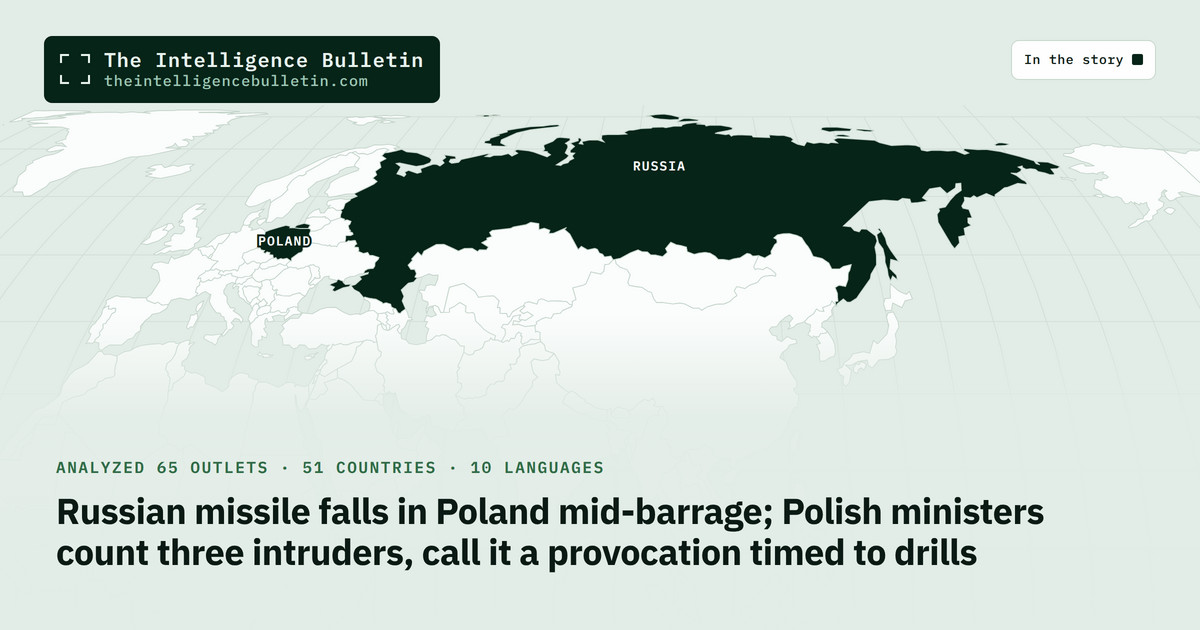
A Russian Kh-101 came down 50–60 km inside Poland on November 20 during Russia’s barrage on Ukraine, with no injuries reported. Polish leaders call it a deliberate provocation tied to allied drills; Moscow has not commented, and Poland’s defense minister says three objects crossed.
Across the press: AP’s wire dispatch describes one Kh-101 missile; Polityka, quoting Poland’s defense minister, reports two probable missiles and a jet drone found burning.
Source base: 2 outlets read in full (Poland, United States), selected from 65 analyzed.
- 1 of 2 · Polityka onlyThree objects violated Polish airspace at three sites in Bilgoraj county and nearby: two probable Russian missiles, including the Kh-101, and a jet drone that was found burning at Nowy Lipowiec.Polityka, citing Interior Minister Kierwinski, Defense Minister Kosiniak-Kamysz and Lublin crisis-management services
- 1 of 2 · The Durango Herald onlyRussia fired more than 400 drones and over 110 missiles at Ukraine overnight, killing at least eight civilians, six of them in Kyiv, hours after Putin vowed to retaliate for the Kerch bridge strikes.AP, citing President Zelenskyy and Ukrainian officials; Polityka quotes Kosiniak-Kamysz calling it one of the largest and most brutal attacks of the war but gives no figures.
- 1 of 2 · The Durango Herald onlyNATO Secretary-General Mark Rutte called the missile landing a ‘grave violation’ of Polish airspace and was expected to visit Poland that weekend.AP, citing Rutte’s post on X
- 2 of 2 · reported separatelyA Russian Kh-101 cruise missile came down in southeastern Poland on Friday, November 20, during Russia’s overnight barrage on Ukraine, roughly 50 to 60 km from the Ukrainian border, with no injuries reported.Polityka quotes Defense Minister Kosiniak-Kamysz saying about 50 km; AP cites the Polish Defense Ministry saying about 60 km.
- 2 of 2 · reported separatelyPolish leaders called the incident a deliberate Russian provocation linked to the European military exercises then under way in Poland.AP quotes Prime Minister Tusk (‘an intentional provocation’); Polityka quotes Defense Minister Kosiniak-Kamysz (‘another provocation of the Russian Federation’), tying it to the coalition-of-the-willing maneuvers.
- AnsweredAP reports that hours after Putin’s vow Russia fired more than 400 drones and over 110 missiles, killing at least eight and hitting Kyiv bridges and power plants, and calls it consistent with Moscow’s heavy responses to Ukrainian strikes such as those on the Kerch Bridge; neither source says whether the earlier 98-drone barrage was part of the response, and Russia’s Defense Ministry described only military targets.
- Still openDid rail traffic resume at 1300 GMT on November 19 as Aksyonov said, and did the Neptune strike damage the rail span itself or only the track? · Was the partial halt to strikes at sea and on energy facilities, which Putin says is now off, an American proposal, and has Washington said anything about losing it?
- 20 Nov · Putin says Crimea bridge strikes end talk of a sea-and-energy truce, vowing a far more painful response
- 17 Nov · Russia hits Kyiv s North and South bridges after Crimean strike; Kyiv officials report damaged heating mains, not collapse
- 19 Nov · As Berlin allies plan Ukraine s postwar force, Putin invites Europeans to Moscow but rules out Europe-Ukraine military ties
Full analysis
What happened Why it matters How each country tells it Room for disagreement Our assessment Sources and evidence
What happened
A Russian Kh-101 cruise missile came down in a wooded area of southeastern Poland early on Friday, November 20, while Russia was striking Ukraine, including its western regions, in one of the heaviest overnight attacks of the war. No injuries were reported. That settles the first question about the incident: it was not a separate event but part of the same night’s barrage, which the Associated Press reports came hours after Vladimir Putin vowed to retaliate for Ukraine’s strikes on the Kerch Strait bridge to Crimea.
This account rests on two newsrooms. One is an AP dispatch filed from Kyiv, Lisbon and Geneva, which the Durango Herald in Colorado ran as received, under AP’s headline leading with the provocation charge and the drills. The other is the Polish weekly Polityka, which built its own account from ministers’ posts, a defense ministry press conference, regional crisis services and prosecutors, under a headline leading with the alarms and the count: "Two missiles, one jet drone." For what happened on Polish soil, both draw on the same well, Polish officialdom. Neither carries a Russian account; AP reports no immediate comment from Moscow, and no Russian outlet is in this set.
Polityka reports that the military flagged a suspected airspace violation around 6:30 a.m. and that the tally settled at three. Interior Minister Marcin Kierwiński said services were working at Rudnik nad Sanem, Mołodycz and Nowy Lipowiec. Defense Minister Władysław Kosiniak-Kamysz said Russian missiles most likely fell at two of those sites, one of them the Kh-101, and that the third object was a jet drone; police and firefighters found it burning at Nowy Lipowiec. He placed the Kh-101 about 50 km from the border and said it spent "several dozen seconds" over Polish territory. AP, citing the Polish Defense Ministry, puts it about 60 km in. Polish F-16s and Swedish Gripens patrolled the sky.
Those seconds rippled across two provinces. The Government Security Centre sent alerts telling residents of Lubelskie and Podkarpackie to seek shelter, sirens sounded in Lublin, and Rzeszów airport halted operations. Infrastructure Minister Dariusz Klimczak said Poland’s air navigation agency evacuated the Rzeszów-Jasionka control tower for the first time. Trains stopped between Nisko, Rudnik nad Sanem and Łętownia after the Rudnik dispatcher heard a blast, and all rail traffic in Podkarpackie was halted until 7:33, when the alert was lifted. A second alert just after 9 a.m. raised air-defense readiness and was lifted at 9:47. Lublin prosecutors opened an investigation in Biłgoraj county, saying they were still establishing the number and nature of the objects.
The charge of intent came from the top. AP quotes Prime Minister Donald Tusk: "we are dealing with an intentional provocation." It notes the site lay about 75 km from where thousands of European troops were holding an unprecedented exercise for a possible postwar mission in Ukraine. Polityka carries Tusk only reassuring Poles the danger had passed; its provocation line belongs to Kosiniak-Kamysz, who called it "another provocation of the Russian Federation," tied it to the coalition-of-the-willing maneuvers, and said he would ask NATO commanders for more forces under Operation Eastern Sentry.
AP supplies the wider night. Volodymyr Zelenskyy said Russia fired more than 400 drones and over 110 missiles, 27 of them ballistic, killing at least eight civilians, six in Kyiv. Russia’s Defense Ministry said it hit missile and drone assembly plants, a rocket-fuel component plant and bridges carrying military cargo. Deputy Energy Minister Artem Nekrasov said grid strikes forced Ukraine’s three operating nuclear plants to cut output, with emergency outages in 11 regions. NATO Secretary-General Mark Rutte called the landing a "grave violation" and is expected in Poland this weekend; Britain’s Andy Burnham called it "utterly unacceptable."
Why it matters
The drills are what turn a crash into a message. Putin has said, AP reports, that European troops deployed to Ukraine after a peace deal would be legitimate targets. By tying the missile to an exercise rehearsing exactly that deployment, Warsaw reads the incident as Moscow’s answer to the coalition TIB reported meeting in Berlin on November 19. It lands as Washington presses its mediation: Jared Kushner told Europeans Russia is "comfortable" with NATO-like guarantees, while Deputy Foreign Minister Sergei Ryabkov said Moscow’s invitation to French, German and British officials does not mean accepting them at the table.
The count matters too. A single stray missile is an accident of proximity; two missiles and a drone across three sites in one morning is a recurring exposure. A reader of the AP text alone meets one missile. Polityka’s local detail shows the cost: a frontline-adjacent province stopping trains and emptying a control tower for an object that was gone in under a minute.
How each country tells it
- Polityka · Poland · original reportingReports the incident as three separate airspace violations at Rudnik nad Sanem, Molodycz and Nowy Lipowiec: two probable Russian missiles, including a Kh-101, and a jet drone found burning. It details the domestic disruption, including shelter alerts in Lublin and Podkarpackie, sirens in Lublin, rail stoppages and the first-ever evacuation of the Rzeszow-Jasionka control tower.
- The Durango Herald · United States · wire copyPlaces one Russian Kh-101 landing about 60 km inside Poland within the night’s barrage on Ukraine: more than 400 drones and 110 missiles, at least eight dead, Kyiv bridges and power plants hit. It quotes Tusk calling it an ‘intentional provocation’ timed to European drills for a postwar Ukraine mission.
Room for disagreement
The strongest case against the provocation reading comes from NATO’s own chief. Rutte called the incident "a consequence of Russia’s ongoing war against Ukraine," language that describes spillover, not targeting. The evidence fits that: the barrage was announced as revenge for Kerch before it reached Poland, Russia was hitting western Ukraine at the time, the Kh-101 crossed briefly and fell 75 km from the drill area. Kosiniak-Kamysz himself said the missiles "most likely" fell, and prosecutors had not fixed what the objects were. On this record, intent is an inference drawn from timing.
Our assessment
NATO is likely to answer with more air-defense assets for Poland under Eastern Sentry rather than any step that widens the confrontation. The warrant is on the record: Kosiniak-Kamysz’s stated request, Rutte’s "grave violation" and planned visit, and condemnations from London, Berlin and the European Council. Warsaw has an interest in the provocation framing because it strengthens the case for reinforcement; Kyiv, through Foreign Minister Andrii Sybiha, presents it as a threat to "the whole of Europe"; Moscow, silent, leaves others to define it. The deliberate-targeting claim will probably stay contested, because nothing published shows aim.
What would change this: Polish prosecutors finding that the missiles flew a course pointing at the exercise area, or Russia claiming the strike, would move this from reinforcement toward escalation.
Sources and evidence
Press quoted
- Did Polish radar records, which Polityka says the military is still checking, show the Kh-101 and the jet drone flying at Polish targets, or straying from strikes on western Ukraine, the question on which the ‘intentional provocation’ charge rests?
- What was the second object Polish officials believe was a missile, and have investigators confirmed its type and where it came down?
- Has Moscow said anything about the objects that came down in Poland, and will NATO grant Kosiniak-Kamysz’s request to add forces to Eastern Sentry?
That’s how the world told the story.
Get our daily open-source intelligence on world events in your inbox — one email a day, up to six stories.
Subscribe freeNo spam. One-click unsubscribe. See the latest email →