 AI-generated analysis published under the editorial responsibility of Rohit Sinnas. How it works →
See the 60 countries
Afghanistan, Albania, Australia, Azerbaijan, Bahamas, Bangladesh, Belgium, Benin, Brazil, Bulgaria, China, Croatia, Egypt, Fiji, Germany, Ghana, Greece, Guyana, Haiti, Hungary, India, Indonesia, Iran, Iraq, Ireland, Israel, Italy, Kuwait, Latvia, Lebanon, Namibia, New Zealand, Nigeria, Norway, Pakistan, Papua New Guinea, Philippines, Poland, Portugal, Qatar, Romania, Russia, Saudi Arabia, Serbia, Singapore, South Africa, South Korea, Spain, Sweden, Syria, Taiwan, Trinidad and Tobago, Turkey, Tuvalu, Ukraine, United Arab Emirates, United Kingdom, United States, Uzbekistan, Vietnam
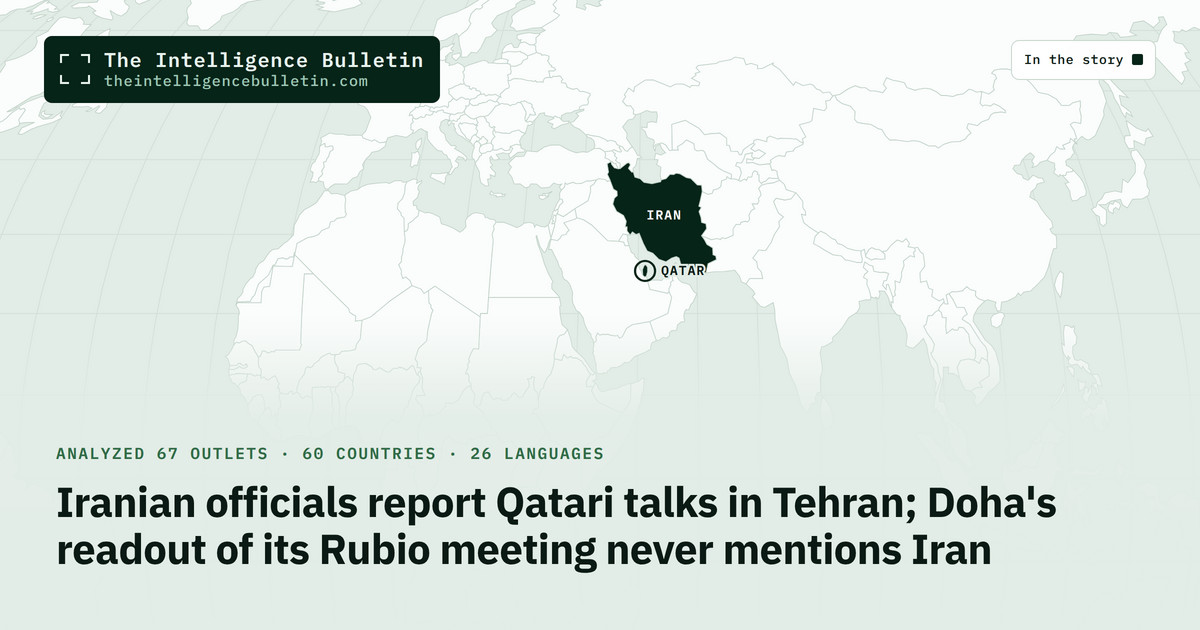
Qatar’s prime minister met Rubio in Washington on November 23. An Iranian deputy foreign minister says a Qatari delegation held two hours of talks in Tehran. Doha’s readout never names Iran, and Trump says he leans toward strikes after the new year absent a deal.
Across the press: Qatar’s own readout of the Rubio dialogue lists AI and critical minerals and never names Iran; the Tehran talks came to light through an Iranian deputy minister.
Source base: 5 outlets quoted (Qatar, United States, Iraq, Lebanon), selected from 67 analyzed. 3 read in full, 2 by their headlines only.
- 1 of 5 · Naharnet onlyA Qatari delegation held two hours of talks in Tehran the evening before Gharibabadi spoke, and he gave no details of their content.Naharnet, carrying AFP, citing Iranian deputy foreign minister Kazem Gharibabadi as quoted by Tasnim.
- 1 of 5 · Yeshiva World News onlyIran was expected to hand Qatar a revised version of its seven conditions for talks on Monday, and was still waiting for a US answer to its proposal to reopen the Strait of Hormuz within two days.Yeshiva World News, citing Iranian media, which cited Arab diplomatic sources.
- 1 of 5 · Yeshiva World News onlyTrump said on Sunday he was leaning toward renewing strikes on Iran after the new year if no deal is reached. Washington has put off any strike by at least a week despite pressure from Netanyahu.Yeshiva World News, on Trump’s remarks and citing Ynet, which cited unnamed US administration officials, on the delay.
- 1 of 5 · The Peninsula onlyQatar and the United States signed an artificial-intelligence acceleration partnership and a memorandum of understanding on critical-minerals processing during the dialogue.The Peninsula, carrying the Qatari government account.
- 3 of 5 · reported separatelyQatar’s prime minister and foreign minister, Sheikh Mohammed bin Abdulrahman Al-Thani, met Secretary of State Marco Rubio in Washington on Monday, November 23.The Peninsula, carrying the Qatari government account; Yeshiva World News, citing a State Department announcement of the meeting; WMAL headline.
- Around November 30The strike postponement of at least a week that Ynet reported runs out, testing whether the Qatari channel has bought more time.
- When Washington repliesA US answer to Iran’s proposal to reopen the Strait of Hormuz within two days would show whether the channel carries American terms as well as Iranian ones.
- If the revised conditions surfacePublication of Iran’s revised seven conditions would show whether Tehran moved or only reworded its terms.
- After January 1, 2027Trump’s stated horizon for renewing strikes if no deal is reached.
- Still openWhat are Iran s seven conditions for reopening Hormuz, and which US commitments beyond lifting recently imposed sanctions does day one require? · Was Trump s not acceptable to me aimed at the two-day Hormuz plan, at Iran s insistence on keeping enriched uranium at home, or at both?
Full analysis
What happened Why it matters How each country tells it Room for disagreement Our assessment Sources and evidence
What happened
On Monday, November 23, Qatar’s prime minister and foreign minister, Sheikh Mohammed bin Abdulrahman Al-Thani, sat down with Secretary of State Marco Rubio in Washington. The two co-chaired the eighth Qatar-US Strategic Dialogue. Qatar’s government published an account of the meeting, carried by The Peninsula. It lists the signing of an artificial-intelligence acceleration partnership and a memorandum of understanding on critical-minerals processing, along with talks on Latin America, the two countries’ defense partnership and "the importance of freedom of maritime navigation." Iran is not named anywhere in it. The nearest reference is a single sentence saying the dialogue addressed "ongoing diplomatic efforts and joint coordination to de-escalate tensions and promote security and stability in the region."
The readout lists both delegations in full. Doha brought Minister of State Mohammed bin Abdulaziz Al Khulaifi and its ambassador, Sheikh Meshal bin Hamad Al-Thani. The American side was State Department staff, among them Counselor Dan Holler and Assistant Secretary for Near Eastern Affairs Donald Blome. None of the reporting we could read places Vice President JD Vance at the table. None of it carries a US account of what was said about Iran, either. The State Department appears only through Yeshiva World News, which notes that it announced the meeting in advance.
The Iranian end of Qatar’s effort is visible only through Iranian voices. AFP, in copy carried by Naharnet, quotes Iran’s deputy foreign minister, Kazem Gharibabadi, speaking to the Tasnim agency: "A Qatari delegation went to Tehran last night, and we held two hours of discussions." He gave no details of what was discussed and did not say whether the delegation was still in the city. He did send a message through the channel: "We consider the economic blockade an act of war and we will take all necessary measures to lift it," adding that Iran had "made this known to the other parties, including the mediators."
Yeshiva World News adds detail it attributes to Iranian media, which in turn cited Arab diplomatic sources. On the day of the Rubio meeting, Iran was expected to hand Qatar a revised version of its seven conditions for talks. Tehran was also still waiting for an American answer to its proposal to reopen the Strait of Hormuz within two days. The same day, Abbas Goudarzi, spokesman for the Iranian parliament’s presidium, said Tehran insists on all seven conditions and that "the U.S. only understands the language of force." TIB reported on November 21 that Foreign Minister Abbas Araghchi had called the timing of those conditions negotiable while treating enriched uranium as a red line. Trump called Iran’s terms unacceptable. In that same interview, carried by AFP, Araghchi said: "I believe a solution can be found, but we have clear red lines: the material will not be taken out of the country."
On the American side, Yeshiva World News reports that Trump said on Sunday he was leaning toward renewing strikes after the new year if no deal is reached. Citing Ynet, which cited unnamed administration officials, it also reports that Washington has put off any strike by at least a week. Ynet’s officials say that decision came despite pressure from Prime Minister Netanyahu for joint action.
The war itself, by AFP’s account, began with US-Israeli strikes in late February. Negotiations have since stalled. The Strait of Hormuz is now its center: before the war it carried a fifth of the world’s oil. Iran is trying to blockade the strait, and the United States counter-blockades Iranian ports and escorts ships through. In August, Washington added what it called an "economic asphyxiation" campaign. Iranian lawmaker Abolfazl Abutorabi claims Iran attacks about ten tankers a day that defy its restrictions. TIB reported on November 22 on Revolutionary Guards strikes on Bahrain. Yeshiva World News reports that Qatar, the UAE and Saudi Arabia condemned those attacks. The Iraqi daily Al Mada headlined the Qatari prime minister warning from Washington that the Middle East cannot bear a new escalation. Only that headline was available to us, so we cannot say what words he actually used.
Why it matters
This is the first diplomatic track to show up in a war TIB has so far covered through its strikes. What the reporting shows is how it works. Qatar carries papers in both directions and says almost nothing in public about doing so. The channel already holds two things that cut against each other: a revised set of Iranian conditions, and Gharibabadi’s statement that the US blockade counts as an act of war. A mediator handed both a negotiating text and a threat is managing a crisis, not hosting a negotiation.
Qatar’s double position raises the stakes for Doha in particular. In the same days it received Iranian conditions, it signed a condemnation of Iranian strikes on a Gulf neighbor. And it chose to fill its own Washington readout with AI and minerals deals rather than Iran. That fits a mediator protecting its standing with both sides. It also means the public record of the Washington leg comes almost entirely from Tehran’s side and from Israeli-sourced reporting. For a reader trying to judge whether Washington is engaging, the missing piece is an American account of the meeting. No report we read supplies one.
The timing compounds this. A strike delay of at least a week, set against Trump’s post-New Year horizon, gives the channel a window of days to weeks. Hormuz’s share of world oil means the outcome reaches well beyond the parties.
How each country tells it
- The Peninsula · Qatar · wire copyReports the Rubio meeting as the eighth Qatar-US Strategic Dialogue, co-chaired by Sheikh Mohammed bin Abdulrahman Al-Thani and Rubio. It lists an artificial-intelligence acceleration partnership, a critical-minerals memorandum, Latin America, defense ties and freedom of maritime navigation.
- WMAL · United States · original reportingIts headline says only that Rubio met the Qatari prime minister, with no mention of Iran or talks.
- Yeshiva World News · United States · carries YnetLeads with Iranian media reports, citing Arab diplomatic sources, that Tehran would hand Qatar a revised version of its seven conditions on the day of the Rubio meeting. It adds Trump’s threat to resume strikes after the new year and Ynet’s report that a strike was put off by at least a week despite pressure from Netanyahu.
- Al Mada · Iraq · original reportingIts headline puts the Qatari prime minister’s warning, delivered from Washington, that the Middle East cannot bear a new escalation.
- Naharnet · Lebanon · wire copyReports Iranian deputy foreign minister Kazem Gharibabadi, via Tasnim, saying a Qatari delegation held two hours of talks in Tehran. It also carries his statement that Iran considers the US economic blockade an act of war and has told the mediators so.
Room for disagreement
The strongest case for real movement comes from Iran’s own words. Araghchi says "a solution can be found" and calls the timing of the conditions negotiable. Sending a revised version of the conditions, if the Arab diplomats cited by Iranian media are right, suggests Tehran is adjusting its terms, not just repeating them. Washington’s reported decision to delay a strike, despite Netanyahu’s pressure, reads as giving the channel room. Qatar’s silence may be ordinary mediator discretion rather than distance from the effort. Mediators who announce what they carry tend to lose access. On this reading, the AI and minerals agreements were the public cover for a private conversation.
Our assessment
It is unlikely that the Qatari channel produces a US-Iran agreement before Trump’s post-New Year horizon. The channel’s existence is well supported. A Qatar-Rubio meeting is reported independently by Qatar’s government and by US outlets, and Gharibabadi is on record about the Tehran talks. But nothing in the reporting shows either side’s terms moving. Goudarzi insists on all seven conditions. Araghchi keeps uranium inside Iran. Trump has rejected Iran’s terms and set his own deadline. The detail suggesting flexibility, the revised conditions, rests on Iranian media citing unnamed Arab diplomats. Tehran has an interest in appearing to engage. The Ynet account of a delayed strike comes from unnamed US officials whose government gains from looking patient. Doha’s readout, the one primary document, commits to nothing.
What would change this: a public American reply to Iran’s two-day Hormuz proposal, or a US account acknowledging the Qatari channel, would make an agreement substantially more likely.
Sources and evidence
Press quoted
- What do Iran’s revised seven conditions say, and did Qatar’s prime minister bring them to Rubio in Washington?
- Has Washington answered Iran’s proposal to reopen the Strait of Hormuz within two days, or is the delay of at least a week in a US strike tied to that answer?
- Does the State Department’s own readout of the dialogue name Iran, given that Qatar’s account does not?
That’s how the world told the story.
Get our daily open-source intelligence on world events in your inbox — one email a day, up to six stories.
Subscribe freeNo spam. One-click unsubscribe. See the latest email →