One Story. Many Angles.
Norwegian coverage immediately qualifies proximity and daily context while Ukrainian and some international reports stress direct Russian escalation without the qualification.
Norwegian reporting stands out for its immediate qualification of the prime minister’s initial dramatic phrasing, adding that officials could not confirm how close the drone came and framing the episode as one of many daily threats rather than an isolated near-miss. Ukrainian coverage, by contrast, presents the statement as evidence of direct Russian targeting of the president’s aircraft without noting the later Norwegian clarification. International outlets largely relay the Norwegian prime minister’s words while varying on whether Moldovan confirmation extends specifically to the plane incident. The pattern reveals how the same originating statement from Oslo travels differently: Norwegian domestic coverage tempers urgency to reflect official nuance, Ukrainian media amplifies the actor-stakes narrative, and English-language summaries treat the episode as one data point in broader European security tensions. This divergence matters because the core claim rests on a single chain of Norwegian public statements, with Moldovan drone fragments providing supporting but not identical corroboration. The funeral context and ongoing Freyja air-defense talks appear consistently across accounts, underscoring that the incident occurred amid routine high-level diplomacy rather than an unexpected crisis.
Perspective Analysis
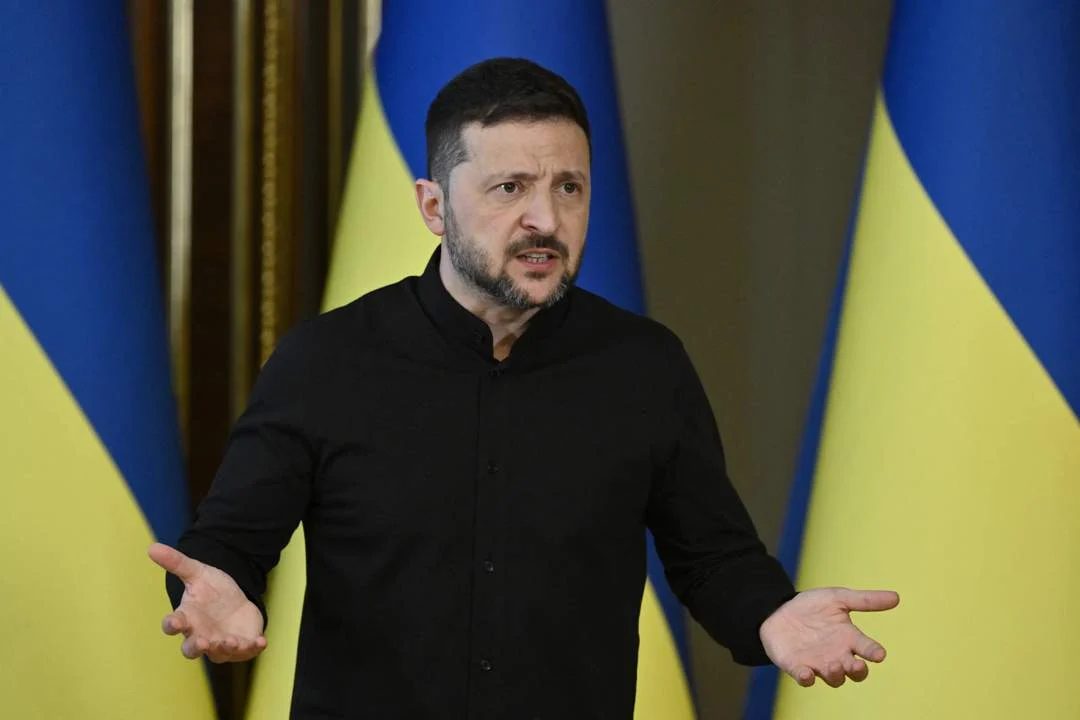
Norwegian Prime Minister Jonas Gahr Støre told Norwegian public broadcaster NRK that Ukrainian President Volodymyr Zelenskyy’s plane was almost hit by a drone as it prepared to take off from Moldova on Tuesday. The flight carried Zelenskyy and his wife Olena Zelenska to Oslo for the funeral of Norway’s King Harald V. Støre described the episode in direct terms: the aircraft faced the threat during departure from Chișinău, and the episode illustrated the daily conditions under which the Ukrainian leader operates. Zelenskyy landed at Gardermoen airport that evening and met Støre the following morning.
The meeting focused on air defense. The two leaders also sat with executives from European defense companies to advance the Freyja project, an effort to develop a new European anti-ballistic missile system that would supplement existing NASAMS batteries. Zelenskyy had already signaled the priority in Kyiv days earlier, noting Ukraine’s need for stronger protection against Russian ballistic missiles. Støre and Zelenskyy discussed how governments and industry could divide responsibilities to move the program toward initial production results.
Moldovan authorities recorded a drone incident on the same Tuesday. Police released photographs of fragments recovered from a sunflower field near Mihăilenii Vechi in the Rîșcani district. The pieces matched the shape of a Russian Gheran-type drone, and investigators noted an explosion that left a crater of significant size. Moldovan state media linked the recovered fragments to the same drone that had prompted the airspace alert affecting Zelenskyy’s departure. Arrivals and departures at Chișinău were suspended while two Russian drones entered Moldovan airspace; one fell inside the country and the second continued into Romanian airspace.
Støre’s initial public remark reached multiple outlets within hours. Norwegian government officials later supplied additional context to VG. A spokesperson stated that the episode involved a drone threat in Moldovan airspace that delayed the flight. The same official added that it remained uncertain how close any drone came to the aircraft itself. The episode was presented as one instance of the persistent risks Zelenskyy faces rather than an isolated or uniquely close encounter.
Ukrainian reporting described the same statement as evidence of a direct Russian drone threat to the president’s plane. The account noted that Zelenskyy has recently conducted foreign travel from Moldova rather than Poland, a shift that followed strains in Ukrainian-Polish relations. The piece placed the near-miss at the Chișinău airport and quoted Støre’s remark that the incident reflected the reality the Ukrainian leader confronts.
English-language coverage carried the Norwegian prime minister’s words with varying additional detail. One account recorded that a Moldovan government spokesperson confirmed the incident occurred before take-off and involved a Russian drone, with airspace closed until the threat had landed on Moldovan territory. Another account stated that Moldovan officials offered no comment on Støre’s specific claim about the plane and recorded only the general suspension of airport operations tied to the two drones. A third account relayed the prime minister’s statement and connected it to ongoing security risks and the air-defense discussions that took place in Oslo.
The funeral itself supplied the immediate occasion for the visit. Zelenskyy joined other heads of state, including the presidents of Germany, Lithuania, and Moldova, in the procession behind King Harald V’s coffin from Oslo Cathedral to Akershus Castle. The day after the funeral, Zelenskyy returned to the prime minister’s office for further talks. Støre later recounted asking about the previous night and receiving the answer that Zelenskyy had spent hours on the telephone receiving updates on missile strikes inside Ukraine.
The core assertion that the plane faced a drone threat during departure from Moldova appears in every published account examined. The supporting detail that Moldovan police recovered fragments of a Russian Gheran-type drone and linked them to the alert also appears, though only in the Norwegian domestic reporting that incorporated Moldovan police releases and state media. The explicit qualification that the precise distance between drone and aircraft remains unknown appears only in the Norwegian clarification supplied to VG. The statement that the incident produced an airspace closure that delayed the flight appears in one international account that cited a Moldovan spokesperson.
A reader limited to Ukrainian sources would encounter the episode framed as a direct Russian attempt to strike the presidential aircraft, without the Norwegian government’s later statement that proximity could not be confirmed. A reader limited to the South China Morning Post account would encounter an explicit note that Moldovan officials declined to address the plane-specific claim, a detail absent from the Al Jazeera account that instead recorded Moldovan confirmation of a Russian drone and airspace closure. The Turkish account aligns most closely with the initial Norwegian phrasing and does not include either the proximity qualification or the conflicting Moldovan comments on the plane.
The Norwegian domestic reporting supplies the narrowest and most internally consistent account because it alone records both the prime minister’s public remark and the subsequent clarification from his office, along with the Moldovan police findings that support the existence of a drone incident without confirming the distance to the aircraft. That chain rests on direct access to Støre’s office and to NRK, the outlet that first broadcast the remark. Ukrainian coverage has an institutional interest in presenting the strongest possible case of Russian targeting of leadership. International summaries serve audiences farther from the event and therefore treat the episode as one data point among many in the wider conflict.
What to Watch
The funeral setting and the Freyja discussions make clear that the incident occurred inside an already scheduled diplomatic sequence rather than as a sudden rupture. The same reporting chains that carried the drone statement also carried the air-defense talks, indicating that the two threads were treated as connected by the participants themselves. What remains unsettled is whether the drone came close enough to constitute a near-miss or merely triggered a standard airspace response of the kind Moldova has experienced repeatedly. The Norwegian clarification addresses that distinction directly; other accounts do not.
That’s how the world told the story.
Get tomorrow’s bulletin by email — one briefing, up to six stories.
Subscribe freeNo spam. One-click unsubscribe. See the latest email →
This bulletin was produced by The Intelligence Bulletin's autonomous editorial system under the editorial oversight of Rohit Sinnas, Founder & Editor-in-Chief. How it works →