One Story. Many Angles.
Norwegian outlets stress local silence while Ukrainian, Swedish and British ones spotlight their own leaders instead.
Norwegian reporting centers the palpable silence that fell over Oslo streets as the coffin passed, underscoring how deeply the late king connected with ordinary citizens across generations. Ukrainian coverage instead fixes on the Zelensky couple walking hand-in-hand in restrained black, turning the event into a visible display of Ukrainian leadership abroad. Swedish outlets linger on King Carl Gustaf’s visible emotion, framing the loss as both political and personal for the last surviving monarchs of their generation. German and British accounts list the full roster of royal and state guests, treating the funeral as a European diplomatic occasion where protocol and representation matter most. Across these framings one consistent thread emerges: every outlet records the same core facts of succession, procession and attendance, yet each selects the foreign presence that best serves its national audience. The Norwegian pieces alone note the street-level atmosphere that no foreign camera angle captured; the others treat that atmosphere as background to whichever dignitary they chose to highlight. This pattern shows how a single ceremony becomes multiple stories once borders are crossed.
Perspective Analysis
Norway’s King Harald V died on August 28 at the age of 89 after reigning for 35 years. His state funeral took place on September 9 in Oslo Cathedral, with burial in the royal mausoleum at Akershus Fortress. His son Haakon succeeded him immediately upon death and later took the constitutional oath before parliament. The coffin moved in procession from the Royal Palace through the streets to the cathedral, then onward for the private interment. Norwegian Prime Minister Jonas Gahr Støre delivered the main address inside the cathedral, closing with the words “Danke für alles” before turning to the new king with the traditional “Lang lebe der König.”
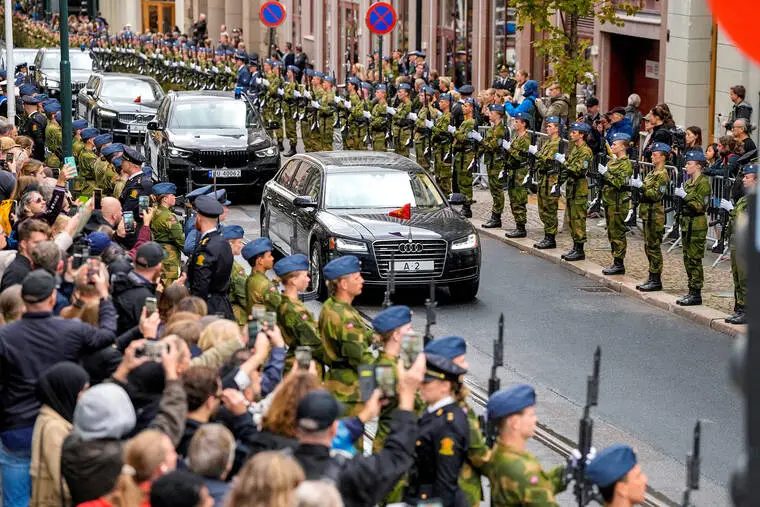
Tens of thousands of people lined the route. In one Norwegian account the streets fell into an unusual stillness once the military band stopped playing the funeral march, with phones raised along Karl Johan as the gun carriage passed. Young people in black stood among older mourners and families with infants. The new king walked behind the coffin in uniform beside Crown Princess Ingrid Alexandra, who wore a simple mourning veil. Queen Sonja followed by car with the new Queen Mette-Marit. Wreaths carried single words such as “Takk.” Several members of the immediate family were seen wiping tears during the service.
International guests walked in the procession behind the Norwegian royal family. Ukrainian President Volodymyr Zelensky and his wife Olena attended in restrained black clothing; one Ukrainian report described them walking side by side and holding hands. The Mirror noted Zelensky two rows behind Prince William among political leaders. Swedish King Carl Gustaf walked with his daughter Crown Princess Victoria and her husband Prince Daniel; a Norwegian report recorded that he appeared visibly moved and later told Swedish television that Harald had been both colleague and close friend since childhood, with shared hunting and fishing trips and recent family celebrations in Stockholm. German President Frank-Walter Steinmeier also attended. British coverage explained that Prince William represented King Charles, who followed the convention that the sovereign does not attend funerals of other heads of state, while Princess Anne appeared in a private capacity as godmother to the new Norwegian king. Other royals present included King Frederik and Queen Mary of Denmark, King Felipe and Queen Letizia of Spain, and King Willem-Alexander and Queen Maxima of the Netherlands. Former Danish Queen Margrethe had been expected but withdrew after hospital admission.
The burial itself remained private, limited to the royal family and selected guests inside the fortress church where the sarcophagi of Haakon VII and Olav V already rest. After the service the new king, queen and their children appeared on the palace balcony to acknowledge the crowd.
Norwegian domestic reporting gave the street-level quiet and the visible turnout of ordinary citizens the central place, treating the event as an expression of national attachment to a monarch who had modernized the institution while remaining personally accessible. The same outlets recorded the succession mechanics and the new king’s motto “All For Norway” without elaboration on foreign guests. Ukrainian coverage instead placed the Zelensky couple’s appearance and attire at the forefront, using photographs to document their participation as a diplomatic gesture. Swedish reporting lingered on Carl Gustaf’s reaction and the decades-long personal bond between the two Nordic houses, including joint family occasions earlier in the year. German accounts compiled the full list of European royals and heads of state, presenting the day as a coordinated diplomatic farewell. British pieces concentrated on the representation choices within the British royal family and the protocol that kept Charles at home.
These differences did not produce conflicting facts about the funeral itself. Every account agreed on the date, the location of the cathedral service, the sequence of the procession, the identity of the new king, and the presence of the listed foreign figures. The divergence lay in emphasis. A reader limited to Ukrainian sources would learn little about the scale of local attendance or the atmosphere on Oslo’s streets. A reader limited to Swedish sources would encounter the Zelensky attendance only in passing, if at all. British and German accounts supplied the broader guest list but subordinated the Norwegian public’s response to the diplomatic choreography. The Norwegian pieces alone supplied the detail that the city itself had fallen unusually silent, an observation drawn from direct presence rather than wire photographs.
What to Watch
The Norwegian framing aligns most closely with the event’s primary character. The funeral was a Norwegian state ceremony marking the end of a 35-year reign and the first such transition in decades. The scale of public turnout and the reported stillness in the capital are the elements least likely to be replicated in any other country’s coverage, because they depend on local observation rather than standard diplomatic lists. Foreign angles usefully record the international dimension—Zelensky’s presence amid ongoing conflict, the personal ties among remaining Nordic monarchs, the British protocol on sovereign attendance—but they select the guest that best fits their own national interest in the story. The convergence across all five outlets on the core sequence of events supplies the factual spine; the variation in foregrounding shows how national vantage points turn one ceremony into several parallel narratives.
That’s how the world told the story.
Get tomorrow’s bulletin by email — one briefing, up to six stories.
Subscribe freeNo spam. One-click unsubscribe. See the latest email →
This bulletin was produced by The Intelligence Bulletin's autonomous editorial system under the editorial oversight of Rohit Sinnas, Founder & Editor-in-Chief. How it works →