 AI-generated analysis published under the editorial responsibility of Rohit Sinnas. How it works →
Press quoted
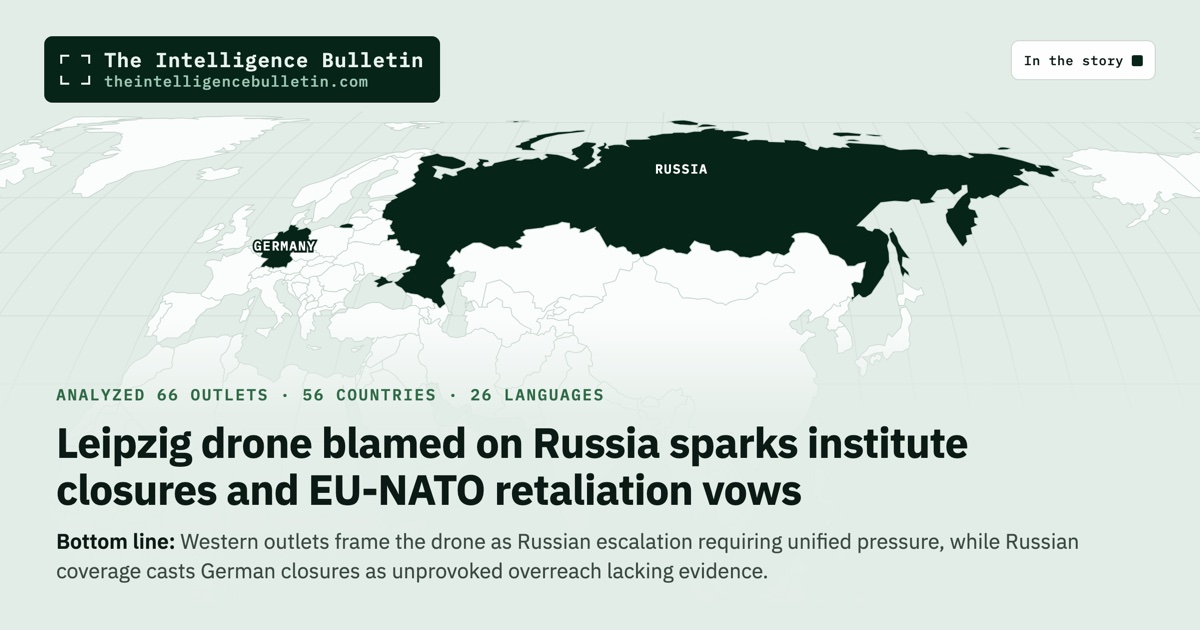
Western outlets frame the drone as Russian escalation requiring unified pressure, while Russian coverage casts German closures as unprovoked overreach lacking evidence.
The reporting across these outlets reveals a clear pattern of tit-for-tat retaliation framed through national lenses rather than a shared factual record. German and Austrian coverage centers the Leipzig incident as evidence of Russian hybrid aggression on NATO soil, with von der Leyen and Rutte using it to rally bloc unity and push for stronger defenses, while experts highlight alliance vulnerabilities. Russian state media instead spotlights a German opposition politician decrying Berlin’s closures as inexplicable and quotes Putin tying the accusations to German domestic politics, downplaying any Russian role. Ukrainian reporting explicitly connects the drone plot to Russia’s war effort and Ukraine logistics, treating the cultural closures as direct spillover. Al Jazeera presents the institute closures as mutual retaliation in a hybrid standoff without assigning primary blame. What stands out is the absence of any outlet bridging these accounts: Western sources treat Russian denials as expected deflection while Russian sources treat German evidence claims as unproven provocation, leaving readers in different countries with incompatible versions of who started the latest round and what it means for the wider conflict.
Full analysis
Germany attributed an explosive-laden drone discovered on August 4 at Leipzig/Halle airport to Russia, describing it as part of a pattern of hybrid operations. The device, a first-person-view quadcopter carrying a Semtex-like plastic explosive, was found in a secure cargo area near a Ukrainian Antonov An-124 transport plane loaded with munitions from France. German authorities reported that a Boeing cargo flight the next day struck a second unidentified object, possibly another drone, though that item was never recovered. Interior Minister Alexander Dobrindt cited police investigations, intelligence assessments, and the established pattern of similar incidents to assign responsibility to Moscow.
Russia rejected the accusation outright. President Vladimir Putin described the claims as fabricated evidence tied to Germany’s difficult domestic political situation. Russian officials, including the ambassador in Berlin, stated that no concrete proof—witness statements, material evidence, or expert analysis—had been provided, and they labeled the incident a hastily assembled provocation. Foreign Minister Sergey Lavrov responded by announcing that Russia would close the Goethe-Institut centers in Moscow, St. Petersburg, and Yekaterinburg, declaring that Germany had deliberately ended its own cultural presence in Russia by shuttering the Russian House in Berlin. Deputy Foreign Minister Alexander Grushko said further retaliatory steps would follow the closure of the Russian consulate in Bonn.
Germany’s measures went beyond the consulate and cultural center. Officials tightened entry rules for Russian citizens, expelled several diplomats, and signaled new sanctions targeting Russia’s military-industrial base and shadow fleet. Berlin summoned the Russian ambassador and framed the actions as necessary to deter further hybrid activity on European soil. The Leipzig airport serves as a major logistics point for military aid to Ukraine, a detail that Ukrainian reporting highlighted as direct context for the attempted sabotage.
European Union and NATO leaders treated the incident as a significant escalation. Commission President Ursula von der Leyen, speaking alongside NATO Secretary General Mark Rutte, called it a new stage of Russian activity on European territory and warned that intimidation would not succeed. EU foreign policy chief Kaja Kallas described the episode as bearing the hallmarks of state-sponsored terrorism and said member states would not allow an act of such gravity to go unpunished. Foreign ministers agreed to advance a sanctions package covering 1,600 individuals and entities linked to Russia’s military industry, with adoption expected by October. Rutte and von der Leyen stressed that infrastructure once considered routine must now be treated as frontline targets requiring enhanced protection.
Coverage of these events diverged sharply in emphasis. German reporting, including expert commentary carried by Merkur, stressed NATO’s lack of agreed thresholds for collective response and the depletion of key capabilities after years of supporting Ukraine and other conflicts. Analysts quoted there argued that Russia finds such sub-threshold operations attractive precisely because they erode alliance cohesion without triggering Article 5. Austrian public broadcaster ORF foregrounded the joint von der Leyen–Rutte statement and the expressions of solidarity from other EU capitals, presenting the episode as a test of European unity. Ukrainian outlets connected the drone directly to Russia’s ongoing war effort, noting the airport’s role in supplying Kyiv and treating the cultural-center closures as predictable retaliation against Western support for Ukraine.
Russian state media instead foregrounded criticism from German politician Sevim Dagdelen of the Bundestag, who called the consulate and Russian House closures inexplicable. Reports quoted Putin linking the accusations to Berlin’s internal politics and presented Moscow’s institute closures as a measured, reciprocal step. International coverage from Al Jazeera described the sequence as mutual retaliation in a hybrid standoff, quoting Lavrov’s warning that Germany must have understood the consequences of its decision and noting EU sanctions discussions without assigning primary fault.
These framings leave readers with incompatible accounts of motive and sequence. A German or Austrian reader encounters an unprovoked Russian probe against NATO territory that demands stronger collective defenses. A Russian reader sees German overreach driven by domestic weakness and lacking evidentiary foundation. Ukrainian coverage positions the episode as an extension of the battlefield into European logistics hubs. The single point of convergence across all five outlets is the factual sequence itself: Germany’s attribution, Russia’s denial and announced closures, and the EU-NATO pledge of additional sanctions. No independent reporting chain in the set bridges the attribution dispute; each side’s interpretation rests on its own national sources and strategic interests.
The corroborated elements—Germany’s public attribution citing its interior ministry and police, Russia’s explicit announcement of the Goethe-Institut closures, the EU and NATO leaders’ on-record commitments to intensified pressure, and Russia’s consistent denial—form the only uncontested spine. Western sources converge on treating the drone as Russian state action and the closures as warranted response, a position supported by four of the five outlets examined. Russian coverage consistently presents the opposite causal direction, yet that account appears in only one national chain within the set. Russia has a clear interest in portraying Western moves as the escalatory driver to justify its own hybrid activity and to weaken alliance resolve. Western governments have an interest in rallying domestic and allied support for continued Ukraine aid by framing hybrid incidents as part of a broader pattern requiring stronger deterrence.
What to Watch
Absent new public evidence from either side, the next phase will likely feature the sanctions package already in preparation and possible further reciprocal closures or restrictions. The episode tests whether European states can establish credible thresholds for response to sub-threshold attacks before such operations erode political cohesion or force a direct confrontation neither side has signaled it wants.
That’s how the world told the story.
Get our daily open-source intelligence on world events in your inbox — one email a day, up to six stories.
Subscribe freeNo spam. One-click unsubscribe. See the latest email →