 AI-generated analysis published under the editorial responsibility of Rohit Sinnas. How it works →
Press quoted
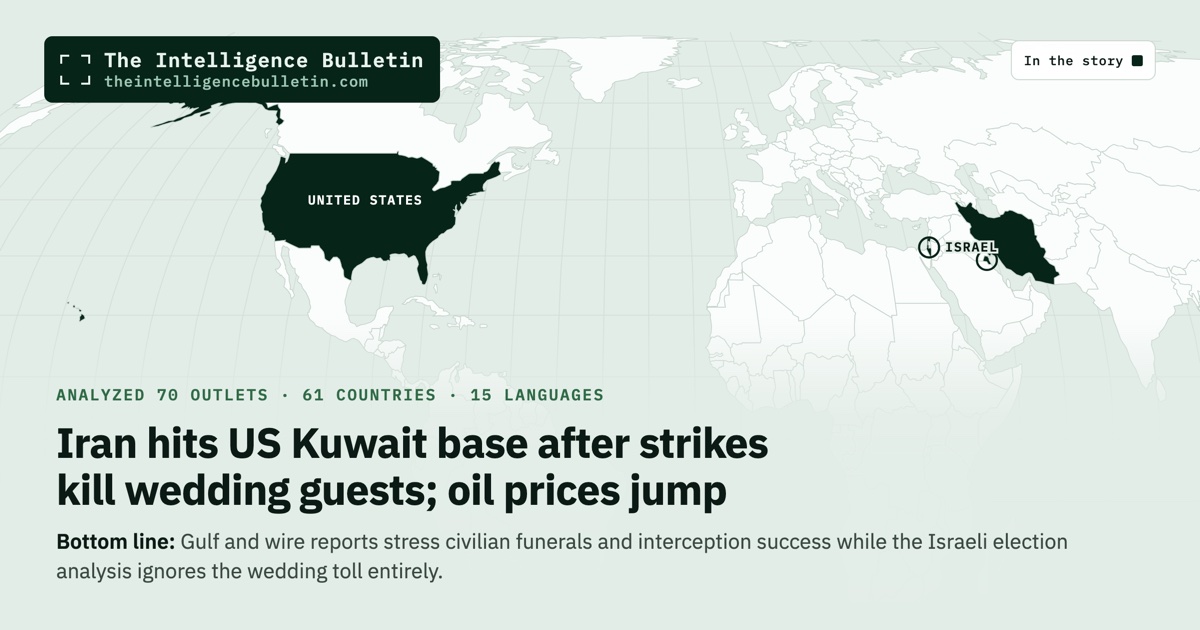
Gulf and wire reports stress civilian funerals and interception success while the Israeli election analysis ignores the wedding toll entirely.
The reporting converges on the core sequence—Iran struck back at a US facility in Kuwait after Washington hit Iranian sites including a wedding venue—but the outlets diverge most revealingly on how much weight to give civilian deaths versus military targets. Arab News and the AP wire both detail mourners burying victims in Kuhestak and quote Iranian claims of five dead, while noting US denials of targeting civilians; this civilian focus is almost absent from the Israeli election piece, which instead folds the Kuwait flare-up into arguments over Netanyahu’s Iran strategy. The German public broadcaster alone flags simultaneous strikes on bases in the Emirates and links the spike directly to European fuel prices, an angle no other source in the set develops. The exile opposition site frames everything inside a regime-resistance narrative but supplies no independent details on the Kuwait attack itself. These choices reveal that the story’s factual core travels intact across borders while each national lens decides whether the human cost or the strategic ripple matters more. No outlet contradicts the basic retaliation timeline, yet the selective omission of the wedding toll in the Israeli domestic analysis shows how quickly a shared event becomes domestic ammunition.
Full analysis
On September 3, 2026, Iran launched missiles and drones at a United States military base in Kuwait. Kuwait’s air defenses intercepted the incoming projectiles, according to statements from its Defence Ministry. The action followed US airstrikes two days earlier on Iranian coastal targets along the Strait of Hormuz, including one that struck a home in the southern village of Kuhestak during a wedding celebration. Iranian state media and local accounts reported four initial deaths from that strike, with a fifth victim, a 22-year-old woman, dying later in hospital. Mourners in Kuhestak carried flag-draped caskets through the streets, with families, soldiers and residents throwing petals as doleful music played. Iranian officials described the victims as civilians, including a four-year-old child.
The United States said its Tuesday strikes targeted military sites, including rocket launchers and maritime assets, after Iran had threatened to mine the Strait of Hormuz. Washington added that it never targets civilians. Iranian reports placed the total death toll from the latest US assault at 18, including the wedding victims. In response, Iran carried out further attacks early on Thursday, stating it was targeting another US base in Kuwait. Some Iranian statements also claimed strikes on US facilities in the Emirates, though this detail appeared in only one account among the sources examined.
Kuwait had already faced Iranian attacks the previous night, alongside Jordan and Bahrain. Air defenses in those countries likewise reported intercepts. The pattern marked the largest escalation in the Gulf theater in more than a month. Ship traffic through the Strait of Hormuz remained well below pre-war levels, with operators rerouting or reducing transits amid the risk. Oil prices responded immediately, with Brent crude futures climbing above $96 a barrel for the fourth straight day.
The sequence of retaliation rests on three independent reporting chains that converge on the same timeline. Arab News, drawing on Reuters, and CP24, carrying Associated Press copy, both recorded the Kuwait launch, the interception, the Kuhestak funeral details and the US denial of civilian targeting. Deutschlandfunk added that Iranian statements described attacks on bases in both Kuwait and the Emirates, while noting the resulting rise in European fuel prices. No source in the set disputes the basic order of events or the interception claim.
The accounts diverge sharply on what receives emphasis once the sequence is established. Arab News and the AP wire both foreground the civilian funerals in Kuhestak, quoting local men who said the pain came from striking a wedding rather than a military site. They describe mourners carrying caskets past soldiers at attention and note the five confirmed deaths. The Jerusalem Post article on Israeli elections makes no reference to the wedding casualties or the funerals. Instead it folds the Kuwait strikes into a discussion of how challenger Gadi Eisenkot would differ from Prime Minister Benjamin Netanyahu on containing Iran, proposing a US “kill zone” around remaining enriched-uranium sites and wider covert operations against ballistic missiles. The piece treats the escalation as further evidence in an ongoing domestic debate over Netanyahu’s handling of the nuclear file and regional threats.
Deutschlandfunk alone connects the Gulf actions directly to European consumers by reporting that the price of E10 gasoline in Germany reached a new high. It frames the theater as widening to include the Emirates and notes Trump’s earlier threats of further action. The National Council of Resistance of Iran outlet places the strikes inside a narrative of regime resistance but supplies no independent reporting on the Kuwait or Kuhestak incidents themselves.
A reader limited to the Jerusalem Post would therefore encounter the Kuwait events only as background for Israeli electoral choices, without learning that US strikes had killed civilians at a wedding or that Kuwait had intercepted the response. A reader limited to Arab News or the AP summary would receive the fullest account of the human cost and the immediate military exchange but would miss the German observation that the same day’s fuel-price spike reached ordinary European drivers. The exile opposition source adds no new factual layer on the Gulf strikes at all.
The three corroborated claims—Iran’s retaliatory launch at the Kuwait base, the US strike on the Kuhestak wedding with four or five civilian deaths, and Kuwait’s successful interception—rest on separate reporting chains that align without contradiction. The single-source claim of additional strikes on Emirates bases carries only the attribution of Iranian statements reported by one outlet. No independent chain confirms or disputes it within the set.
The wire and Gulf accounts supply the most complete picture of the immediate event because they track both the military exchange and the civilian toll from the same set of primary statements. The Israeli domestic analysis narrows the lens to strategic options for one country’s leadership, which is a legitimate editorial choice but leaves the human dimension of the Kuhestak strike outside the frame. The German report widens the lens to economic effects felt beyond the region, an angle absent from the others. These differences do not alter the shared timeline; they show how each outlet selects which consequences of that timeline matter most to its audience.
What to Watch
The corroborated sequence across Reuters, AP and the German public broadcaster provides the strongest warrant for the basic facts of the day. Primary statements from Kuwait’s Defence Ministry and Iranian state media anchor the interception and launch claims, while the funeral details rest on local reporting from Kuhestak carried by multiple outlets. The interest of any single national lens is to render the event legible to its own readers, whether as electoral ammunition, regional security concern or energy-market signal. What follows next will depend on whether further US or Iranian actions stay limited to the bases already struck or expand into sustained pressure on shipping lanes. The price movement above $96 already registers the market’s assessment that the risk has increased.
That’s how the world told the story.
Get our daily open-source intelligence on world events in your inbox — one email a day, up to six stories.
Subscribe freeNo spam. One-click unsubscribe. See the latest email →