 AI-generated analysis published under the editorial responsibility of Rohit Sinnas. How it works →
Press quoted
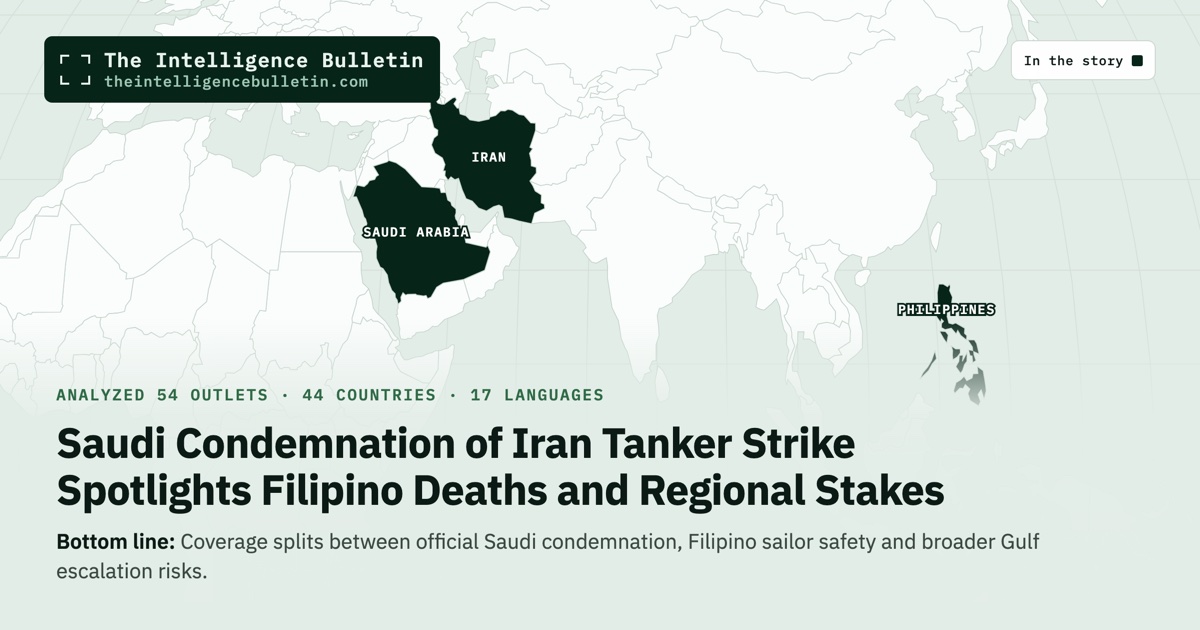
Coverage splits between official Saudi condemnation, Filipino sailor safety and broader Gulf escalation risks.
The five reports converge on the core facts of Saudi condemnation and Filipino deaths yet diverge in what they foreground, revealing how national stakes shape coverage of the same incident. Rappler centers the Philippine government’s response, detailing assistance for families, repatriation efforts and the explicit right of Filipino seafarers to refuse high-risk voyages through the strait, an angle absent elsewhere. Arab News leads with the Saudi foreign ministry statement, extending condemnation to alleged Iranian attacks on Jordan, Bahrain and Kuwait while stressing sovereignty and energy security. Al Jazeera places the event inside the ongoing US-Israel-Iran war, noting neighbors’ shared language on violations of navigation freedom and Iran’s threats to the waterway. Khaama Press frames it as a new escalation threatening global shipping routes and energy flows, reflecting an Afghan vantage on regional instability. Middle East Eye offers the briefest update, recording the accusation and fatalities without additional context. These choices show that outlets with direct national connections to victims or actors supply granular local reactions, while others embed the event in the wider conflict narrative; the absence of Iranian-sourced accounts in the set leaves the Saudi framing unchallenged within this coverage.
Full analysis
The Strait of Hormuz saw another direct strike on commercial traffic on August 31 when the Saudi-owned tanker Sidr came under attack while carrying crude from the kingdom’s east coast. The vessel, operated by national shipping company Bahri, was transiting the narrow waterway when the incident occurred at 23:40 local time. Two Filipino crew members died in the attack. Saudi Arabia’s foreign ministry issued a statement the next day condemning what it described as Iran’s targeting of the tanker and calling for an immediate halt to escalation, respect for the safety of international navigation, and protection of global energy supplies.
Saudi officials framed the strike as a violation of state sovereignty and the principles of good neighborliness. Their statement urged all parties to return to negotiations and peaceful solutions under international law. The same ministry extended its condemnation to reported Iranian actions against Jordan, Bahrain and Kuwait in the same period, expressing solidarity with those governments in defending their security. Bahri confirmed the security incident on its vessel and said it remained in contact with the ship while coordinating with authorities and maritime stakeholders.
Neighboring governments aligned with the Saudi position on the navigation issue. Kuwait’s foreign ministry called the attack a heinous violation of international law. Qatar described it as a flagrant breach of the freedom of maritime navigation and rejected any use of the strait as a bargaining chip. Jordan’s foreign ministry expressed absolute solidarity with Saudi Arabia. These statements appeared alongside the Saudi announcement in coverage from the region.
The incident fits a pattern of tanker strikes that has intensified since the start of the US-Israel conflict with Iran on February 28. Earlier attacks had already hit other Bahri vessels, including the Wedyan supertanker in July near Oman’s coast and the Masa and Amzan in the Red Sea. Shipping data show that roughly one-fifth of global oil and liquefied natural gas trade once passed through the strait before traffic began to drop sharply under the threat of mines, projectiles and Iranian restrictions. Two other supertankers loaded at Juaymah the previous week were also reported hit in separate overnight strikes.
The Philippines government responded through its Department of Migrant Workers. Officials coordinated with the vessel’s principal, the licensed manning agency and relevant authorities to arrange repatriation of the two deceased sailors and to deliver medical, welfare and compensation support to their families under employment contracts and international maritime rules. The department reiterated that Filipino seafarers hold the right to refuse deployment on high-risk voyages and reminded shipowners to conduct risk assessments and implement security measures before any passage through conflict zones. An investigation into whether proper safeguards were followed on the Sidr is under way.
Accounts of the event converge on the Saudi condemnation and the deaths of the two Filipino sailors. Five separate outlets carried the foreign ministry statement and the Bahri confirmation without material variation in those core details. They also recorded the parallel condemnations from Kuwait, Qatar and Jordan. The convergence holds across Saudi, Qatari, Philippine, British and Afghan reporting despite the outlets’ different locations and editorial priorities.
The reporting diverges in emphasis according to national connections. Arab News opened with the full Saudi foreign ministry text and noted the extension of condemnation to three other Gulf states. Al Jazeera placed the strike inside the broader US-Israel-Iran war that began in February and highlighted the shared language from Kuwait and Qatar on navigation rights. Rappler devoted space to the Philippine department’s assistance program and the explicit policy allowing seafarers to decline risky routes. Khaama Press stressed the threat to global energy shipping routes and the wider security crisis in the Gulf. Middle East Eye limited itself to a short live-blog note recording the Saudi accusation and the fatalities.
These differences track the outlets’ direct stakes. The Saudi paper drew on its government’s primary statement and national carrier details. The Philippine outlet followed the affected citizens and their government’s welfare response. The Qatari outlet embedded the event in its ongoing conflict coverage. The Afghan outlet connected it to regional stability concerns. The British outlet supplied a minimal factual update inside a larger live blog.
No Iranian-sourced material appears in the set. Iranian Revolutionary Guard statements claiming mines or other causes for fires on tankers are referenced only indirectly through the Saudi accusation and the pattern of prior incidents. The selected coverage therefore presents the Saudi framing without a parallel Iranian account to test it against.
The corroborated elements rest on multiple independent chains: the foreign ministry statement carried by Arab News, Al Jazeera and Rappler; the condemnations from three neighboring states recorded in Arab News and Al Jazeera; and the deaths confirmed by Bahri and reported across all five outlets. The single-source detail on Philippine government assistance comes solely from Rappler’s account of the Department of Migrant Workers statement.
What to Watch
The Saudi and Philippine accounts carry the strongest primary documents in this set. The foreign ministry text supplies the official condemnation and policy call. The Department of Migrant Workers statement supplies the concrete response to the victims’ families. Both rest on named government sources rather than secondary interpretation. The other outlets add useful context on the conflict backdrop and shipping risks, yet they rely on the same core statements. The absence of Iranian reporting in the selected sources leaves the Saudi version of events standing without direct rebuttal inside this coverage. That gap means readers of these outlets receive a one-sided picture of responsibility even while the factual spine of the condemnation and the deaths remains consistent across the reporting chains.
That’s how the world told the story.
Get our daily open-source intelligence on world events in your inbox — one email a day, up to six stories.
Subscribe freeNo spam. One-click unsubscribe. See the latest email →