 AI-generated analysis published under the editorial responsibility of Rohit Sinnas. How it works →
See the 47 countries
Afghanistan, Argentina, Armenia, Austria, Azerbaijan, Bangladesh, Belgium, Brazil, Canada, Chile, China, Czech Republic, Egypt, Finland, Germany, Ghana, India, Indonesia, Ireland, Israel, Jamaica, Japan, Kenya, Kuwait, Lebanon, Lithuania, Madagascar, Morocco, Netherlands, New Zealand, Nigeria, Niue, Oman, Pakistan, Poland, Russia, Serbia, South Africa, South Korea, Switzerland, Syria, Turkey, Ukraine, United Kingdom, United States, Vietnam, Yemen
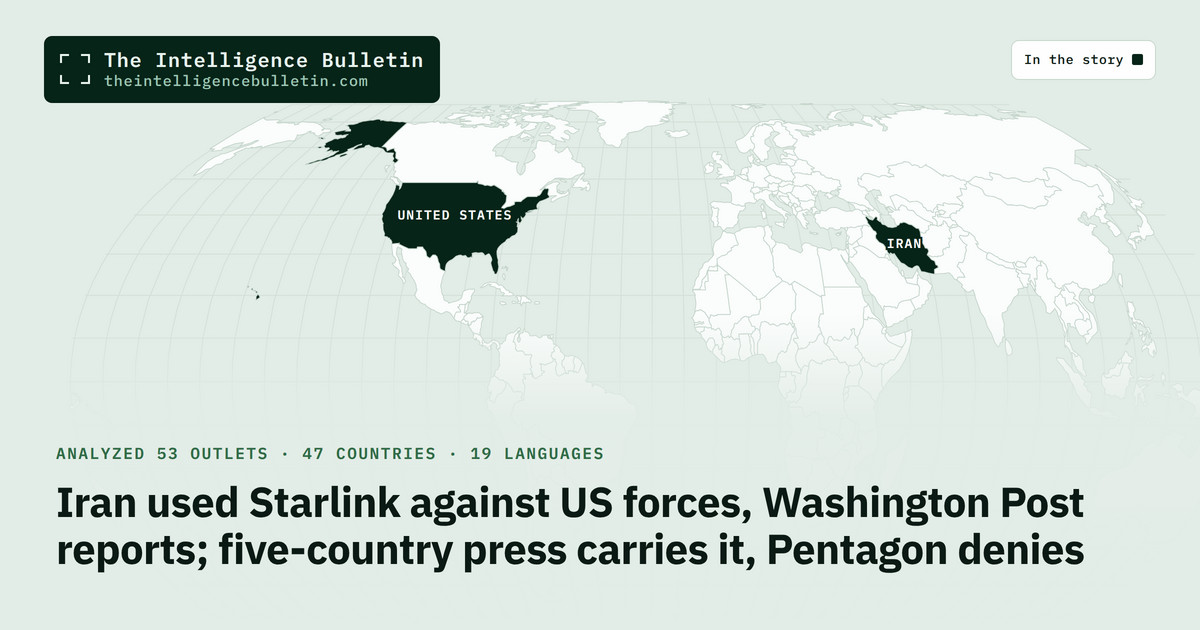
The Washington Post, citing sources, reported Iran used Starlink in attacks on US forces; the Pentagon says it is unaware of any such report, and Vetogate’s headline alone casts Gulf states as the target.
Across the press: Al-Monitor, The Jerusalem Post, AiF and G1 retell one Washington Post report; Vetogate’s Arabic headline alone says Gulf states were the target.
Source base: 5 outlets quoted (United States, Israel, Egypt, Russia, Brazil), selected from 53 analyzed. 4 read in full, 1 by its headline only.
- Denied on the recordThe Pentagon says it is unaware of any such report to the Office of the Secretary of Defense and has declined to confirm that Iran used Starlink.Source: US Defense Department statement to Reuters, carried by Al-Monitor, and Pentagon spokeswoman Kingsley Wilson to The Jerusalem Post.
- 4 of 5 · one shared reportIran used SpaceX’s Starlink satellite internet service in military operations against US forces after the United States and Israel began striking Iran.The Washington Post, citing sources, as carried by Reuters under Al-Monitor’s masthead and retold by The Jerusalem Post, Argumenty i Fakty and G1.
- 3 of 5 · one shared reportMusk became enraged on learning of unauthorized Iranian uses of Starlink and of US military use of Starshield one-way drones under a subscription intended for ground operations.The Washington Post, citing two people familiar with internal discussions and one other person, carried in Al-Monitor’s Reuters copy, The Jerusalem Post and G1.
- 3 of 5 · one shared reportAt least two SpaceX executives were fired by the end of that week over the two unauthorized-use incidents.The Washington Post, via a person familiar, reported in The Jerusalem Post, Argumenty i Fakty and G1.
- 2 of 5 · one shared reportA classified war update delivered to Defense Secretary Pete Hegseth described Iran’s use of Starlink for command and control and overseeing attack drone operations.The Washington Post, citing a person familiar with the report, carried by Al-Monitor’s Reuters copy and The Jerusalem Post.
- Still openWere the Italians killed by debris from drones Kuwait shot down, as Kuwait s ministry describes, or by a drone that hit the Skyguard site, as Tajani s account of a strong explosion at air-defense facilities suggests? · Will Kuwait accept Araghchi s offer of a joint investigation, and how does that offer square with his own military spokesman s charge that Israel and the United States staged a false flag?
Full analysis
What happened Why it matters How each country tells it Where accounts conflict Room for disagreement Our assessment Sources and evidence
What happened
The Washington Post reported on Saturday, November 28, that Iran used SpaceX’s Starlink satellite internet service to support military operations against US forces after the United States and Israel began striking Iran in late February. The account, carried in these pages through a single Washington Post report — Al-Monitor runs Reuters’s dispatch of it, and The Jerusalem Post, Argumenty i Fakty and G1 retell it — says the use was detected in early March and that a classified war update delivered to Defense Secretary Pete Hegseth over the summer described Iran’s use of the service for command and control and to oversee attack drone operations, according to a person familiar with the report as quoted by The Jerusalem Post.
Musk became enraged upon learning of two unauthorized uses of Starlink that his team concluded were related to Iran’s efforts against US forces, the Post reported citing two people familiar with internal company discussions, according to Al-Monitor’s Reuters copy. Musk was also told that the US military flew one-way drones on the militarized version of Starlink, called Starshield, under a cheaper subscription meant for ground operations, one person told the Post. At least two SpaceX executives were fired by the end of that week over the two incidents, a person familiar told the newspaper, as reported by The Jerusalem Post, Argumenty i Fakty and G1. SpaceX subsequently tightened checks on customers buying through resellers, according to the Post.
The Pentagon denied awareness. The US Defense Department said in a statement to Reuters that it "is not aware of the report to the (office of the defense secretary) pertaining to this subject." Pentagon spokeswoman Kingsley Wilson told The Jerusalem Post the department was unaware of a US Central Command report to the secretary’s office on the subject and declined to comment on whether Iran had used Starlink. SpaceX and the Iranian Foreign Ministry did not immediately respond to Reuters’ requests for comment.
An Iranian drone strike killed six US soldiers at Kuwait’s Port Shuaiba on March 1, The Jerusalem Post noted, adding that The Washington Post did not establish whether Starlink was used in that attack and that the Pentagon has not made its investigation findings public. Starlink is not licensed to operate in Iran, but Musk has previously said the service is active there; Iranian authorities have cut public internet access during unrest, and the US government smuggled thousands of terminals into Iran after January protests, according to the Wall Street Journal as carried by Al-Monitor. The Iranian government has maintained tight control of internet access since the conflict began at the end of February.
TIB reported on November 26 that Kuwait’s Foreign Ministry blamed Iran for a drone strike that killed two Italian technicians servicing a Skyguard air-defense system, and on November 28 Kuwait summoned Iran’s ambassador to protest the attack. Those strikes sit in the same shadow war the Starlink report describes, though the reporting does not link them.
Why it matters
The claim, if accurate, means Iran rebuilt battlefield communications after the US and Israel destroyed traditional links, using a civilian American satellite network whose owner is also a US government contractor. It would show that sanctions and export controls did not keep the technology out of Iranian hands, and that the same network Washington has used to aid allies — G1 notes the US government helped expand access for partner militaries including Ukraine — can be turned against US forces. The stakes are not only military: cutting off Starlink entirely in Iran would also disconnect civilians and dissidents who rely on it during government-imposed internet blackouts, a trade-off The Jerusalem Post and Argumenty i Fakty both flag. The story also raises the question of who bears responsibility when a private network becomes a battlefield tool. The Pentagon’s denial of awareness means the US government has not publicly confirmed the report, leaving the dispute between a single newspaper chain and an on-record official statement. For Musk, the reported firings and tightened reseller checks suggest an internal admission of control failure, but those details also come only from the Washington Post.
How each country tells it
- Al-Monitor · United States · wire copyA Washington-based Middle East policy outlet carries the Reuters wire relaying the Washington Post report, framing it as an American security problem: Iran using Starlink in attacks on US forces after US-Israeli strikes.
- The Jerusalem Post · Israel · carries The Washington PostIsrael’s English-language daily reads the same Washington Post report as evidence of Iranian capability and reach against US forces, foregrounding the March 1 Port Shuaiba drone strike that killed six US soldiers and the classified Hegseth update.
- Vetogate · Egypt · carries The Washington PostThe Arabic headline recasts the Washington Post report as Iranian military operations against Gulf states, making the Gulf monarchies the victims rather than the United States.
- Argumenty i Fakty · Russia · carries The Washington PostThe Russian weekly presents the Starlink accusation as a bare ‘WP:’ attribution, allowing the claim to stand unverified and then adding civilian-internet and SpaceX VP departure context rather than treating it as proven.
- G1 (Globo) · Brazil · carries The Washington PostG1 reads the same report as a tech-and-billionaire story, leading with Musk being left furious and treating the US-Iran confrontation as background.
Where accounts conflict
The only clear conflict among the pages in this set is over who the victim was. The Washington Post report as carried by Al-Monitor, The Jerusalem Post, Argumenty i Fakty and G1 says Iran used Starlink in attacks on US forces. Vetogate’s Arabic headline alone says Iran used Starlink in military operations against Gulf states, naming the Gulf monarchies rather than the United States and doing so only in the headline, which is all that could be fetched. No other source makes that substitution. The difference changes the geography and the stakes: a US forces victim draws in Washington and the Pentagon, while a Gulf states victim pulls in the regional monarchies and the earlier Kuwait drone attacks that TIB has covered.
Room for disagreement
The strongest case that this story will go another way is the Pentagon’s own statement. Kingsley Wilson told The Jerusalem Post the department was unaware of any such report and declined to confirm Iran had used Starlink; the Defense Department told Reuters it is not aware of a report to the defense secretary’s office on the subject. If no such report exists, then the classified-update detail is wrong, and the rest of the account rests on unnamed sources the Post did not substantiate with a document. The Post itself did not establish Starlink use in the March 1 Port Shuaiba strike that killed six Americans, the one attack where the claim could have been tested against a known incident. The Pentagon has not made its investigation public, so no independent evidence has emerged. On this record, the story could remain a single-source allegation that official Washington does not confirm and that no second reporting chain has independently matched.
Our assessment
It is likely that this report will force a public accounting of who controls Starlink in conflict zones, even though the specific claim of Iranian military use remains unconfirmed. The warrant is the pattern in the reporting: five outlets across five countries all trace to one Washington Post report, and the only on-record official comment is a denial. That means the story’s power comes from the governance failure it describes — a civilian satellite network used in war, a CEO angered into firing executives, tightened reseller checks — rather than from corroboration. The Pentagon has an interest in not confirming a report that would show a US contractor’s technology used against US forces, and the White House has an interest in keeping Musk, a public ally of the president, from embarrassment. Neither interest makes the claim false, but it means the reader is holding an unverified single chain.
What would change this: an on-record confirmation from the Pentagon or a second independent reporting chain that obtains the classified update or direct evidence of Iranian terminals.
Sources and evidence
Press quoted
- Does any reporting chain independent of the Washington Post corroborate that Iran used Starlink against US forces, or do all available outlets trace to that one account?
- Was Starlink used in the March 1 Port Shuaiba drone strike that killed six US soldiers, and has the Pentagon made any investigation finding public?
- What do Tehran and SpaceX say on the record, given that both the Iranian Foreign Ministry and SpaceX declined or did not respond to comment requests in the available reporting?
That’s how the world told the story.
Get our daily open-source intelligence on world events in your inbox — one email a day, up to six stories.
Subscribe freeNo spam. One-click unsubscribe. See the latest email →