 AI-generated analysis published under the editorial responsibility of Rohit Sinnas. How it works →
See the 60 countries
Afghanistan, Algeria, Argentina, Armenia, Australia, Austria, Azerbaijan, Bahrain, Bangladesh, Brazil, Bulgaria, Burkina Faso, Canada, China, Croatia, Cyprus, Egypt, France, Germany, Greece, Hungary, India, Indonesia, Iran, Israel, Italy, Japan, Jordan, Kenya, Kuwait, Lebanon, Lithuania, Malta, Mexico, Moldova, Netherlands, Nigeria, Oman, Paraguay, Portugal, Qatar, Romania, Russia, Saudi Arabia, Serbia, Singapore, South Africa, South Korea, Spain, Sri Lanka, Switzerland, Tunisia, Turkey, Tuvalu, Ukraine, United Arab Emirates, United Kingdom, United States, Yemen, Zimbabwe
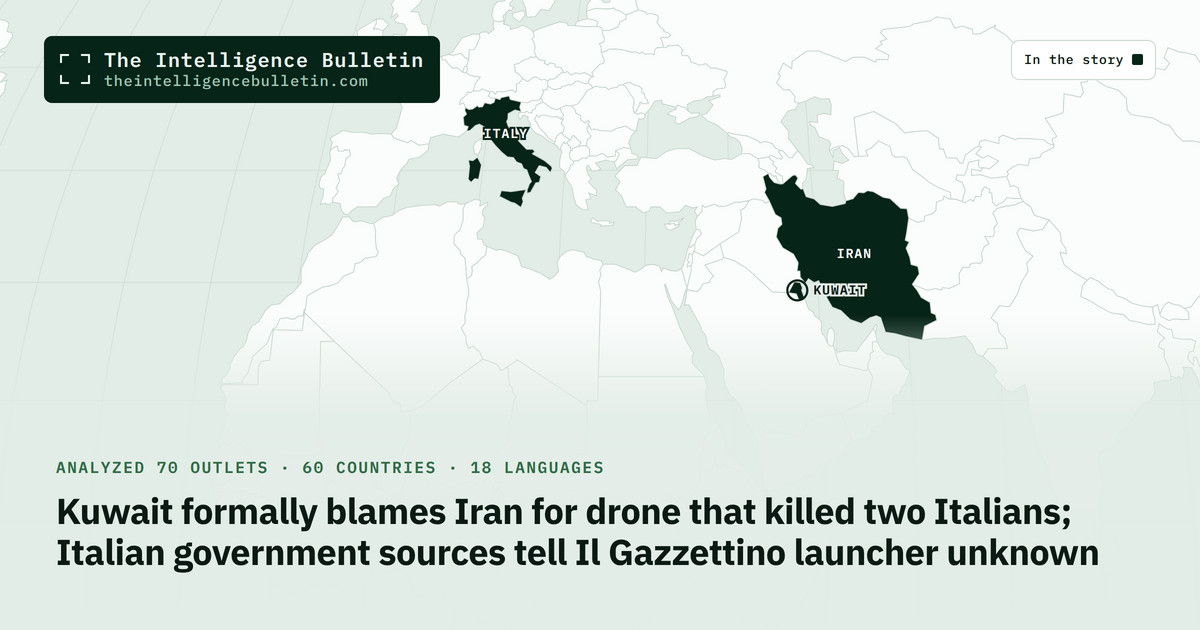
Kuwait’s Foreign Ministry summoned Iran’s ambassador on November 27, holding Tehran fully responsible for the November 26 drone strike that killed two Rheinmetall Italia technicians. Iran’s foreign minister denies any role. Italian government sources say the launcher is unidentified and do not exclude Iraqi militias.
Across the press: Kuwait’s government holds Iran fully responsible; Italy’s, whose citizens died, told Il Gazzettino through unnamed sources it cannot yet name the launcher.
Source base: 5 outlets read in full (Kuwait, Italy, Germany, Oman, Ukraine), selected from 70 analyzed.
- Denied on the recordIran carried out the attack.Source: Asserted by Kuwait and Italy. Denied on the record by Foreign Minister Abbas Araghchi, who said Iran had no role and offered Kuwait and Italy a joint investigation, and by Iran’s military, which raised a false flag.
- 1 of 5 · Al-Jarida onlyKuwait holds Iran fully responsible, calls the attacks a breach of UN Security Council Resolution 2817 (2026), and reserves its right of self-defense under Article 51 of the UN Charter.Deputy Foreign Minister Hamad Al-Mashaan, as reported by Al-Jarida.
- 1 of 5 · Il Gazzettino onlyItalian investigators cannot yet identify who launched the Iranian-made drone and do not exclude Iran-aligned Shia militias in Iraq.Unnamed Italian government and intelligence sources, as reported by Il Gazzettino.
- 2 of 5 · reported separatelyKuwait’s Foreign Ministry summoned Iranian Ambassador Mohammad Totonji on Friday, November 27, and handed him a protest note over continued Iranian attacks, most recently Thursday’s drone strike that killed two Italian nationals.Kuwait Foreign Ministry statement, carried by Al-Jarida and by AFP copy in the Oman Observer quoting the ministry’s post on X.
- 3 of 5 · reported separatelyThe two Rheinmetall Italia technicians, who were servicing Skyguard air-defense equipment, were killed by fragments of an intercepted drone rather than by a direct hit.Kuwaiti accounts via KUNA (Glavred) and Reuters-sourced reporting (wallstreet-online); Italian government analysis cited by Il Gazzettino.
- Coming daysWhether Kuwait and Italy take up Araghchi’s offer of a joint investigation, which would test Tehran’s denial against its military’s false-flag claim.
- When Italy’s fragment analysis concludesWhether Italian investigators name a launch point, Iran or Iraq, which would settle or deepen the attribution dispute.
- Early 2027Italy’s next missions decree, which government sources say will further reshape Italian forces in the Gulf.
- AnsweredIl Gazzettino, citing Rome’s analysis, reports that the drone was intercepted and exploded and its fragments killed the technicians, matching Kuwait’s debris account, which wallstreet-online and Glavred also carry.
- Still openWill Kuwait accept Araghchi s offer of a joint investigation, and how does that offer square with his own military spokesman s charge that Israel and the United States staged a false flag? · Has the Revolutionary Guards, which claimed the strikes in Bahrain days earlier, said anything about this attack, and what did Italy s protest to the Iranian embassy actually demand?
Full analysis
What happened Why it matters How each country tells it Where accounts conflict Room for disagreement Our assessment Sources and evidence
What happened
Kuwait’s Foreign Ministry summoned Iran’s ambassador, Mohammad Totonji, on Friday, November 27, and handed him a note of protest "over the continued Iranian attacks on the State of Kuwait." The ministry announced it on X, in a post quoted in AFP copy run by the Oman Observer. The trigger was the drone strike of the previous day, Thursday, November 26, on what the ministry calls "a vital site." This is the same attack TIB reported that day, not a new one. Al-Jarida, the Kuwaiti daily that reproduces the ministry’s statement, adds that a Kuwaiti and a Pakistani were wounded and that the material damage was serious.
The statement goes well past a routine summons. In Al-Jarida’s text, Deputy Foreign Minister Hamad Al-Mashaan calls the attacks a flagrant violation of Kuwait’s sovereignty and a grave breach of the UN Charter and Security Council Resolution 2817 (2026). He holds the Islamic Republic fully responsible for the attacks and their consequences. And he says Kuwait retains its inherent right of self-defense under Article 51 of the Charter.
The dead, named by Il Gazzettino, were Antonio Saccoccio and Emanuele Lo Russo, technicians for Rheinmetall Italia. Ansa, cited by wallstreet-online, gave their ages as 36 and 65. They were servicing the detection antennas of the Skyguard air-defense system used by Kuwait’s armed forces.
How they died, a question left open in TIB’s November 26 edition, now has one answer across three reporting chains. Kuwait’s state agency KUNA, relayed by Glavred from CNN, says the military tried to intercept several hostile drones and that falling debris injured four people. Reuters-sourced copy in wallstreet-online carries Kuwait’s debris account. And Italian government sources told Il Gazzettino the drone was intercepted and exploded, and that its fragments killed the two men.
Those sources supply the most detail anywhere in the set. They say the drone was Iranian-made, perhaps a Shahed or an Ababil, and was meant to knock out a desalination plant near Kuwait City that the Rheinmetall radar protected. Rome’s reading, the paper says, is that this was a precise attack rather than a fatal error, though not one aimed at Italians. Foreign Minister Antonio Tajani told the Senate that several drones of Iranian origin struck Kuwaiti military installations, according to wallstreet-online.
Tehran denies the attack. Foreign Minister Abbas Araghchi phoned Tajani and his Kuwaiti counterpart, Jarrah Jaber Al Ahmad al Sabah. Iran’s foreign ministry quoted him telling Tajani that "Iran had no role or involvement whatsoever" and that it was ready to work with Kuwait and Italy to "determine the origin of the incident." wallstreet-online reports that Araghchi also called the incident suspicious, and that Iran’s military leadership raised a false-flag attack without offering evidence. Seyed Mohammad Marandi, a former adviser to Iran’s nuclear negotiators, suggested on X, Glavred reports, that Ukraine staged the strike to impress President Trump, again without evidence.
AFP supplies the backdrop. The war began February 28, when the US and Israel attacked Iran, and has since spread to Iranian strikes on Gulf states hosting US bases. AFP writes that Iran has ratcheted up attacks on Kuwait and Bahrain over the past week. It reports that earlier in November Iran said it had targeted US drone and missile sites in Kuwait after a US strike on Qeshm Island. AFP also calls Thursday’s attack the first fatal strike in Kuwait for months.
Why it matters
The summons changes the form of Kuwait’s position more than its content. TIB’s November 26 edition recorded that Kuwait’s Defense Ministry had already blamed Iran, so this is not a Gulf state breaking silence. It is a Gulf state moving from a military attribution to a written legal case. Naming a Security Council resolution and Article 51 in a note handed to Tehran’s envoy builds the record a state would cite to claim self-defense later. The word "continued" turns one deadly night into a pattern.
For Italy, Il Gazzettino’s government sources treat the deaths as a dividing line. They say the next missions decree, due early next year, will further reshape Italian forces within range of Iranian missiles. The paper reports that Task Force Arabia has already been cut from 400 to 300 troops since mid-September, when an Iranian attack damaged an Italian Eurofighter at Saudi Arabia’s Al Taif base. About 30 Italian soldiers remain in Kuwait, and the foreign ministry is handling the return of civilians, including defense-industry staff.
For European contractors, the strike puts civilian deaths on record, so far without a market cost. wallstreet-online reports that Rheinmetall shares rose 4.1 percent on Thursday and that no concrete financial consequences are known. None of the five reports carries a statement from Rheinmetall itself.
How each country tells it
- Al-Jarida · Kuwait · carries Kuwait Foreign MinistryCarries the Foreign Ministry’s protest in full: Deputy Foreign Minister Hamad Al-Mashaan handed Ambassador Mohammad Totonji a note holding Iran fully responsible for continuing attacks, with Thursday’s drone strike as only the latest.
- Il Gazzettino · Italy · original reportingReports that Rome is treading softly with Tehran, and cites government sources: the drone was Iranian-made, possibly a Shahed or Ababil, it was aimed at a desalination plant near Kuwait City, and its fragments killed the technicians after it was intercepted.
- wallstreet-online · Germany · carries ReutersTreats the deaths as news for Rheinmetall investors and places them alongside the company’s capital markets day, where it cut its 2030 revenue target from about 45 billion euros to 33 to 37 billion.
- Oman Observer · Oman · wire copyRuns agency copy on the summons and adds Oman’s Foreign Ministry statement, which condemns attacks on the sisterly State of Kuwait and offers condolences.
- Glavred · Ukraine · carries CNNReports that Seyed Mohammad Marandi, a former adviser to Iran’s nuclear negotiating team, claimed on X that the attack could have been a Ukrainian false-flag operation meant to impress President Trump.
Where accounts conflict
The dispute is over who launched the drone. Kuwait’s position, in Al-Mashaan’s statement, is that Iran bears full responsibility; the published text asserts this without setting out evidence. Iran’s position, through Araghchi, is that it had no role whatsoever. Neither its military’s false-flag suggestion nor Marandi’s Ukraine theory comes with evidence.
Between them sits the government whose citizens died. Italian government and intelligence sources told Il Gazzettino the fragments establish the drone’s make but not who launched it, and that the destruction of the Rheinmetall radar complicates the reconstruction. They do not exclude a launch from Iraq by Shia militias linked to the Revolutionary Guards, which hold Iranian drones of this type. Tajani’s public phrase, Iranian origin, fits both Kuwait’s charge and his own officials’ doubt.
The accounts of the target differ too. Tajani spoke of military installations; Il Gazzettino’s sources speak of a desalination plant the radar guarded. No Iranian or Iraqi outlet is among the five reports, so Tehran’s case reaches this page only through its foreign ministry, as relayed by AFP and others.
Room for disagreement
The strongest case against reading Rome’s doubt as meaningful is in Il Gazzettino itself. The paper says the Italian government has no interest in an open clash with Iran, which makes uncertainty about the launcher the convenient position as well as the cautious one. Tehran’s own claim this month of strikes on US sites in Kuwait also makes an Iranian-made drone over Kuwait no anomaly. European Commission President Ursula von der Leyen, quoted by AFP, did not hedge: "We must step up pressure on Iran to end these unacceptable attacks against its neighbours and our partners in the Gulf." Nor is the Article 51 line boilerplate. Written into a note handed to an ambassador, amid the escalation AFP describes, it can be read as the step a state takes before acting.
Our assessment
It is very unlikely that Kuwait will use force of its own against Iran in response to this strike in the coming weeks. The warrant is the on-record text: Al-Mashaan reserves a right rather than announcing its use, and the measure Kuwait actually took was a protest note. Its neighbors and partners point the same way. Oman’s foreign ministry, in the statement the Oman Observer carries, condemned the attacks without naming Iran and called for a halt to all military actions. Italy, the injured party, is trimming its Gulf deployment rather than hardening it.
Each actor has an interest in the reader seeing the strike its way. Kuwait wants responsibility fixed on Tehran in UN terms. Tehran wants it blurred, pairing a joint-inquiry offer with a false-flag charge that presumes the inquiry’s answer. Rome wants to keep its line to Araghchi open. The attribution itself is likely to stay contested. As TIB reported on November 22, the Revolutionary Guards publicly claimed strikes in Bahrain days earlier, so Tehran disowning this one is a choice, and one that will keep it disputed.
What would change this: another fatal strike on Kuwaiti soil, or Italian investigators announcing that the drone was launched from Iranian territory.
Sources and evidence
Press quoted
- Was the drone launched from Iran or from Iraq, as Rome’s sources do not rule out, and will Kuwait’s charge of full Iranian responsibility hold once the ballistic analysis is finished?
- Does Kuwait’s reservation of its Article 51 self-defense right point to any measure beyond the protest note, and will it take up Araghchi’s offer of a joint investigation?
- Was the target a desalination plant near Kuwait City, as Il Gazzettino’s sources say, or the vital site Kuwait leaves unnamed?
That’s how the world told the story.
Get our daily open-source intelligence on world events in your inbox — one email a day, up to six stories.
Subscribe freeNo spam. One-click unsubscribe. See the latest email →