 AI-generated analysis published under the editorial responsibility of Rohit Sinnas. How it works →
See the 54 countries
Albania, Argentina, Armenia, Australia, Austria, Azerbaijan, Bosnia and Herzegovina, Brazil, Bulgaria, Burundi, Canada, Chile, Colombia, Croatia, Cuba, Dominican Republic, Ecuador, France, Germany, Greece, India, Iraq, Israel, Italy, Lebanon, Malta, Mexico, Nigeria, Norway, Panama, Paraguay, Peru, Philippines, Poland, Portugal, Qatar, Romania, Russia, Saudi Arabia, Singapore, Slovakia, Slovenia, Spain, Sri Lanka, Sweden, Switzerland, Turkey, Tuvalu, Ukraine, United Arab Emirates, United Kingdom, United States, Uruguay, Venezuela
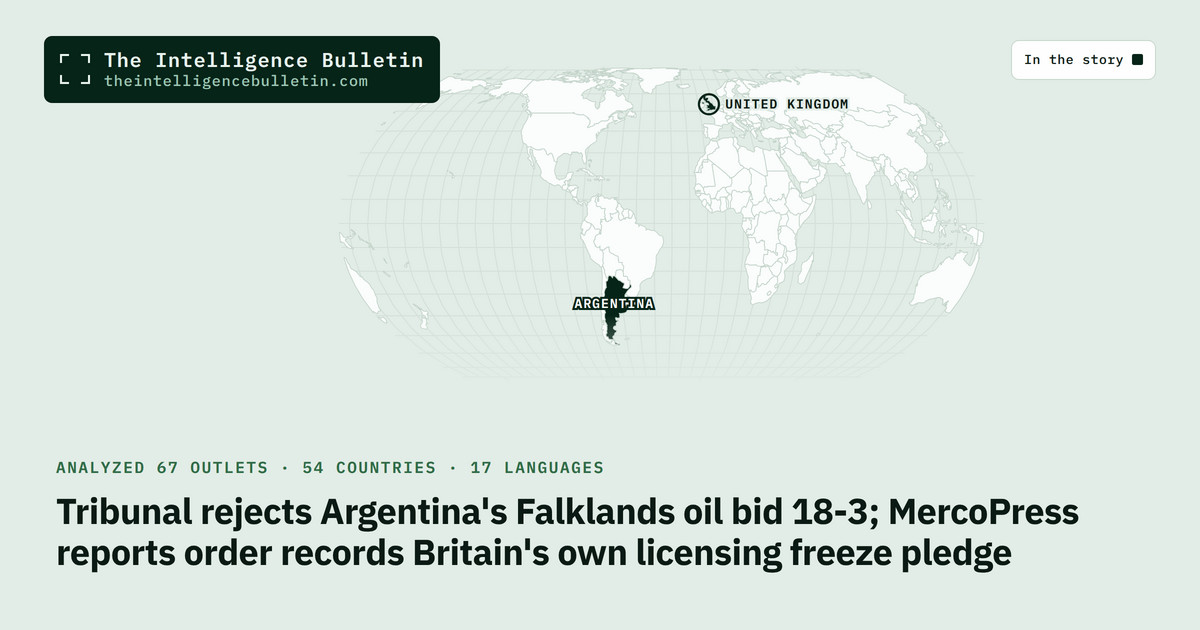
On November 28 the Law of the Sea tribunal voted 18-3 against halting the Falklands’ Sea Lion oil project, finding sovereignty outside its reach. Milei’s office vows arbitration; British ministers claim vindication. MercoPress reports Britain pledged no drilling before March 21, 2027.
Across the press: Only MercoPress reports the order recording Britain’s licensing freeze and drilling date; the Express’s ‘huge blow’ story never mentions either.
Source base: 5 outlets read in full (United Kingdom, Argentina, Uruguay, Israel, Venezuela), selected from 67 analyzed.
- 1 of 5 · MercoPress onlyThe order records British assurances that drilling will not begin before March 21, 2027 and extraction not before March 2028, and that no further licenses will be granted because the licensing regime is suspended.MercoPress, reporting the text of the order; IsraelInfo separately gives March 2027 as the drilling start, but as the company’s timeline, not a UK pledge.
- 5 of 5 · reported separatelyOn November 28 in Hamburg, the International Tribunal for the Law of the Sea voted 18 to 3 to reject Argentina’s October 13 request for provisional measures to halt the Sea Lion oil project north of the Falklands.Reported independently by the Express, Clarín, MercoPress, IsraelInfo and wire copy carried by Radio Mundial, citing the order read by ITLOS President Maurice Kamga.
- 5 of 5 · reported separatelyThe tribunal found no prima facie jurisdiction for the Annex VII arbitral tribunal on any of Argentina’s four requests, because ruling on them would require deciding territorial sovereignty over the islands, which falls outside UNCLOS.MercoPress quoting the order; Clarín citing a document it obtained; Radio Mundial wire copy; the Express and IsraelInfo in summary.
- 4 of 5 · reported separatelyIn a statement signed by Milei, the Argentine presidency said the tribunal had recognized the existence of a sovereignty dispute, rejected its finding on jurisdiction, and said Argentina would move without delay to constitute the arbitral tribunal and seek new measures there.The Office of the President of Argentina, as quoted by Clarín, MercoPress, IsraelInfo and Radio Mundial wire copy.
- 4 of 5 · reported separatelyForeign Secretary Ed Miliband and Attorney General Ellie Reeves welcomed the order as confirming Britain’s legal strategy, said Argentina had failed, and urged Buenos Aires to end its economic pressure on the islands.UK government statement as quoted by Clarín, IsraelInfo and Radio Mundial wire copy; MercoPress relays it via Clarín.
- Week of November 30, 2026Milei has asked Argentina’s Chamber of Deputies to pass a national sovereignty protection law, IsraelInfo reports.
- Coming weeksArgentina says it will move without delay to constitute the Annex VII arbitral tribunal and seek new provisional measures there.
- March 21, 2027MercoPress reports this is the earliest drilling date under Britain’s assurance recorded in the order, and the date Argentina called a fait accompli.
- March 2028Britain’s recorded assurance rules out extraction before this date; MercoPress reports the companies expect first oil in the first quarter of 2028.
Full analysis
What happened Why it matters How each country tells it Room for disagreement Our assessment Sources and evidence
What happened
On November 28, in Hamburg, the International Tribunal for the Law of the Sea voted 18 to 3 to reject Argentina’s request for provisional measures against the Sea Lion oil project north of the Falkland Islands. The tribunal’s president, Judge Maurice Kamga of Cameroon, read the order. It closes the emergency phase of a case Buenos Aires opened on October 13 and argued at hearings on November 10 and 11, according to EFE wire copy carried by Venezuela’s Radio Mundial.
Argentina had asked for a great deal. Per the wire account, it wanted Britain made to ensure that no new drilling for hydrocarbon exploitation took place and no production infrastructure was installed in the islands’ North Basin. It also asked that London abstain from anything that could aggravate the sovereignty dispute, above all new authorizations to exploit the contested continental shelf. Its case for urgency was that drilling beginning in March 2027 would create a "hecho consumado" with "irreversible" consequences. Britain answered that the case was purely about territorial sovereignty and so beyond the tribunal’s reach. Attorney General Ellie Reeves told the hearing, as the Daily Express reported, that an order would have "devastating consequences" for islanders entitled to develop their resources "pursuant to their fundamental right to self-determination."
The tribunal did not decide who owns the islands. Its question was narrower: whether the arbitral tribunal Argentina intends to convene under Annex VII of the UN Convention on the Law of the Sea would, at first sight, have jurisdiction over Argentina’s four claims. It found that it would not. MercoPress, quoting the order, reports that the first claim, on coastal-state rights, "requires the identification of the coastal State that has sovereignty over the Falkland Islands (Malvinas), and presupposes the determination of a question of territorial sovereignty," a question the Convention does not govern.
The same reasoning disposed of the claims on refraining from unilateral measures and on protecting the marine environment. A document Clarín obtained adds that the articles Argentina invoked concern maritime delimitation, not territorial sovereignty. On the fourth claim, the tribunal held that the duty to settle disputes peacefully and in good faith is no independent basis for jurisdiction. Having found no jurisdiction, it never examined urgency, MercoPress notes.
MercoPress names the three dissenters: Judges Horinouchi of Japan and Patel of India, and Argentina’s ad hoc judge, Raúl Vinuesa. The majority included Britain’s ad hoc judge, Vaughan Lowe, and Chile’s María Teresa Infante Caffi. Clarín adds Brazil’s George Rodrigo Bandeira Galindo to that majority.
MercoPress alone reports a second element of the order. It places on record assurances Britain gave at the hearing: drilling will not begin before March 21, 2027, extraction will not begin before March 2028, and no further licenses will be granted because the licensing regime is suspended. Per the same report, the order also states that the Convention applies in the disputed waters and that the tribunal expects both parties to act accordingly. It urges them to set up the arbitral tribunal swiftly and says it does not prejudge that tribunal’s jurisdiction or the merits.
The two governments read the order in opposite ways. A statement from the Office of the President, signed by Javier Milei, said the tribunal had recognized, "en un voto no unánime," the existence of a sovereignty dispute. It celebrated that recognition against what it called Britain’s effort to deny the dispute and avoid negotiating, and rejected the jurisdiction finding. It said Argentina "avanzará sin demora" to constitute the arbitral tribunal and seek new measures there, and that the ruling "de ningún modo legitima la explotación." IsraelInfo adds that the government opened five further sanctions proceedings and that Milei asked the Chamber of Deputies to pass a national sovereignty law the following week.
In London, Foreign Secretary Ed Miliband and Reeves said in a joint statement that the outcome confirmed Britain’s legal strategy and that Argentina had tried to stop islanders deciding their future and failed. They urged Buenos Aires to end its economic pressure on the islands. Navitas Petroleum welcomed "the Tribunal’s decision to reject all of Argentina’s requests for provisional measures," and Stacy Bragger of the islands’ Legislative Assembly called it "a good day for the Falklands," according to MercoPress.
Why it matters
Sea Lion would produce the first oil ever taken from Falklands waters, IsraelInfo reports. Navitas holds 65 percent of the project and Britain’s Rockhopper Exploration 35 percent, and the partners put reserves at 1.7 billion barrels. They took the final investment decision in December 2025. IsraelInfo says the field lies about 220 kilometers north of the islands and that the first phase costs about $1.8 billion, of which Navitas pays roughly $1.17 billion. That phase targets around 170 million of the estimated barrels at up to 50,000 barrels a day.
For Buenos Aires, the scorecard is starker than either government’s statement suggests. Argentina asked for a bar on new licenses. If MercoPress’s account of the order is right, Britain had already volunteered that restraint, so the only check on paper came from London itself. The Express’s "huge blow" story does not mention those assurances.
The bigger cost may be at home. Clarín reports critics across the political spectrum accusing Foreign Minister Pablo Quirno of breaking a five-decade policy of keeping the Malvinas away from international judges. They warn the ruling hands Britain new arguments. Experts it quotes anonymously are alarmed that Britain’s pleadings called Argentina a "coastal state," a term they fear implies the two countries are simply neighbors, each sovereign over its own territory. Their summary: Argentina went to court to protect sovereign rights, and the court declined precisely because those rights hinge on a sovereignty dispute.
For Israel, the stakes are commercial and diplomatic. IsraelInfo reports that Navitas warned investors in its third-quarter report that a freeze could be material. It also covers Jerusalem’s position between Milei, a close ally, and a Tel Aviv-listed company: Israel’s embassy in London denied a Telegraph report that Benjamin Netanyahu had told diplomats to back Argentina’s call for talks.
How each country tells it
- Daily Express · United Kingdom · original reportingTreats the order as a ‘huge blow’ to Argentina and gives the British case for islanders’ self-determination, with Milei’s September sovereignty speech quoted at length as the foil.
- Clarín · Argentina · original reportingCalls the order a heavy blow to Argentina’s claim and turns it against the Milei government, quoting anonymous experts and opposition critics who say Foreign Minister Pablo Quirno broke a five-decade policy of keeping the Malvinas away from international judges.
- MercoPress · Uruguay · original reportingGives the most precise reading of the order: claim by claim, the tribunal found no prima facie jurisdiction because each Argentine request required deciding sovereignty, which UNCLOS does not cover.
- IsraelInfo · Israel · original reportingTells the story as a win for Tel Aviv-listed Navitas Petroleum, which owns 65 percent of Sea Lion and had warned investors that a freeze could be material.
- Radio Mundial (YVKE Mundial) · Venezuela · wire copyA straight account of the ruling, of Argentina’s four requests and its argument that drilling from March 2027 would be a fait accompli, with statements from both governments.
Room for disagreement
The case against reading this as the end of Argentina’s legal campaign rests on the order itself. It expressly does not prejudge the Annex VII tribunal, a different body that will hear the merits. Three judges dissented, two of them permanent members of the court, so the jurisdiction question did not command unanimity. The order’s statement that the Convention applies in the disputed waters, and that it expects the parties to act accordingly, gives Argentina a textual opening to argue that environmental duties stand apart from sovereignty.
Milei’s sanctions are a second route. They reach shareholders, directors and suppliers of companies drilling without Argentine permission, IsraelInfo reports. Navitas’s own warning to investors shows the company treats this legal risk as material, not theoretical.
Our assessment
It is very unlikely that Argentina obtains a court-ordered halt to Sea Lion before the March 2027 drilling window opens. Five independent reporting chains agree on the vote and on the ground for it: every claim ran into sovereignty. That obstacle does not disappear in a new forum. MercoPress’s text of the order shows that even the environmental claim failed for the same reason. IsraelInfo reports the order cannot be appealed. An arbitral tribunal must still be constituted before it can hear a fresh request, and the clock to March 21, 2027 is short.
Each side has a reason to tell this its own way. Milei’s office needs the dispute to sound recognized, Britain’s ministers need vindication, and Navitas needs calm investors. The order’s recorded assurances cut against the cleanest version of each.
What would change this: an Annex VII tribunal constituted quickly and willing to treat Argentina’s environmental claims as separable from sovereignty, or Britain withdrawing its recorded assurances.
Sources and evidence
Press quoted
- When will the Annex VII arbitral tribunal be constituted, and can Argentina separate its environmental and restraint claims from the sovereignty question that sank it in Hamburg?
- Is Britain’s pledge to keep Falklands licensing suspended binding, and does it last until the arbitral tribunal rules or only until drilling begins in March 2027?
- Will the Argentine Congress pass Milei’s sovereignty protection bill, and will widened sanctions on Navitas, Rockhopper and their suppliers strain Buenos Aires’ ties with Israel?
That’s how the world told the story.
Get our daily open-source intelligence on world events in your inbox — one email a day, up to six stories.
Subscribe freeNo spam. One-click unsubscribe. See the latest email →