 AI-generated analysis published under the editorial responsibility of Rohit Sinnas. How it works →
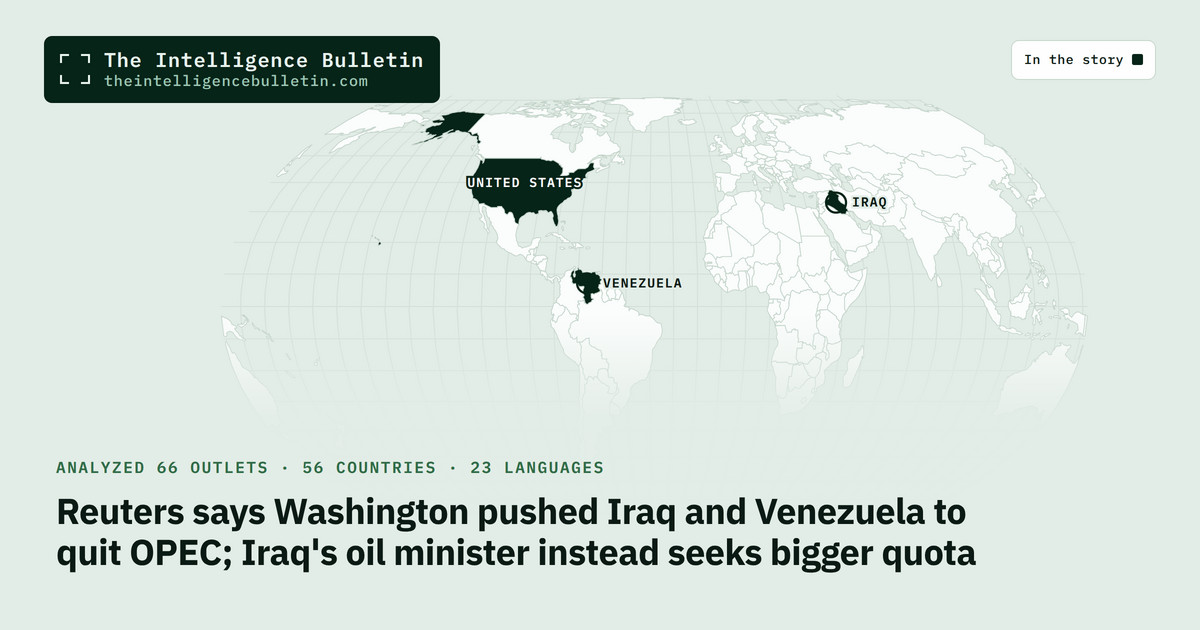
See the 56 countries
Afghanistan, Armenia, Australia, Azerbaijan, Bangladesh, Belgium, Bosnia and Herzegovina, Brazil, Bulgaria, China, Croatia, Cuba, Cyprus, Czech Republic, Estonia, Finland, Greece, Hungary, India, Iran, Iraq, Ireland, Israel, Italy, Jamaica, Japan, Kazakhstan, Kenya, Lebanon, Luxembourg, Macedonia, Malaysia, Netherlands, New Zealand, Nigeria, Pakistan, Philippines, Poland, Qatar, Romania, Russia, Saudi Arabia, Singapore, Slovakia, Somalia, South Korea, Switzerland, Syria, Taiwan, Thailand, Turkey, Tuvalu, Ukraine, United Arab Emirates, United Kingdom, United States
Reuters, citing 10 sources, reports Washington urged Iraq and Venezuela to weigh quitting OPEC, blocked Venezuela’s dues, and backed off on Caracas after Saudi lobbying; a State Department official conceded only lower-level talk. Iraq’s oil minister says Baghdad seeks a bigger quota inside OPEC.
Across the press: Four outlets retold one Reuters exclusive; Iraq’s Noon News instead quoted Baghdad’s oil minister bargaining inside OPEC, with no mention of US pressure.
Source base: 5 outlets read in full (United States, Iraq, Russia, Pakistan, Brazil), selected from 66 analyzed.
- 4 of 5 · one shared reportThe Trump administration encouraged Venezuela and Iraq to consider leaving OPEC earlier this year and kept Caracas from paying its annual dues, about 2.8 million euros according to Gazeta do Povo, through its control of Venezuelan state funds.Reuters, citing 10 people familiar with the matter; relayed by all four outlets that mention it.
- 4 of 5 · one shared reportSaudi Crown Prince Mohammed bin Salman intervened, in the summer according to two of the reports, to persuade the Trump administration to stop pressing Venezuela to quit OPEC.Reuters, citing two people familiar with the matter.
- 4 of 5 · one shared reportIraqi Prime Minister Ali Faleh al-Zaidi raised leaving OPEC at a government meeting after talks with US officials, but the oil ministry persuaded him to stay and seek a higher production quota.Reuters, citing two people familiar with the matter.
- 2 of 5 · one shared reportThe State Department did not flatly deny the push: an anonymous official said lower-level US officials may have raised an OPEC exit with Venezuela but that it was not a focus of senior White House officials, and that talks with Iraq centered on energy infrastructure.State Department statements to Reuters, carried by Rossiyskaya Gazeta (the lower-level concession) and Gazeta do Povo (the senior-official and Iraq-infrastructure lines).
- 2 of 5 · reported separatelyIraq’s oil minister said on November 27 that Baghdad is negotiating with OPEC to raise its production as a founding member, and that the ministry wants American companies to invest in Iraqi oil and gas.The Iraqi oil minister, on record at a Kirkuk press conference; Noon News names him as al-Abadi, while Gazeta do Povo names him as Basim Mohammed Khudair.
- Sunday, November 29, 2026OPEC+ ministers meet, the first test of whether Iraq’s request for a higher quota as a founding member gains any ground.
- Around November 29, 2026Iraq’s oil minister says the reopened Iraq-Turkey pipeline should rise from 300,000 to 500,000 barrels a day, adding barrels Baghdad wants a quota to cover.
- End of 2027PDVSA’s target of 1.5 million barrels a day, per Gazeta do Povo, would test whether Venezuela’s exemption from OPEC+ limits still holds.
Full analysis
What happened Why it matters How each country tells it Where accounts conflict Room for disagreement Our assessment Sources and evidence
What happened
Washington spent part of this year nudging two of OPEC’s five founding members, Venezuela and Iraq, toward the exit, according to a Reuters exclusive published on Friday, November 27, that cites 10 people familiar with the matter. Reuters says President Donald Trump’s administration urged both governments to consider leaving the cartel and stopped Caracas from paying its annual dues, which Brazil’s Gazeta do Povo puts at about 2.8 million euros.
Readers should know what this edition is made of. Every detail of the alleged lobbying below comes from that single Reuters dispatch, retold by four outlets: International Business Times in the United States, Rossiyskaya Gazeta in Russia, Aaj News in Pakistan and Gazeta do Povo in Brazil. None added reporting of its own on the push. The one independent strand is a press conference Iraq’s oil minister gave in Kirkuk the same day, carried by Iraq’s Noon News Agency, whose article never mentions Reuters, US pressure or any exit talk.
According to Reuters, US officials wanted more oil production and investment in both countries and saw OPEC’s output limits as an obstacle. Aaj News, which headlined the episode as an American attempt to break up the producers’ alliance, reports from the dispatch that State Department officials began raising an exit with Venezuelan officials in Washington after Nicolás Maduro was removed in January. Gazeta do Povo, which calls Maduro a dictator and his successors a regime, relays Reuters’ account that Washington withheld the dues on the grounds that the money had better uses. The pressure was heavy enough, two of Reuters’ sources said, that Saudi Crown Prince Mohammed bin Salman intervened in the summer and persuaded the administration to stop pressing. Gazeta do Povo adds that Trump said publicly in August the decision belonged to Venezuelans.
In Iraq, Reuters reports that Prime Minister Ali Faleh al-Zaidi raised leaving OPEC at a government meeting after talks with US officials, whom Rossiyskaya Gazeta’s rendering describes as backing the idea. The oil ministry objected and persuaded him to stay and seek a higher production quota. Aaj News carries the dispatch’s fullest Iraqi detail: Exxon Mobil and Chevron were then planning major new Iraqi investments; some in the ruling coalition still favor leaving OPEC and OPEC+ because they see Saudi and Russian sway over both; and Washington this year threatened to cut Iraq off from its oil revenue unless it reduced Iran’s influence in government.
The leverage, in Reuters’ telling, is custody of money. Venezuela’s state funds sit in a US-controlled account, and Aaj News reports the interim government needs State Department approval to spend them. Iraq’s oil revenue still passes through an account at the Federal Reserve Bank of New York, set up after the 2003 invasion. International Business Times went furthest beyond the wire, citing the New York Times and a confidential KPMG report: a summer deal gave a US-backed company, North American Blue Energy Partners, 100-year rights to 17 Venezuelan fields holding an estimated 65 billion barrels; the State Department may buy a fifth of its output at production price; the Pentagon’s Office of Strategic Capital holds a 35% stake; and from January to September the US government received more than $12 billion in Venezuelan oil revenue, most of it passed back.
Washington’s response reached readers only through Rossiyskaya Gazeta and Gazeta do Povo. Rossiyskaya Gazeta reports that the State Department would not say whether it blocked the dues, confirmed it has authority over Venezuela’s funds, and, through an anonymous official, allowed that lower-level US officials may have raised an exit with Caracas early this year, though senior White House officials were not focused on it. Gazeta do Povo carries the department’s line that talks with Iraq centered on improving energy infrastructure.
In Kirkuk, the minister said Baghdad is negotiating with OPEC to raise its output and hopes members will weigh Iraq’s standing as a founding state that has endured five decades of exceptional circumstances. He said the ministry wants American companies investing in Iraqi oil and gas, reopened the Iraq-Turkey pipeline at 300,000 barrels a day, said exports had climbed from about 200,000 barrels a day in May to about 3.6 million, and disclosed talks with BP on contracts for the Ajil, Hamrin and Qayyarah fields. Gazeta do Povo alone set his quota remarks beside the Reuters story, noting they came two days before an OPEC+ ministerial meeting.
Why it matters
OPEC is already thinner than it was. Gazeta do Povo counts four departures since 2019, Qatar, Ecuador, Angola and the United Arab Emirates, leaving 11 members. Losing two founders would strip the group of much of its claim to speak for producers at all.
The method matters more than the outcome. What Reuters describes is not tariffs or summitry but control over where two producers’ oil money lands, to the point that a member’s dues payment needed US sign-off. That makes OPEC membership something negotiated inside bilateral finance rather than a sovereign choice.
The near-term barrel stakes are smaller than the headline suggests. Venezuela is exempt from OPEC+ limits, produced about 1.2 million barrels a day in September and aims for more, so quotas do not bind it today; the push concerns capacity being built with US capital. Iraq is where quotas bite, and its ministry’s chosen compromise, more barrels inside the group, lands squarely on Riyadh’s table. The crown prince’s intervention shows Saudi Arabia judged a founder’s membership worth spending capital with Trump to keep.
How each country tells it
- International Business Times · United States · carries ReutersRetells the Reuters exclusive as an attributed report, then adds the scale of US control over Venezuelan oil: the 100-year NABEP concession on 17 fields, the State Department’s right to buy a fifth of output at production price, and a Treasury-supervised New York account, citing the New York Times.
- Noon News Agency (Non14) · Iraq · original reportingReports Iraq’s oil minister at a Kirkuk press conference saying Baghdad is negotiating with OPEC for a higher production quota as a founding member, courting American companies, and reopening the Iraq-Turkey pipeline at 300,000 barrels a day, rising to 500,000 within two days.
- Rossiyskaya Gazeta · Russia · carries ReutersRuns a close Russian rendering of the Reuters copy under a Reuters headline, including the State Department’s partial response that lower-level officials may have raised an OPEC exit with Venezuela but that it was not a focus of senior White House officials.
- Aaj News · Pakistan · carries ReutersFrames the episode as a US attempt to break up the producers’ alliance, with the Saudi crown prince stepping in, and adds Reuters detail the others omit: Exxon Mobil and Chevron were planning Iraqi investments, factions in Iraq’s ruling coalition still favor leaving OPEC and OPEC+ over Saudi and Russian influence, and Washington threatened Iraq’s oil revenue unless it curbed Iranian influence.
- Gazeta do Povo · Brazil · carries ReutersAttributes the push to Reuters and adds the dues figure of about 2.8 million euros, Trump’s August remark that leaving was Venezuela’s decision, Venezuela’s OPEC+ exemption at roughly 1.2 million barrels a day, and the OPEC+ ministerial meeting set for Sunday, November 29.
Where accounts conflict
The two reports of the Kirkuk press conference name different ministers: Noon News calls him al-Abadi, Gazeta do Povo calls him Basim Mohammed Khudair. Both cannot be right, and nothing in this set settles it. Aaj News dates the UAE’s exit to April, Gazeta do Povo to May. International Business Times’ headline says the administration encouraged Iran to leave OPEC; its own body text says Iraq, as every other account does.
Room for disagreement
The strongest case against a quiet ending is in the dispatch itself. Aaj News reports that factions in Baghdad’s ruling coalition still want out of OPEC and OPEC+, and that Washington has already threatened Iraq’s revenue over Iran. Venezuela, meanwhile, is not paying dues and is exempt from limits, a membership already hollowed out. The UAE showed this year that a major producer can walk. And the State Department’s answer cuts the other way too: if this was only lower-level chatter, Reuters may be describing loose talk rather than a campaign.
Our assessment
It is very unlikely that Iraq or Venezuela announces an exit from OPEC at or around the November 29 ministerial meeting. The warrant is unusually strong for a single-chain story: Iraq’s minister is on record, in independent reporting, pursuing a quota inside the group; Trump publicly handed Venezuela the decision in August; and the State Department narrowed the story rather than denying it, which supports Reuters’ core account. Washington has an interest in casting this as low-level, Baghdad in casting itself as a loyal founder, and Riyadh in being seen as the bloc’s protector.
What would change this: OPEC+ rejecting Iraq’s quota request while Washington ties access to Iraqi or Venezuelan oil revenue to leaving.
Sources and evidence
Press quoted
- Will Iraq’s bid for a higher quota come up at the OPEC+ ministerial meeting on Sunday, November 29, and would a larger allowance settle the Iraqi factions that, according to Aaj News’ account of Reuters, still want out?
- Who in Washington drove the push: the lower-level officials the State Department concedes may have raised it, or senior White House figures, as Reuters’ account of talks with Iraq’s prime minister implies?
- How do Caracas and Riyadh describe the crown prince’s intervention? The selected sources include no Venezuelan or Saudi outlet, and none quotes either government.
That’s how the world told the story.
Get our daily open-source intelligence on world events in your inbox — one email a day, up to six stories.
Subscribe freeNo spam. One-click unsubscribe. See the latest email →