 AI-generated analysis published under the editorial responsibility of Rohit Sinnas. How it works →
See the 34 countries
Armenia, Australia, Bahrain, Bangladesh, China, Egypt, Germany, India, Indonesia, Iraq, Ireland, Israel, Japan, Jordan, Lebanon, Morocco, Oman, Pakistan, Poland, Qatar, Romania, Russia, Saudi Arabia, Serbia, South Korea, Sudan, Syria, Taiwan, Turkey, Tuvalu, Ukraine, United Kingdom, United States, Yemen
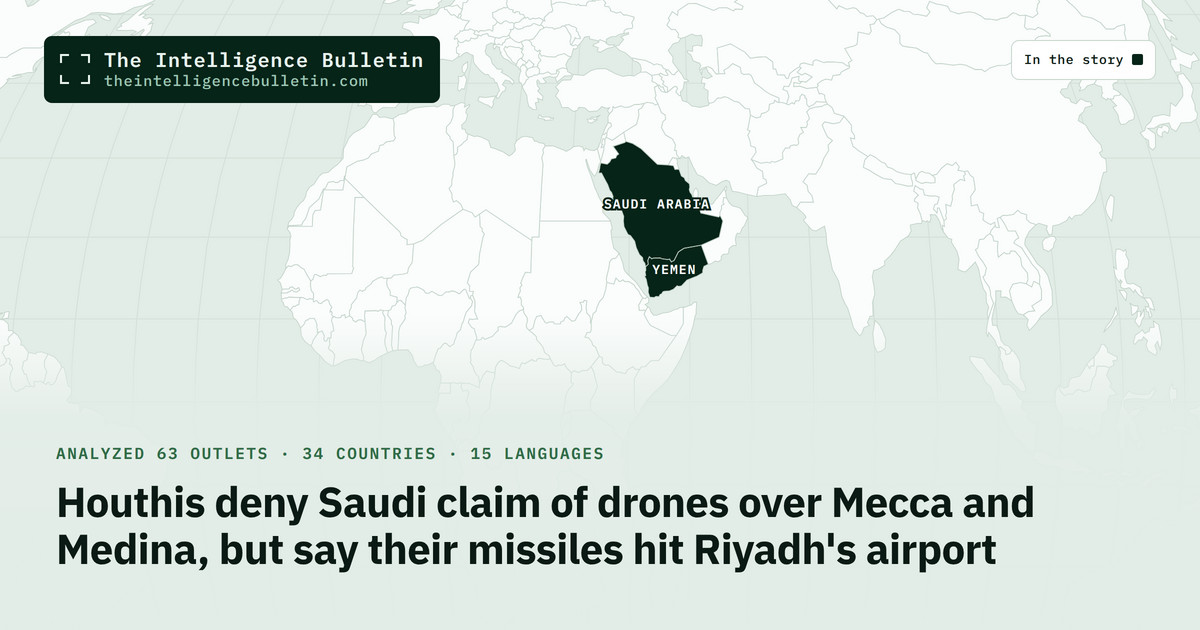
The Saudi-led coalition says it downed Houthi drones over the Makkah and Madinah regions and two missiles aimed at Riyadh. Houthi spokesman Yahya Saree calls the holy-city claim a fabrication but says the missiles struck Riyadh’s airport and a financial center.
Across the press: Houthi spokesman Saree, in Islamic Invitation Turkey’s relay, denies a three-drone Saudi claim over Mecca and Medina; Samaa and Al-Shorouk report the coalition counted four.
Source base: 5 outlets read in full (Pakistan, Egypt, Qatar, Turkey, Serbia), selected from 63 analyzed.
- DisputedTwo ballistic missiles were fired at Riyadh before dawn on Sunday; the coalition says both were intercepted, while the Houthis say they struck King Khalid International Airport and a financial center.Source: The coalition, via Samaa TV and Al-Shorouk; Saree, via Samaa TV, Islamic Invitation Turkey and Politika, which credits Al Jazeera. Samaa adds a 4:08am Civil Defence alert and three loud explosions before the all-clear.
- Denied on the recordThe Saudi-led coalition said on Sunday, November 15, that it intercepted two drones over the Makkah region and two over the Madinah region, launched by the Houthis.Source: Coalition spokesman Turki al-Maliki, as reported by Samaa TV and Al-Shorouk; Houthi spokesman Yahya Saree, relayed by Islamic Invitation Turkey and quoted by Samaa, calls the claim ‘a lie and a fabrication’ and says Houthi operations target only oil facilities and military bases.
- 2 of 5 · one shared reportThe coalition also said it intercepted three drones over the Eastern Province on Sunday, while Saree claimed two drones targeted pumping stations No. 5 and No. 6 of the East-West pipeline in the Riyadh region.Both claims appear in Samaa TV, which says Saudi authorities had not commented on the pipeline claim; Al-Shorouk carries only the three Eastern Province drones.
- 1 of 5 · Al-Shorouk onlyOn Monday, November 16, the coalition said it intercepted two more Houthi drones, over the Mecca and Riyadh regions.Coalition spokesman Turki al-Maliki, as reported by Al-Shorouk only.
- 3 of 5 · reported separatelySaudi-backed Southern Forces withdrew from Dhubab airport and the Bab al-Mandeb area, describing the move as a repositioning to protect Aden.The Southern Forces’ and Yemeni army’s statements, as carried by Samaa TV, Al-Shorouk and Politika; Politika, crediting Al Jazeera, says the cause was incessant Houthi attacks.
- Coming daysWhether Saudi authorities address Saree’s claim of hits on East-West pipeline pumping stations No. 5 and No. 6, after a claimed strike on No. 7 days earlier.
- Next coalition statements on XWhether al-Maliki keeps reporting interceptions over the Makkah region, which would test whether Monday’s launch was part of a sustained pattern.
- As fighting nears Kharaz camp in LahjUNHCR says 9,000 refugees there are at risk, a marker of how close the ground war is drawing to Aden after the Bab al-Mandeb pullback.
- Still openDo Houthi forces now hold or control by fire the coastal road at Khor Omaira, and where on the Karish and Ras al-Ara axes does the government s defensive line now sit relative to Aden? · Did the Southern Forces under al-Mahrami pull back from the strait with the Saudi-led coalition s agreement, or over a dispute, as analyst Ali al-Dhahab s reference to a political dispute suggests?
- 16 Nov · Yemeni forces quit Bab al-Mandeb as Houthi official denies Aden push but places fighting on its approach
- 13 Nov · Houthis claim strike on Saudi Hormuz-bypass pipeline; Xinhua says coalition tied only one of four drones to them
- 15 Nov · Iran s Guards claim six drones hit US radar in Bahrain; Bahrain, not Washington, says none got through
Full analysis
What happened Why it matters How each country tells it Where accounts conflict Room for disagreement Our assessment Sources and evidence
What happened
At 4:08am on Sunday, November 15, Saudi Civil Defence warned residents of Riyadh of an incoming aerial threat, Samaa TV reported. Three loud explosions followed within minutes, and then an all-clear was issued. The Saudi-led coalition said its air defenses had intercepted two ballistic missiles fired at the capital. Houthi military spokesman Yahya Saree gave a different account: the two missiles, he said, struck King Khalid International Airport and a financial center in Riyadh.
Over the rest of the day, coalition spokesman Maj. Gen. Turki al-Maliki posted separate statements on X, according to Samaa. He reported three drones downed over the Eastern Province, then two launched toward the Makkah region and two over the Madinah region, all attributed to the Houthis. By the coalition’s tally, that made seven drones neutralized on Sunday. The coalition gave no details of casualties or damage. The Cairo daily Al-Shorouk relayed the holy-city interceptions in the coalition’s own language, as "a repetition of targeting the holy sites and provoking the feelings of Muslims." It also reported that on Monday, November 16, al-Maliki announced two more drones intercepted over the Mecca and Riyadh regions. No other outlet in the set carries Monday’s interceptions.
On the launches the Houthis want credit for, there is no dispute about who fired them. No Iranian claim on the Saudi strikes appears in any of the reporting. Saree claimed the Riyadh missiles. According to Samaa, he also claimed two drones aimed at pumping stations No. 5 and No. 6 of the East-West pipeline in the Riyadh region, a claim Saudi authorities had not addressed. Samaa notes that the line, known as Petroline, runs about 1,200 kilometers from Abqaiq in the east to Yanbu on the Red Sea and can carry up to seven million barrels a day. TIB reported on November 13 that Saree had claimed a hit on Pumping Station No. 7 of the same pipeline a day earlier.
What Saree would not own was Mecca and Medina. Islamic Invitation Turkey, a pro-Iran aggregator, relayed his Telegram statement. In it, he said Houthi operations target only oil facilities and military bases, and he urged Riyadh to acknowledge its battlefield losses rather than invoke the holy sites. The same statement offered a Houthi counter-ledger. By Saree’s count, Saudi forces carried out 75 air and missile strikes in 24 hours on Saada, Taiz, Lahj, Al-Jawf and Marib, killing and wounding civilians, and 5,095 strikes since the escalation began. Those figures appear only in his account.
On the ground the same Sunday, the Saudi-backed Southern Forces pulled out of Dhubab airport and the Bab al-Mandeb area in western Taiz province. TIB reported on November 16 that these forces had retaken the area about six weeks earlier. In the statement carried by Al-Shorouk, the forces called the move a repositioning to protect Aden and neighboring provinces and to continue lifting the siege of Taiz, with coalition support. Politika, crediting Al Jazeera, attributed the pullback to incessant Houthi attacks. It also carried a Houthi claim of six ballistic missiles fired at Saudi forces at a camp it calls "Kawa" in southern Yemen and at nearby positions in Lahj.
Al Jazeera’s live blog put numbers on the displacement. The International Organization for Migration (IOM) counts 348,377 people displaced since the escalation began in June, including 18,780 in the single week of November 8 to 14. Taiz province hosts 41 percent of them and Lahj 26 percent. UNHCR warns that 9,000 refugees at Kharaz camp in Lahj are at risk as the fighting approaches.
Why it matters
The pipeline is the target with real consequences. Saudi Arabia now relies on Petroline to move crude around a restricted Strait of Hormuz. A Houthi claim against three of its pumping stations inside a single week is a claim against the kingdom’s workaround, not against a symbolic site. Riyadh’s silence on stations 5 and 6 leaves the damage unknown.
The holy-city charge raises different stakes. Placing Mecca and Medina in the target set turns a war over oil and territory into a question for Muslims everywhere, and the coalition’s phrasing invites exactly that reading. Saree’s quick rebuttal shows Sanaa understands the cost.
The weekend’s strikes also coincided with the coalition’s side giving up ground on the Red Sea. The forces left Bab al-Mandeb to defend Aden while displacement climbed in the two provinces on the road to it. Al-Shorouk reported in the same item that Bahrain had intercepted what it called "Iranian air attacks." Pressure on the Gulf states arrived from two directions on one day.
How each country tells it
- Samaa TV · Pakistan · original reportingThe fullest tally in the set: the coalition’s Sunday count of two drones over the Makkah region, two over Madinah, three over the Eastern Province and two ballistic missiles at Riyadh, set beside Yahya Saree’s claims on Riyadh’s airport, a financial center and pumping stations 5 and 6 of the East-West pipeline.
- Al-Shorouk · Egypt · original reportingRelays coalition spokesman Turki al-Maliki’s statements in the coalition’s own vocabulary, calling the attackers ‘the Houthi militia’ and the Mecca and Medina launches ‘a repetition of targeting the holy sites and provoking the feelings of Muslims.’
- Al Jazeera · Qatar · original reportingRunning Yemen live blog whose headline pairs the government’s repositioning toward Taiz with Houthi targeting of Riyadh; the fetched entry covers only the humanitarian toll, with IOM counting 348,377 displaced since the June escalation and UNHCR warning that 9,000 refugees at Kharaz camp in Lahj are at risk as fighting approaches.
- Islamic Invitation Turkey · Turkey · carries Houthi military spokesman Yahya Saree (Telegram)Relays Saree’s Telegram statement: the Saudi claim of intercepting two drones over Mecca and one over Medina is ‘fabricated’, Houthi operations target only oil facilities and military bases, and two ballistic missiles struck King Khalid International Airport.
- Politika · Serbia · carries Al JazeeraA short item crediting Al Jazeera that leads with the Houthi claim of hits on Riyadh’s King Khalid airport and financial center and adds a claim of six ballistic missiles fired at Saudi forces at ‘Kawa’ camp in southern Yemen and nearby positions in Lahj.
Where accounts conflict
The first conflict is over Mecca and Medina. As reported by Samaa and Al-Shorouk, the coalition says four drones were intercepted, two over each region. Saree, in Islamic Invitation Turkey’s relay, rejects a claim of three: two over Mecca and one over Medina. Either he was answering a different or partial statement, or the relay garbled the count. Neither possibility fully answers the coalition’s figure, and the denial does not address Monday’s Mecca-region interception.
The second conflict is over Riyadh. The coalition says both missiles were destroyed. Saree says both hit the airport and a financial center. The three explosions Samaa reports fit either account. The coalition cites no damage, and the Houthis cite no evidence.
Room for disagreement
The strongest case against treating this as an assault on the holy cities comes from the wording of the claims themselves. The coalition spoke of the Makkah and Madinah regions, which are provinces. The Makkah region contains Taif, whose airbase Saree’s own statement names as a launch point for Saudi jets. The Madinah region contains Yanbu, the pipeline’s terminus, where TIB’s November 13 edition recorded a Houthi claim to have hit an oil facility. A drone bound for a military or oil target could be logged as intercepted "over the Makkah region" without ever being aimed at the city. On that reading, both accounts could be partly true. The phrase "targeting the holy sites" would then be the coalition’s gloss, carried by Al-Shorouk, rather than a description of the launches. Nothing in the reporting shows debris, imagery or a stated target for those four drones.
Our assessment
Houthi missile and drone fire at Saudi territory is very likely to continue in the coming days, with the East-West pipeline its most consequential target. The warrant is that both sides confirm the campaign. The coalition and Saree agree that Houthi missiles flew at Riyadh and differ only on the outcome. Saree has now claimed three pumping stations in a week, and Al-Shorouk’s report of Monday launches, though single-sourced, points to a pace rather than a one-off.
The holy-city charge should be read with each side’s interest in view. The coalition gains from a framing that rallies Muslim opinion. The Houthis gain from claiming Riyadh’s airport while disowning Mecca. Saree’s line that Houthi operations hit only oil and military targets sits awkwardly beside his own claim to have struck an airport and a financial center.
No Saudi or Yemeni outlet is in the source set. Riyadh’s account reaches the reader through Pakistani and Egyptian relays, and Sanaa’s through a Turkish aggregator and a Serbian condensation of Al Jazeera. Every figure here is therefore secondhand.
What would change this: several consecutive days of coalition statements reporting no interceptions, which would mark Monday as an endpoint rather than a pace.
Sources and evidence
Press quoted
- Were the three explosions heard in Riyadh after the 4:08am alert interceptions, or did anything land at King Khalid International Airport as the Houthis claim?
- Did the coalition announce four drones over Makkah and Madinah, as Samaa and Al-Shorouk report, or three, as the Houthi denial puts it, and does it say who launched the three Eastern Province drones?
- Has Aramco or the Saudi government said whether pumping stations No. 5 and No. 6 on the East-West pipeline were hit?
That’s how the world told the story.
Get our daily open-source intelligence on world events in your inbox — one email a day, up to six stories.
Subscribe freeNo spam. One-click unsubscribe. See the latest email →