 AI-generated analysis published under the editorial responsibility of Rohit Sinnas. How it works →
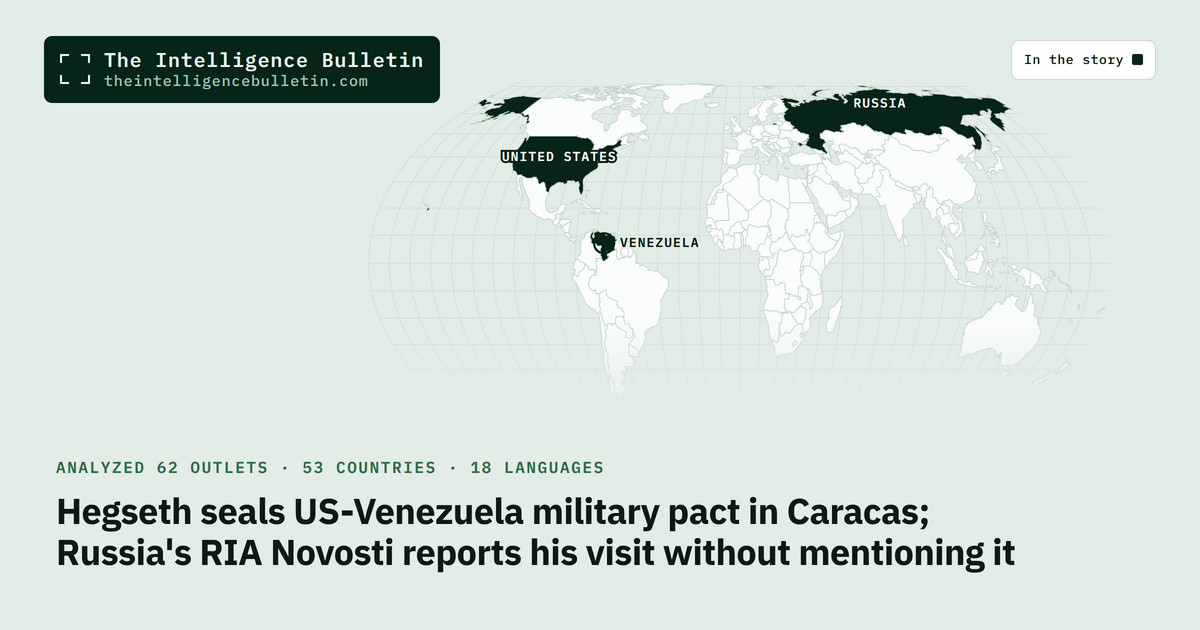
See the 53 countries
Albania, Argentina, Australia, Austria, Azerbaijan, Belarus, Bolivia, Bosnia and Herzegovina, Brazil, Bulgaria, Chile, China, Colombia, Croatia, Cuba, Denmark, Dominican Republic, Ecuador, Fiji, France, Germany, Guatemala, Honduras, Indonesia, Ireland, Israel, Italy, Jamaica, Lithuania, Mexico, Netherlands, Nigeria, Pakistan, Panama, Paraguay, Peru, Portugal, Qatar, Romania, Russia, Samoa, Slovakia, South Africa, South Korea, Spain, Sweden, Thailand, Turkey, Tuvalu, United Kingdom, United States, Uruguay, Venezuela
US Defense Secretary Hegseth and acting President Delcy Rodríguez agreed in Caracas on November 18 to restore military ties: training and equipment, plus intelligence sharing per Hegseth and new technology per Rodríguez. The Pentagon has given no further details.
Across the press: Only Colombia’s Noticias RCN carries Rodríguez’s list of what Venezuela gets; Russia’s RIA Novosti covers the visit without mentioning the military pact.
Source base: 5 outlets quoted (Venezuela, United States, Russia, China, Colombia), selected from 62 analyzed. 3 read in full, 2 by their headlines only.
- 1 of 5 · RIA Novosti onlyThe August 28 energy deal covers 17 strategic oil fields with combined potential of 65 billion barrels and more than $100 billion in investment.RIA Novosti
- 2 of 5 · reported separatelyThe United States and Venezuela agreed on military cooperation during Hegseth’s November 18 visit to Caracas, where he met acting President Delcy Rodríguez.AP via ABC11, citing Hegseth; Noticias RCN, citing Hegseth, Rodríguez and Venezuelan state television
- 2 of 5 · reported separatelyThe agreement covers training and defense equipment for Venezuela’s military; Hegseth adds intelligence sharing, and Rodríguez adds access to new military technology.AP via ABC11, quoting Hegseth, who reports that the Pentagon gave no further details; Noticias RCN, citing Rodríguez
- 2 of 5 · reported separatelyHegseth said the US-Venezuela oil deal makes the Strait of Hormuz a non-factor for the Western Hemisphere.AP via ABC11 and RIA Novosti, both quoting Hegseth’s speech at the US embassy
- 2 of 5 · reported separatelyIn his embassy speech Hegseth celebrated the January operation that captured Maduro, saying it was carried out without US casualties (per RCN) and lasted 48 minutes (per AP).AP via ABC11 and Noticias RCN, quoting Hegseth
Full analysis
What happened Why it matters How each country tells it Room for disagreement Our assessment Sources and evidence
What happened
Pete Hegseth, the US defense secretary, arrived in Caracas on Wednesday, November 18, and left with an agreement to restore military ties between the United States and Venezuela. Colombia’s Noticias RCN reported the trip as a surprise visit the Pentagon had not announced, and RIA Novosti also called it unannounced. RCN said the visit made Hegseth the highest-ranking US official to travel to Venezuela since the January operation that captured Nicolás Maduro. Venezuelan state television broadcast his meeting with acting President Delcy Rodríguez at the Miraflores palace. According to RCN, the footage also showed him shaking hands with Defense Minister Gustavo González López.
The terms come from the two leaders, in lists that only partly overlap. In the Associated Press account carried by ABC11, Hegseth said the two militaries would be "training together, partnering together, sharing intelligence, more defense equipment and capabilities together." The AP added that the Pentagon did not immediately offer further details.
Rodríguez’s version appears in RCN alone among the sources we could read. She called the deal a "reanudación de la relación técnico-militar," a resumption of the technical-military relationship. She said it covers training programs for the Bolivarian National Armed Forces (FANB), improvements to operational equipment and access to new military technologies.
RCN reports Hegseth’s stated purpose as helping Venezuela face threats from "actores extranjeros," or foreign actors, as well as narco-terrorist organizations and criminal groups, while protecting its borders and sovereignty. The AP quotes him on Venezuela partnering with Washington "to recover its territory from narco-terrorist networks." It quotes Rodríguez hoping the cooperation "can be brought to its highest possible level" to "address common threats." Neither readable account gives a dollar figure, a weapons system, a basing arrangement or a duration.
After Miraflores, Hegseth addressed diplomats and military officers from both countries at the US embassy. He celebrated the Maduro raid, which RCN identifies as Operation Absolute Resolve. In the AP’s account he called it "the single most sophisticated military operation in the history of Latin America" and said it "lasted just 48 minutes." RCN quotes him saying it was carried out without US casualties. "America’s best and bravest warfighters solved a 27-year problem for this hemisphere in a matter of hours," he said. Venezuela, he declared, had gone "from our most aggressive regional threat to a compliant security partner." He also turned Maduro’s old slogan back on him, saying the operation ended with "no war, yes, peace."
He tied the pact to oil. President Donald Trump said in August that Hegseth helped broker a deal for the United States to take control of some Venezuelan oil reserves. At the embassy, Hegseth said that deal "makes the Strait of Hormuz a non-factor for the Western Hemisphere," a line quoted by both the AP and RIA. RIA reports that shipping through the strait has nearly stopped since the US-Iran conflict began in February.
RIA alone gives the energy deal’s terms. It says the deal was announced August 28 and covers 17 strategic fields, with combined potential of 65 billion barrels and more than $100 billion in investment. It also reports Rodríguez saying private operators will be brought in while oil resources remain state-owned. The AP noted that Alejandro Betancourt attended the speech. He owns North American Blue Energy Partners, which the AP describes as Venezuela’s second-largest oil operator.
The visit built on months of contact. According to the AP, the US interior and energy secretaries visited Venezuela earlier this year. Gen. Francis Donovan of US Southern Command has met Venezuela’s interim authorities at least twice. RCN reports that Hegseth was continuing to Colombia, where Abelardo de la Espriella is president.
Two more outlets are known to us only by their headlines. The Venezuelan paper Correo del Caroní calls the deal a signed military cooperation agreement. The headline from China’s Phoenix New Media says Hegseth looks forward to jointly developing Venezuela’s resources, a phrase that appears in none of the texts we could read.
Why it matters
Rodríguez’s list describes a supplier relationship: training, hardware and technology flowing into the FANB. That is a role Russia filled for two decades. Washington is taking it on with the same armed forces, under the same ruling party, that it fought in January. The AP notes the party has held power since 1999 and still leads the country, now with Rodríguez in charge. Her court-allowed term expired in July. A signed pact with the Pentagon gives her the kind of standing an election has not.
The Russian state agency’s handling is telling. RIA built its story around Hormuz and the oil figures. In the text we read, it never mentioned the military agreement, the part of the visit that most directly displaces Moscow. Our source set holds no Cuban outlet and no readable Chinese article. No source we read carries an official reaction from Moscow or Beijing. How Venezuela’s longtime backers will respond is therefore unreported here, not settled.
For Hegseth, the oil line serves a domestic need. The AP links the Iran war’s effect on gasoline prices to Republican losses in this month’s midterm elections. The intelligence-sharing piece connects the pact to the boat-strike campaign. The AP counts at least 240 people killed since September 2025 and notes that officials have released little public evidence that the vessels carried drugs.
How each country tells it
- Correo del Caroní · Venezuela · original reportingOnly the headline could be read; it presents the event as a signed military cooperation agreement between the two governments, concluded during Hegseth’s visit.
- ABC11 (WTVD) · United States · wire copyThis is the Associated Press account. It leads on Hegseth’s claim that the deal restores military ties through joint training, intelligence sharing and equipment, and quotes his line that Venezuela has gone from ‘our most aggressive regional threat to a compliant security partner.’
- RIA Novosti · Russia · original reportingDatelined Washington, it leads on Hegseth’s claim that the August oil deal makes the Strait of Hormuz irrelevant to the Western Hemisphere. It adds that deal’s terms (17 strategic fields, 65 billion barrels of potential, more than $100 billion in investment) and Rodríguez’s assurance that oil resources stay state-owned.
- Phoenix New Media (ifeng.com) · China · original reportingOnly the headline could be read; it pairs Hegseth’s boast about capturing Maduro with a stated wish to jointly develop Venezuela’s resources.
- Noticias RCN · Colombia · original reportingIt calls the trip a surprise visit by the highest-ranking US official since Maduro’s capture, drawing on images from Venezuelan state television. It carries Rodríguez’s own description of the deal as a ‘reanudación de la relación técnico-militar’ that brings Venezuela’s armed forces (the FANB) training, upgraded equipment and access to new military technology.
Room for disagreement
The strongest case against reading this as a lasting realignment comes from the reporting itself. Hegseth "offered few specifics," in the AP’s words, and the Pentagon added nothing. An agreement with no published scope may stay mostly symbolic, an ending for the embassy speech rather than the start of a program.
The partner is also provisional. Secretary of State Marco Rubio has called the reconciliation talks that brought opposition leader María Corina Machado home "the best opportunity" in three decades for free elections. The AP reports that many Venezuelans think Washington put oil ahead of democracy. A government chosen at the ballot box could revisit a pact signed by a leader whose mandate has lapsed. Hegseth’s word "compliant" may also flatter a military that has every reason to hedge.
Our assessment
It is likely that this agreement produces working US training and equipment programs for Venezuela’s armed forces, even though their scope is still undefined. The warrant is strong for a deal this new. Both principals described it on the record, state television filmed the signing, and Hegseth and Rodríguez independently name training and equipment, which the AP and RCN carry separately. It follows a Southern Command channel and an oil deal that give Washington a material reason to keep the FANB close.
The reader should weigh the interests involved. Hegseth wants the raid and the oil to read as one strategic success, and Rodríguez wants Washington’s endorsement in place of an election. What remains genuinely unknown is depth. Training and "defense equipment" could mean a handful of courses or a full rearmament away from Russian systems.
What would change this: the absence of any program announcement while an election date is set and the opposition reopens the terms, which would show the pact was tied to Rodríguez rather than to Venezuela.
Sources and evidence
Press quoted
- Does the signed text give US forces any presence or access in Venezuela, and does it commit Washington to supplying weapons to the FANB, given that the Pentagon offered no details?
- Does the pact require Caracas to wind down its military ties with Russia, Cuba or China, and are those the ‘foreign actors’ Hegseth told RCN’s sources the alliance would guard against?
- Would the agreement bind a future elected government, given that Rodríguez’s court-allowed term expired in July and no presidential election date has been set?
That’s how the world told the story.
Get our daily open-source intelligence on world events in your inbox — one email a day, up to six stories.
Subscribe freeNo spam. One-click unsubscribe. See the latest email →