 AI-generated analysis published under the editorial responsibility of Rohit Sinnas. How it works →
See the 60 countries
Albania, Argentina, Australia, Austria, Azerbaijan, Bangladesh, Belgium, Brazil, Canada, Chile, China, Colombia, Cuba, Cyprus, Czech Republic, Dominican Republic, Ecuador, Egypt, Finland, France, Germany, Greece, Hungary, India, Indonesia, Iraq, Ireland, Israel, Italy, Jordan, Kenya, Kuwait, Lebanon, Lithuania, Malaysia, Mexico, Moldova, Morocco, Netherlands, Norway, Oman, Pakistan, Paraguay, Portugal, Qatar, Romania, Russia, Saudi Arabia, South Africa, South Korea, Spain, Sweden, Switzerland, Syria, Tunisia, United Arab Emirates, United Kingdom, United States, Venezuela, Vietnam
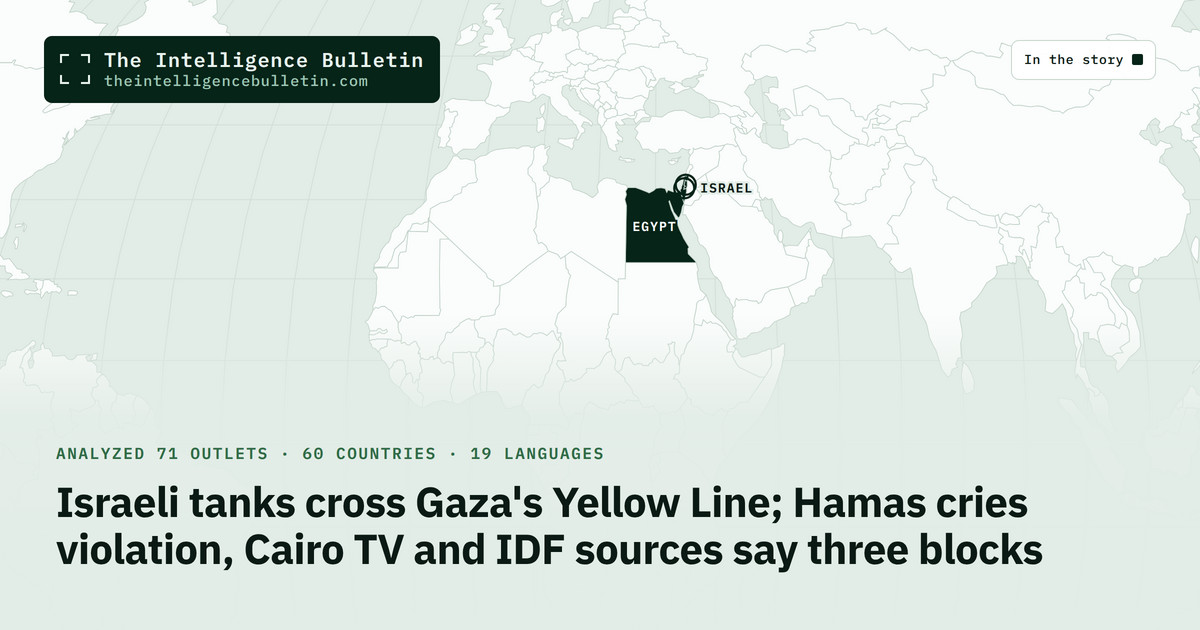
Israeli tanks crossed Gaza’s Yellow Line on November 18, the first ground raid since the October 2025 truce, and medics report three Palestinians killed. Hamas calls it a flagrant violation. Israel says it is removing threats, and IDF sources say the operation is narrow.
Across the press: El Watan headlined a ‘wide’ operation, but the Cairo News correspondent it quoted said three blocks, matching IDF sources speaking to The Jerusalem Post.
Source base: 5 outlets read in full (Israel, Qatar, Egypt, Austria, Chile), selected from 71 analyzed.
- 5 of 5 · reported separatelyOn November 18, Israeli tanks pushed west of the Yellow Line onto or near Salah al-Din road in central Gaza, the first such ground move since the October 2025 ceasefire.Residents via Reuters copy; Al Jazeera correspondents; COGAT via Europa Press copy; Cairo News correspondent via El Watan
- 5 of 5 · reported separatelyIsrael says the operation targets Hamas infrastructure to remove immediate threats to its forces along the Yellow Line, and that it reserves the freedom to act anywhere in Gaza.IDF spokesperson via Reuters copy and Al Jazeera; COGAT via Europa Press copy and Cairo News
- 3 of 5 · reported separatelyThree Palestinians were killed on November 18: one in an airstrike near the operation, at al-Mughraqa, and two earlier in Deir el-Balah and Gaza City; the IDF said it was not aware of any Deir el-Balah incident.Palestinian medics via Reuters copy; al-Awda, al-Shifa and al-Aqsa Martyrs hospital officials via Al Jazeera; IDF denial via Reuters copy
- 2 of 5 · reported separatelyThe operation is narrow, confined to about three blocks along the Salah al-Din axis, with no wider or longer invasion planned.Multiple IDF sources to The Jerusalem Post; Cairo News correspondent Dana Abu Shamsiya via El Watan, citing Israeli media
- 2 of 5 · reported separatelyHamas called the raid and the forced evacuation of homes northeast of Nuseirat a flagrant ceasefire violation and holds Israel and the United States responsible.Hamas statement via Reuters copy and Al Jazeera
- When COGAT declares the operation overWatch whether the closed section of Salah al-Din road reopens and the tanks pull back east of the Yellow Line, which would test the three-block account.
Full analysis
What happened Why it matters How each country tells it Where accounts conflict Room for disagreement Our assessment Sources and evidence
What happened
On Wednesday, November 18, Israeli tanks crossed west of the Yellow Line in central Gaza and moved onto or near Salah al-Din road, the Strip’s main north-south artery. Residents told Reuters it was the first ground raid since the ceasefire of October 2025. The Yellow Line was drawn under that agreement. It marks the roughly two-thirds of Gaza that Israel still holds, and the ground west of it is controlled by Hamas. Al Jazeera’s correspondents placed the tanks near Salah al-Din Street, east of Nuseirat refugee camp and north of Bureij. Dana Abu Shamsiya, a correspondent for Egypt’s Al Qahera News quoted by El Watan, said the operation covered three blocks along the Salah al-Din axis.
Israel explained the move through two channels. An IDF spokesperson said forces were targeting "Hamas infrastructure" outside the areas where they are deployed, in order to "remove threats." A military statement quoted by Al Jazeera added: "We reserve the freedom to act and manoeuvre whenever necessary to eliminate any immediate threat in the Gaza Strip." COGAT, the Israeli body that administers the territories, issued a notice in Arabic, which Europa Press reported in copy run by BioBioChile. The notice said the target was "terrorist infrastructure" near Bureij and Nuseirat. It said al-Awda hospital and the neighboring refugee camps were outside the operation and that part of Salah al-Din road was temporarily closed. It told residents to keep away until the operation ended.
Several IDF sources told The Jerusalem Post they expected no wider or longer invasion and had no plans for an expansive one "for the foreseeable future." They would not say why the raid was happening now. They also did not deny that the added pressure might be meant to push Hamas toward concessions on disarmament. The Post said it was unclear whether Washington had been told in advance.
Palestinian medics told Reuters that an airstrike near the raid killed one person. An official at al-Awda Hospital told Al Jazeera that the strike hit al-Mughraqa, north of Nuseirat, and wounded several others. Two people had been killed earlier that day. Al-Shifa Hospital reported one death in the Sheikh Ijlin neighborhood of southwestern Gaza City, and al-Aqsa Martyrs Hospital reported one in Deir el-Balah. Europa Press said a child was among those two. Gaza’s Health Ministry said its hospitals recorded seven deaths and 15 wounded in the previous 24 hours, and attributed six of the deaths to Israeli attacks. The IDF also confirmed to the Post that its strikes on Tuesday killed two platoon commanders of the Qassam Brigades: Ashraf Nayek Muhammad Tabasi in Khan Yunis and Saber Nayef Mahmoud Nabhan in Jabalya. It said the two were rebuilding Hamas’s capabilities "in systematic violation of the ceasefire agreement."
Witnesses told Reuters that gunfire and tank shells drove families out of nearby shelters. Al Jazeera’s Hind Khoudary described people in eastern Maghazi and Bureij fleeing after "huge explosions," live fire and artillery shelling. Abu Shamsiya reported large-scale displacement.
Hamas called the raid, together with the forced evacuation of homes northeast of Nuseirat, a dangerous escalation and a "flagrant violation." It said the displacement was a war crime aimed at "herding citizens into a narrow strip" of Gaza, and it held both Israel and the United States responsible. Israel, for its part, says Hamas has been regrouping and rearming.
Abu Shamsiya linked the timing to two things. One was the arrival in Israel of the commander of US Central Command, who met Israel’s security chiefs and its chief of staff as Washington pushes to begin reconstruction under the Trump plan. The other was a statement that morning by Defense Minister Israel Katz. Katz said the army would not leave the yellow zones in Gaza or in southern Lebanon, and that Israel could take new areas if necessary.
Why it matters
Until Wednesday, the Yellow Line was the plainest physical sign that the truce existed. Strikes and deaths had continued across it. Europa Press puts the toll since October 2025 at 1,658 killed and 6,000 wounded, without naming who counted. But Israeli armor had stayed on its own side. A crossing of three blocks is small in distance and large as a precedent. The military’s claim of freedom to act anywhere in the Strip changes the line’s meaning, from a boundary Israel stays behind to a starting point it can advance from.
The IDF sources’ unwillingness to deny a link to disarmament matters for the same reason. Hamas disarmament is the issue the next phase of the Trump plan depends on. If the sources are right, the raid is a bargaining tool, applied with tanks.
The closure also has a practical cost. Shutting a stretch of Salah al-Din road cuts the route most Gazans use to move between the north and the south of the Strip.
The reporting also shows a gap. None of the accounts gathered here comes from an American outlet or quotes an American official. Yet Hamas blames Washington, the Post cannot say whether Washington was told, and Abu Shamsiya reads the raid as a test of how the US, the Board of Peace and the truce’s sponsors will respond.
How each country tells it
- The Jerusalem Post · Israel · wire copyTreats the advance as a calibrated pressure move into ‘Hamas-controlled’ ground, adding its own IDF sources who would not explain the timing, did not deny it was meant to push Hamas on disarmament, and said no wider or longer invasion is planned.
- Al Jazeera English · Qatar · original reportingLeads with Palestinians fleeing eastern Maghazi and Bureij under shelling, and its Gaza correspondent says Israel announced demolitions but issued no evacuation order for residents.
- El Watan News · Egypt · carries Al Qahera NewsRelays a Cairo News correspondent who reads the operation as a test of Palestinian, US and Board of Peace reactions, timed with the CENTCOM commander’s arrival in Israel and Defense Minister Katz’s vow not to leave the yellow zones.
- Der Standard · Austria · wire copyA brief factual item: tanks advanced west of the Yellow Line, the military says it is targeting Hamas infrastructure, and medics report three dead.
- BioBioChile · Chile · wire copyFrames the operation through COGAT’s Arabic-language notice: it targets ‘terrorist infrastructure’ near Bureij and Nuseirat, closes part of Salah al-Din road, and urges residents to keep away.
Where accounts conflict
The first dispute is whether Israel’s military spoke at all. Abu Shamsiya said the IDF spokesman had issued no statement in Hebrew, English or Arabic, that the only information came from COGAT, and that this amounted to a media blackout. Reuters copy and Al Jazeera, however, both quote an IDF spokesperson or statement. The difference may simply reflect when each was reporting, but it changes whether this was an operation Israel announced or one it played down.
The second is evacuation. Hamas speaks of "forced evacuation orders." Khoudary said Israel announced demolitions but issued no evacuation order for residents. COGAT’s notice, as Europa Press reported it, asked people to keep away. Whether people were ordered out or fled the shelling bears directly on Hamas’s war-crime charge.
The third is the death in Deir el-Balah. Al-Aqsa Martyrs Hospital reported one person killed there. The IDF said it was not aware of any incident in the town.
Room for disagreement
The case that this is the start of something larger comes from Israeli officials themselves. Katz threatened, on the same morning, to seize new ground. The IDF sources hedged their denial of a wider invasion with the words "for the foreseeable future." They also conceded that the aim was to pressure Hamas, and pressure only works if escalation is credible. COGAT gave no end date for the operation. Abu Shamsiya’s reading points the same way: if the probe draws no pushback from Washington or Cairo, a second and larger one becomes cheaper. Hamas’s warning that civilians are being herded into a narrowing strip describes where repeated three-block advances would end up.
Our assessment
It is likely that this incursion stays close to its three-block footprint and ends with the ceasefire formally intact, while setting a precedent Israel will draw on again. The narrow scale rests on independent reporting chains: IDF sources speaking to the Post, and an Egyptian correspondent citing Israeli media. COGAT’s description of the road closure as temporary points the same way. Israel has an interest in the raid looking limited to Washington, and Hamas has an interest in it looking like a breach. The Cairo correspondent, whose country is a guarantor of the truce, had no obvious reason to shrink it, which is part of why her account carries weight.
What would change this: tanks remaining west of the Yellow Line after COGAT declares the operation over, or a second crossing elsewhere in the Strip.
Sources and evidence
Press quoted
- Was Washington told in advance, given that the Jerusalem Post says this was unclear and Cairo News notes the CENTCOM commander was meeting Israel’s chief of staff that same day?
- Did Israel order residents northeast of Nuseirat out of their homes, as Hamas says, or only warn them to keep away, as COGAT’s notice and Al Jazeera’s correspondent describe?
- Will Israeli forces pull back east of the Yellow Line when the operation ends, after Defense Minister Katz threatened to take new areas if needed?
That’s how the world told the story.
Get our daily open-source intelligence on world events in your inbox — one email a day, up to six stories.
Subscribe freeNo spam. One-click unsubscribe. See the latest email →