 AI-generated analysis published under the editorial responsibility of Rohit Sinnas. How it works →
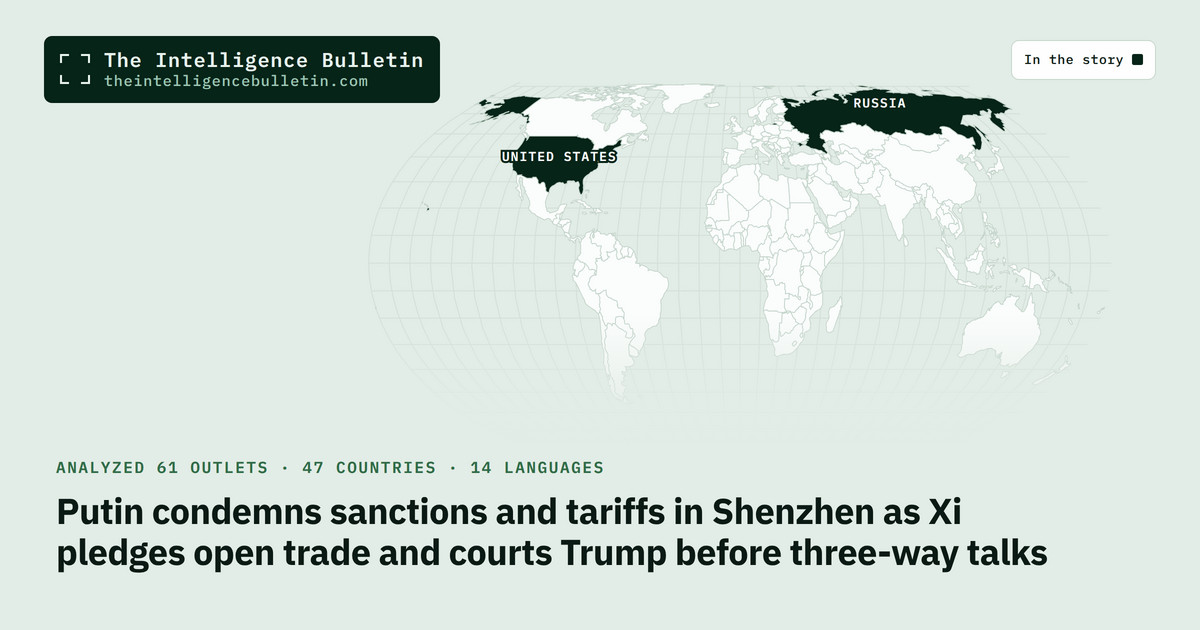
See the 47 countries
Afghanistan, Argentina, Australia, Austria, Bulgaria, Canada, China, Colombia, Costa Rica, Croatia, Cuba, Denmark, Egypt, France, Greece, Hungary, Indonesia, Ireland, Israel, Italy, Japan, Kenya, Kyrgyzstan, Luxembourg, Mexico, Moldova, Nigeria, Norway, Pakistan, Philippines, Poland, Qatar, Romania, Saudi Arabia, Serbia, South Africa, South Korea, Spain, Sweden, Switzerland, Syria, Turkey, Uganda, Ukraine, United Arab Emirates, United Kingdom, United States
In Shenzhen, Putin told APEC executives that sanctions and tariffs have lost their bite, while Xi pledged open trade without naming Washington and welcomed Trump warmly. Their shared multipolar language came only in a separate meeting, before Thursday’s first US-China-Russia summit.
Across the press: Xinhua’s account of Xi welcoming Trump never mentions Putin, tariffs or sanctions; AP and Nikkei Asia lead with Putin calling sanctions toothless.
Source base: 5 outlets read in full (China, United States, Kyrgyzstan, Austria, Japan), selected from 61 analyzed.
- 1 of 5 · AKIpress onlyXi and Putin held separate talks on November 18, in which Xi called the relationship an ‘unshakable’ mountain and both leaders spoke of building a multipolar world.AKIpress, relaying the South China Morning Post and Russia’s RBC
- 2 of 5 · reported separatelyPutin told the APEC CEO Summit that sanctions, tariffs and export restrictions have lost their power to intimidate, and that economic domination by ‘former dominant powers’ is a thing of the past.Associated Press, and Nikkei Asia’s own reporting from Shenzhen, quoting Putin’s speech
- 2 of 5 · reported separatelyXi used his first in-person APEC CEO Summit address since 2018 to argue for free and open trade, pledging that China would cut tariffs and expand market access.Associated Press and Nikkei Asia, quoting the speech
- 1 of 5 · Nikkei Asia onlyXi personally greeted Trump at Shenzhen’s airport on November 18, returning the airport welcome Trump gave him in Washington in September.Xinhua, carried by People’s Daily Online; Nikkei Asia’s live coverage
- 4 of 5 · reported separatelyThe first-ever trilateral meeting of the US, Chinese and Russian leaders is set for Thursday, November 19, in Shenzhen.Associated Press; Nikkei Asia citing the White House; AKIpress citing Xinhua; Kurier
- November 19, morningAPEC leaders meet behind closed doors, where Xi has asked for "concrete results" on openness and cooperation.
- November 19The first US-China-Russia leaders’ meeting tests whether Xi keeps his criticism of US trade policy implicit with Putin at the table.
- If Kim Jong Un appears in ShenzhenTrump, and possibly Putin according to the Kremlin, could meet him, after Xi told Lee he backs a North Korea-US dialogue.
- December, G20 Summit in MiamiXi and Trump are expected to meet again, a check on whether the trade truce holds.
- Still openNow that Trump says he will discuss Ukraine, will he and Putin meet one-on-one in Shenzhen, which naTemat reports was not yet scheduled though the Kremlin says arrangements are under way? · Will Kyiv or Europe s five-nation negotiating team be briefed on whatever Trump and Putin say about Ukraine, given Merz s public no surprises request?
- 18 Nov · Trump says Ukraine, his favorite subject, is on Shenzhen agenda; Ukrainian and Korean reports still say Washington excluded it
- 16 Nov · Trump says he may meet Kim Jong Un in China; Reuters-based copy notes Pyongyang has said not now
- 16 Nov · China confirms Xi will host Trump and Putin November 19, the last of three capitals to say so
- 14 Nov · White House pitches Trump-Xi-Putin nuclear talks without Ukraine; Kremlin aide says Shenzhen meeting will cover Ukraine
Full analysis
What happened Why it matters How each country tells it Room for disagreement Our assessment Sources and evidence
What happened
Before Donald Trump landed in Shenzhen on November 18, the two leaders he meets on Thursday had already addressed the APEC CEO Summit, and they did not say the same thing.
Vladimir Putin was making his first in-person appearance at an APEC leaders’ meeting since 2017, according to the Associated Press. He told executives that "sanctions, tariffs, and export restrictions" have "outlived their usefulness and have largely lost their intimidating effect." Nikkei Asia reported from the hall that he said "former dominant powers" had tried to suppress other countries’ development, and that "economic domination and coercion are now a thing of the past." AP reports he said the Asia-Pacific accounts for more than half of Russia’s trade and announced a Russian bid to chair APEC in 2035. Nikkei reports he said he expected significant benefits from the coming meeting with Xi and Trump.
Xi Jinping spoke earlier, in his first in-person CEO Summit address since 2018 in Papua New Guinea. He argued for free and open trade and for settling differences through dialogue. "China will not only cut tariffs and expand market access, but also go a step further," AP quoted him. He named no one. AP reports that Xi and other leaders called for openness "without directly criticizing" the United States. It also quotes George Chen of The Asia Group noting that Xi never mentioned export controls, Nvidia or the US. Nikkei reports that Beijing had yet to formally answer Washington’s latest move to restrict Chinese access to advanced AI chips through overseas data centers.
Other leaders were blunter. Malaysia’s Anwar Ibrahim said, according to Nikkei: "You can’t say in one voice [that you’re] promoting trade and investment, but only to your country." Canada’s Mark Carney had met Xi the day before. His office said the two sides would extend a preliminary trade agreement, securing tariff relief for about C$400 million ($280 million) of Canadian exports.
Trump flew in from the ASEAN summit in the Philippines. Xi met him on the tarmac, returning the airport welcome Trump gave him in Washington in September. Xinhua’s dispatch, carried by People’s Daily Online, describes PLA honor guards, a flyover and a girl with a bouquet. In it, Xi calls China "a nation with a tradition of courtesy" that reciprocates goodwill. He offers "a constructive China-U.S. relationship of strategic stability based on respect, fairness and reciprocity." In Xinhua’s account Trump called China a great country and Xi a great leader. Nikkei expects a Xi-Trump meeting on the sidelines, their third summit this year.
Xi and Putin also met separately that day. Among the reports read here, that meeting appears only in AKIpress, which relays the South China Morning Post and Russia’s RBC. In that account, Xi likened the relationship to a mountain unshakable against wind and rain and called for efforts to "promote the formation of a multipolar world and the democratization of international relations." Putin spoke of a shared approach to "a fairer multipolar world order."
At the evening banquet, Nikkei reports, Trump and Putin shook hands while Xi looked on. Xi also shook hands with Japan’s Sanae Takaichi after more than a year of frost over her remarks on Taiwan, and he urged leaders toward "concrete results" on Thursday. AKIpress cites Xinhua as saying the trilateral will focus on international security and strategic stability. TIB reported on November 16 that the White House wants it to open talks on nuclear arms reduction, which Beijing has resisted. Kurier writes that Beijing insists on strict agendas in which each side reads out its position.
Why it matters
The split in roles is what Beijing needs from this week. AP reports that China’s growth, still above 4%, rests mainly on exports. It puts the trade surplus on course to exceed $1 trillion for a second year, and says Trump’s warmth toward Xi may extend the trade truce reached last year. A Xi who denounced sanctions alongside Putin would put that truce at risk. A Xi who pledges tariff cuts while Putin denounces sanctions keeps both relationships intact. Nikkei reports Xi and Trump are expected to meet again at next month’s G20 in Miami.
The stakes reach beyond the three capitals. Kurier reports that Trump has already lifted US sanctions on Russian oil and that his envoys Witkoff and Kushner have put to Putin a plan to push Europe toward a gas deal with Moscow. It also reports that Ukraine struck Russia’s bridge to Crimea on Tuesday. It quotes Andrei Kortunov, head of the Valdai Club, saying what matters is that Russia plays in the top league again and that Europeans are not at the table. On Korea, Nikkei reports Xi told South Korea’s Lee Jae Myung he would support a North Korea-US dialogue, citing Seoul’s national security adviser via Yonhap. Nikkei adds that Xinhua’s readout of the meeting left this out.
How each country tells it
- People’s Daily Online · China · wire copyRuns Xinhua’s account of Xi greeting Trump on the Shenzhen tarmac, with honor guards, a flyover and a bouquet, and Xi offering a ‘constructive China-U.S. relationship of strategic stability based on respect, fairness and reciprocity.’
- The Durango Herald · United States · wire copyAP copy that sets Xi’s open-trade appeal against Trump’s ‘America First’ tariffs and Nvidia chip limits, and quotes Putin calling ‘sanctions, tariffs, and export restrictions’ outdated and toothless.
- AKIpress · Kyrgyzstan · carries South China Morning PostLeads with a separate Xi-Putin meeting on November 18, in which Xi compared the relationship to a mountain ‘unshakable against wind and rain’ and both leaders spoke of a multipolar world.
- Kurier · Austria · opinionAnalysis piece arguing that the ‘new Yalta’ talk comes from Putin and Russian media, but that the three leaders are not victors dividing up the world: Trump and Putin are both stuck in wars that have gone badly for them, and China is profiting from both.
- Nikkei Asia · Japan · original reportingOn-the-ground live blog tracking the whole day: Putin’s ‘economic domination and coercion are now a thing of the past,’ Xi’s tarmac welcome, Trump and Putin shaking hands at the banquet while Xi watched, and Xi’s handshake with Japan’s Takaichi.
Room for disagreement
The case against reading this as distance between Beijing and Moscow is that the substance matched and only the venue differed. Xi’s "democratization of international relations" is the same complaint as Putin’s "former dominant powers," put in the language of Chinese diplomacy. Chen’s reading in AP is that Xi’s open-trade pitch was itself aimed at Washington’s restrictions. Nikkei reports Xi told Lee that both countries are "beneficiaries of multilateralism and free trade," a line Nikkei reads as working a wedge between the US and an ally. Kurier argues China is the biggest beneficiary of both Trump’s and Putin’s wars, with Russian oil and gas cheaper than ever. On that view, Xi’s restraint is choreography: he never had to sound like Putin, because Putin was speaking for both.
Our assessment
It is very unlikely that Xi will publicly join Putin in condemning US sanctions or tariffs during Thursday’s trilateral. The behavior is documented across independent reporting chains: AP and Nikkei, each quoting the speeches, agree that Putin attacked these tools by name. AP adds that Xi named none of them. Xinhua’s own text shows what Beijing chose to publish, a welcome built on reciprocity with no mention of Putin. The multipolar language exists only in one relayed account of a closed bilateral meeting. Beijing has an interest in presenting itself as the courteous host, Moscow in showing that Russia is back at the top table, and Washington in a friendly summit. The reporting read here includes no Russian outlet directly and no White House account of the day, so Moscow’s and Washington’s own framing is missing from it.
What would change this: a Chinese readout or joint statement after Thursday’s meeting that names sanctions, export controls or "former dominant powers" in Xi’s voice.
Sources and evidence
Press quoted
- What did the Kremlin’s own readout of the November 18 Xi-Putin talks say about the next day’s trilateral meeting or about Ukraine, given that no Russian outlet is among these sources?
- Will Ukraine come up at the trilateral table, when Kurier reports that the official agenda is AI and that Ukraine and Iran are not fixed items?
- Will Kim Jong Un appear in Shenzhen, now that Interfax quotes the Kremlin saying Putin could also meet him and Rubio says Trump is prepared to?
That’s how the world told the story.
Get our daily open-source intelligence on world events in your inbox — one email a day, up to six stories.
Subscribe freeNo spam. One-click unsubscribe. See the latest email →