 AI-generated analysis published under the editorial responsibility of Rohit Sinnas. How it works →
See the 58 countries
Armenia, Australia, Austria, Azerbaijan, Bangladesh, Barbados, Belarus, Bosnia and Herzegovina, Bulgaria, Chad, China, Croatia, Cuba, Denmark, Egypt, Finland, France, Germany, Greece, Hungary, India, Indonesia, Ireland, Israel, Italy, Kenya, Kyrgyzstan, Lebanon, Lithuania, Macedonia, Madagascar, Malaysia, Moldova, Morocco, Nigeria, Norway, Oman, Pakistan, Philippines, Qatar, Romania, Russia, Saudi Arabia, Serbia, Singapore, Somalia, South Africa, South Korea, Spain, Sri Lanka, Sweden, Switzerland, Turkey, Tuvalu, Ukraine, United Arab Emirates, United Kingdom, United States
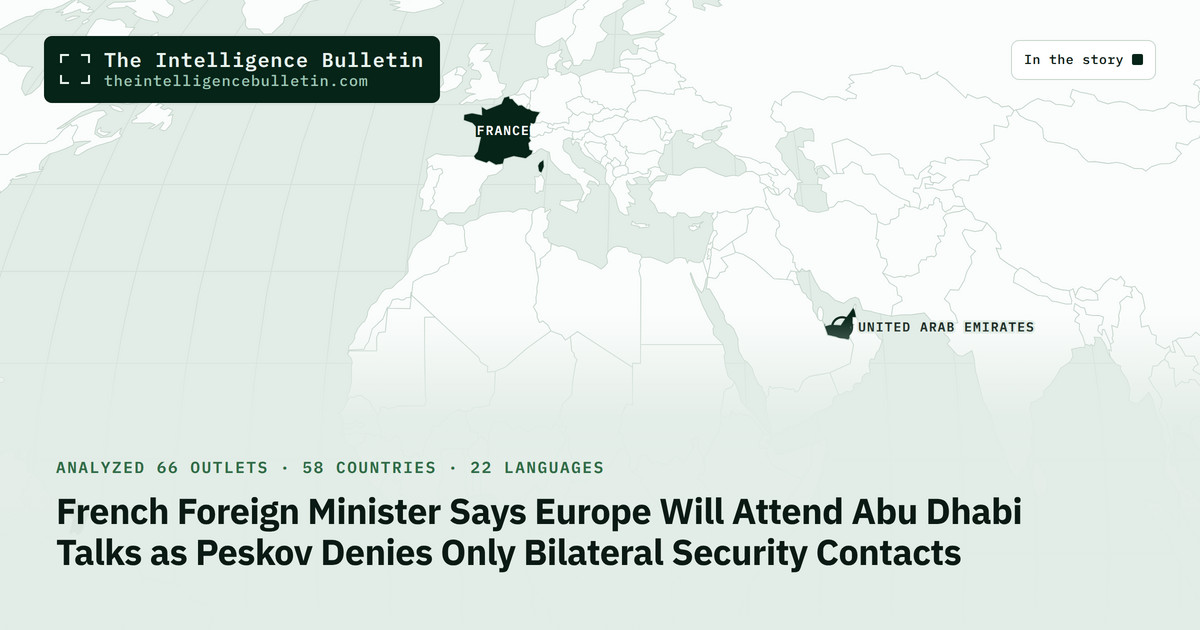
France says European states will be in Abu Dhabi for the Nov. 10-11 U.S.-brokered Russia-Ukraine talks, without specifying whether they negotiate or observe. Moscow 24’s Peskov denies only bilateral security contacts with Europe; Lavrov concedes Europe wants a seat — the contest is format, not entry.
Across the press: Moscow 24’s Peskov concedes Washington consulted Europeans and Lavrov says Europe wants a seat, while KMUW’s headline frames the attendance as defying Kremlin objections.
Source base: 5 outlets read in full (Russia, Ukraine, Germany, United Arab Emirates, United States), selected from 66 analyzed.
- 1 of 5 · TSN onlyJared Kushner is exploring a broader Russia-Europe security dialogue modeled on the NATO-Russia Council, while European officials insist that a Ukraine ceasefire must come before any continental security architecture.TSN, summarizing David Ignatius’s Washington Post column based on sources close to the talks.
- 1 of 5 · KMUW onlyMoscow’s negotiating team will be led again by Vladimir Medinsky and will also include deputy foreign ministers Sergei Ryabkov and Mikhail Galuzin, Yury Zhigarlovsky and military intelligence chief Igor Kostyukov.KMUW, reporting the Russian delegation’s composition; TSN separately names Medinsky as the Kremlin’s lead negotiator.
- 4 of 5 · reported separatelyFrance and other European states will be represented at the Nov. 10-11 Abu Dhabi talks, with France present so that Europe’s voice is heard.French Foreign Minister Jean-Noël Barrot on RTL, reported by Moscow 24, n-tv, Al Bayan and KMUW.
- 2 of 5 · reported separatelyThe Kremlin says Russia has had no contacts with European countries on a security agreement, though Washington has consulted Europeans, and Peskov has said the trilateral format is already agreed.Kremlin spokesman Dmitry Peskov, quoted by Moscow 24 from an interview with Vesti’s Pavel Zarubin; KMUW separately carries the earlier Peskov line on the trilateral format.
- 5 of 5 · reported separatelyThe talks are scheduled for Nov. 10-11 in Abu Dhabi as a U.S.-brokered Russia-Ukraine-US trilateral covering security arrangements, de-escalation, humanitarian issues and next steps.Announced by U.S. envoy Steve Witkoff and repeated across Russian, Ukrainian, German, Emirati and American reporting.
- Nov. 10-11, Abu DhabiWhether any European official is named as a negotiator, and whether the trilateral holds as Moscow says it must.
- Late November, APEC summit in ShenzhenWhether a Trump-Xi-Putin meeting revives the continental security-architecture idea Kushner is exploring.
- JanuaryWhether Russia moves to lock in Trump-era outlines before the new Democratic-controlled Congress arrives.
- After the roundWhether the talks close with a further round scheduled, as former ambassador John Herbst predicts.
- AnsweredYes; this edition’s sources converge on Nov. 10-11 in Abu Dhabi, with Russia, Ukraine and the U.S. all named as participants, according to Moscow 24, TSN, n-tv and KMUW.
- AnsweredEurope has now secured at least a presence: French Foreign Minister Barrot says France and the EU will be represented in Abu Dhabi, though the sources do not specify whether this is direct negotiation or observation.
- Still openDoes Kyiv now formally accept the November 10-11 Abu Dhabi dates, and who will sit for Ukraine, given that Obozrevatel offers no fresh Ukrainian official confirmation or delegation name? · Do France, Germany, the UK, the EU and NATO agree to the Brussels agenda Witkoff announced, or is the list only Washington s framing?
- 03 Nov · US names Abu Dhabi dates for Ukraine-Russia talks as Kremlin confirms but Kyiv stays quiet
- 05 Nov · Witkoff and Peskov set Nov. 10-11 for the Ukraine-Russia-US talks, but Zelenskyy confirms only within a week.
- 07 Nov · Zelenskyy counts nine wounded, Klitschko five, as Russia strikes Kyiv s grid and bridge before Abu Dhabi talks
- 04 Nov · Russia s aif.ru reports clean military strikes on Ukraine s grid as Kyiv Post counts civilian dead before Abu Dhabi talks
Full analysis
What happened Why it matters How each country tells it Where accounts conflict Room for disagreement Our assessment Sources and evidence
What happened
France’s foreign minister said on Sunday that European states, France among them, will be in Abu Dhabi this week when the United States brings Russian and Ukrainian delegations together — an announcement that lands in the gap between a U.S. framing of the Kremlin’s position and the Kremlin’s own words. Jean-Noël Barrot told RTL that France "will be in Abu Dhabi to take part in these discussions" and that "Europe’s voice will be heard," and he did not say who would represent Paris or whether French and other European officials would negotiate or observe; all four of Moscow 24, n-tv, Al Bayan and KMUW carried the statement in matching form. Al Bayan adds his fuller line: such talks sometimes went ahead "without the Europeans, sometimes with the Europeans present… They will participate this time," and that Europeans had recently told the Americans that any discussion of the continent’s future cannot ignore their aspirations or requirements.
The session, announced by U.S. special envoy Steve Witkoff, is a trilateral Russia–Ukraine–United States meeting on Nov. 10–11 covering postwar security arrangements, de-escalation, humanitarian issues and next steps — the fourth U.S.-brokered round and the first since Geneva in February, with earlier rounds making little progress, and Moscow confirmed its return only after Witkoff visited Vladimir Putin in St Petersburg in October.
The Kremlin’s position, carried in full only in Moscow 24, is narrower than the American headline suggests. Spokesman Dmitry Peskov told Vesti’s Pavel Zarubin that Russia had had no contacts with European countries on a security agreement, while conceding that the American side had conducted such consultations with Europeans, and that Europeans still had not decided on a negotiator to represent them. The same outlet quotes Foreign Minister Sergei Lavrov: European states are seeking a seat at the table, their real contribution remains in question, and they do not want the talks to be exclusively between Russia and the United States.
Behind the attendance question sits a larger fight about architecture. TSN, summarizing David Ignatius’s Washington Post column, reports that Jared Kushner is exploring a broader Russia–Europe security dialogue modeled on the NATO–Russia Council, while European officials insist a Ukraine ceasefire must precede any continental security arrangement. Putin received the idea positively at the Oct. 21 St Petersburg meeting with Witkoff, Kushner joining by video, according to TSN; on Nov. 5 Trump met Kremlin envoy Kirill Dmitriev and said a coming deal could "involve all of Europe." Zelenskyy told CNN he had been shown no details and called it dangerous, invoking Yalta.
Delegations: KMUW reports Russia’s will again be led by Vladimir Medinsky, now joined for the first time by deputy foreign ministers Sergei Ryabkov and Mikhail Galuzin, Yury Zhigarlovsky and military intelligence chief Igor Kostyukov. TSN names Ukraine’s delegation leader as Rustem Umerov, whom it identifies as head of the Foreign Intelligence Service, alongside presidential office chief Kyrylo Budanov.
The war did not pause: KMUW reports Russia fired 36 ballistic missiles at the Kyiv area overnight Saturday, four intercepted, and that the Komyshuvakha aid-site toll has reached at least 55 dead; Al Bayan reports more than 600,000 people without power in Dnipropetrovsk region and about 250,000 in Kharkiv after strikes on energy infrastructure.
Why it matters
Whether Europe is in the room at the first broad security conversation since the invasion determines whose postwar settlement this is. Zelenskyy’s Yalta warning, carried by KMUW, names the fear directly: a Europe divided again by great powers, with affected countries outside. TSN’s account of the Washington Post sourcing puts the European stake as sequencing — European officials quoted in the column insist a peace agreement for Ukraine must come before any security-architecture agreement with Moscow — while one European official concedes the Kushner approach creates risks for Europe but says allies are better joining the consultations than staying aside. For Moscow, the format is itself the prize: Peskov’s line that the trilateral is already agreed and Lavrov’s complaint that Europe merely wants a seat, both in Moscow 24, show the Kremlin treating Europe’s presence as a managed intrusion rather than a veto threat. Al Bayan, the host country’s daily, leads with Europe "at the heart" of the Abu Dhabi negotiations, reading the meeting as validation of the Emirates’ stage rather than of Washington’s mediation. KMUW’s broker framing adds the calendar pressure: Russia may want the Trump administration’s outlines locked in before a Democratic-controlled Congress arrives in January, and a possible Trump–Xi–Putin meeting at APEC in Shenzhen later this month hangs over the round.
How each country tells it
- Moscow 24 · Russia · original reportingThe Kremlin’s own voice, via Peskov, denying that Russia has had any contacts with Europe on a security agreement while conceding Washington conducted such consultations with Europeans.
- TSN · Ukraine · carries The Washington PostKyiv’s Ukrainian-language coverage measures the Abu Dhabi diplomacy by what it would do to end the war, centering Jared Kushner’s proposed NATO-Russia Council-inspired format and Europe’s insistence on a ceasefire first.
- n-tv · Germany · original reportingA German rolling live ticker records France’s announcement that Europeans will attend as one item among drone attacks, power cuts, battlefield claims and political accusations.
- Al Bayan · United Arab Emirates · original reportingThe host country’s Arabic daily leads with Europe at the centre of the Abu Dhabi talks, reading the meeting as validation of the Emirates’ role, then shifts to battlefield strikes and power outages.
- KMUW · United States · wire copyU.S. public radio’s broker framing: the round is U.S.-brokered, Europe is joining it over Kremlin objections, and the Russian delegation’s unusual seniority is the new development.
Where accounts conflict
The accounts disagree on what the Kremlin actually objected to, and that determines whether Europe’s arrival is defiance or an expected step. KMUW’s headline and lede state Europe is joining "defying Kremlin objections," and report that Peskov "had earlier ruled out a European role, saying the trilateral format had already been agreed." Moscow 24, the only source carrying Peskov’s remarks directly, has him denying only that Russia has had contacts with European countries on a security agreement — while conceding the United States conducted such consultations with Europeans and complaining that Europeans have not decided who would speak for them — and it quotes Lavrov saying Europe wants a seat at the table. One account describes a Kremlin that closed the door; the other describes a Kremlin that has left the door ajar and is arguing about who walks through and in what order.
Room for disagreement
The strongest case that this changes little is not hard to assemble. John Herbst, the former U.S. ambassador to Ukraine, argues in an Atlantic Council piece carried by KMUW that Putin has rejected every U.S. proposal Kyiv accepted and prefers participating in peace talks to pursuing actual peace; "Perhaps the only outcome of the talks," he wrote, "will be to agree to another round." On that view, the European presence is a pressure valve rather than a seat, while the trilateral format Peskov says is "already agreed" gives Moscow a pretext to dig in if Europeans press for full participation. TSN’s own European source concedes the approach "creates risks for Europe." If the parallel architecture track Kushner is exploring outruns Europe’s ceasefire-first demand, European officials could find themselves inside a process whose sequencing they explicitly distrust — present, but not in control.
Our assessment
It is likely that Europe’s representation in Abu Dhabi will be real but short of a negotiating seat: consultative, with the trilateral format intact. The warrant is the reporting itself. Barrot, quoted in all four of Moscow 24, n-tv, Al Bayan and KMUW, announced presence and a voice without naming a representative or saying whether Europeans would negotiate or observe, and no account names a European negotiator at the table. Peskov’s concession that Washington consulted Europeans and Lavrov’s acknowledgment that Europe wants a seat — both in the Kremlin’s own outlet — show Moscow has already priced in some European presence and is contesting format and sequencing, not the room. The fight that will actually move next is elsewhere: TSN’s reporting on the Ignatius column shows Kushner pushing parallel tracks for Ukraine peace and continental security while European officials insist ceasefire first. That sequencing dispute, not Sunday’s attendance claim, is where the architecture gets decided.
What would change this: a named European principal sitting at the trilateral table in Abu Dhabi.
Sources and evidence
Press quoted
- What is the exact status of European participation — direct negotiation, observation or consultation on the sidelines — and who will represent France and the EU?
- Has Kyiv formally accepted the Nov. 10-11 dates and named its delegation, and are TSN’s named members correct given that it assigns Rustem Umerov and Kyrylo Budanov posts that conflict with their publicly known roles?
- Does the Kremlin’s denial of any Russian-European security contacts extend to the broader Kushner or NATO-Russia Council-inspired format, or only to the formal trilateral track?
That’s how the world told the story.
Get our daily open-source intelligence on world events in your inbox — one email a day, up to six stories.
Subscribe freeNo spam. One-click unsubscribe. See the latest email →