 AI-generated analysis published under the editorial responsibility of Rohit Sinnas. How it works →
See the 58 countries
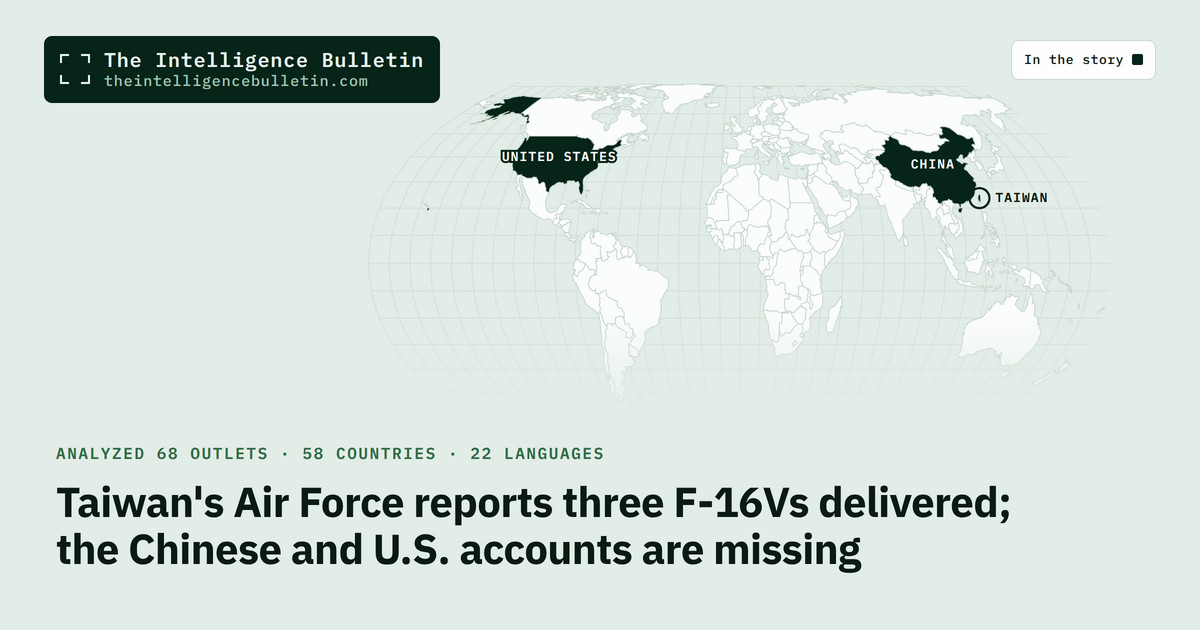
Argentina, Azerbaijan, Bangladesh, Brazil, Bulgaria, Burundi, Canada, Chile, China, Croatia, Cuba, Cyprus, Ecuador, Egypt, France, Germany, Hong Kong, Hungary, India, Indonesia, Iran, Israel, Italy, Japan, Jordan, Kenya, Lebanon, Lithuania, Madagascar, Malawi, Malaysia, Mexico, Morocco, New Zealand, Nigeria, Oman, Pakistan, Peru, Philippines, Poland, Portugal, Qatar, Romania, Russia, Saudi Arabia, Serbia, Slovakia, South Africa, South Korea, Spain, Sri Lanka, Sudan, Taiwan, Thailand, Turkey, Ukraine, United Kingdom, United States
Taiwan’s Air Force says three F-16V Block 70 jets — numbers 6729, 6731 and 6732 — landed at Chihhang Air Base on Nov. 8, second batch of 66 jets in a 2019 US$8 billion sale; no Chinese or U.S. account reached TIB.
Across the press: Taiwan’s CNA reports tail numbers and an eight-billion-dollar sale; Baku’s News.az headlines it as ‘rising China tensions.’
Source base: 4 outlets quoted (Taiwan, Azerbaijan), selected from 68 analyzed. 2 read in full, 2 by their headlines only.
- 1 of 4 · focustaiwan.tw onlyThe three newly arrived jets are numbered 6729, 6731 and 6732.CNA English-service account, citing the Air Force.
- 1 of 4 · focustaiwan.tw onlyThe United States approved the sale of 66 F-16Vs and related equipment to Taiwan in 2019 for about US$8 billion.CNA English-service account.
- 1 of 4 · focustaiwan.tw onlyDeliveries were originally expected to begin in 2023 and be completed by 2026, but technical problems have pushed back the timetable.CNA English-service account.
- 3 of 4 · reported separatelyA second batch of three F-16V Block 70 fighter jets bought by Taiwan from the United States arrived in Taiwan on Nov. 8.Taiwan’s Air Force, carried by CNA’s Chinese headline and its English-service account on focustaiwan.tw; News.az also headlines the arrival, without attribution in the available text.
- Nov. 9, 2026, or the following daysChinese Foreign Ministry or state-media response to the Nov. 8 landing; whether Beijing addresses the delivery and in what register will define the escalation.
- At the next delivery trancheWhether CNA continues to publish tail numbers for each arriving jet and whether any outlet outside Taiwan picks up the delivery.
Full analysis
What happened Why it matters How each country tells it Room for disagreement Our assessment Sources and evidence
What happened
Three F-16V Block 70 fighter jets landed at Chihhang Air Base in Taitung County, southeastern Taiwan, at around 11 a.m. on Sunday, Nov. 8 — the second batch of aircraft Taiwan has received in a deal with the United States. Taiwan’s Air Force announced the arrival, and its state-aligned Central News Agency carried the fullest account: the three jets are numbered 6729, 6731 and 6732, and the Air Force Command said it would proceed with training for the aircraft’s induction into service as planned, gradually building their initial operational capability.
That English-service dispatch by CNA, published on Focus Taiwan, is the only fully fetched account of the delivery in the reporting gathered for this edition. It gives the route — the jets left Lockheed Martin’s factory in South Carolina earlier this month and arrived in Hawaii on Nov. 4 local time, according to media reports the dispatch cites — and it places the landing after a first batch of two F-16V Block 70 jets delivered on Oct. 2. The United States approved the sale of 66 of the fighters and related equipment to Taiwan in 2019 for approximately US$8 billion, the dispatch says, and deliveries were originally expected to begin in 2023 and be completed by 2026 before technical issues pushed the timetable back.
The apparent breadth of the story’s coverage narrows once the entries are inspected. The set TIB gathered holds four items: two are the identical CNA English dispatch at the same Focus Taiwan address, one is the CNA Chinese-language item whose retrievable part is only its headline — reporting that the Air Force’s second batch of three F-16V blk70 jets purchased from the U.S. has arrived at Taitung — and one is a headline from News.az, an Azerbaijani outlet, reading "Taiwan receives new batch of US F-16 Block 70 fighter jets amid rising China tensions." That headline’s text could not be fetched, and it carries no attribution in what was retrieved. No U.S. government account, no Chinese government account, and no second newsroom’s full report reached the reader.
Even within the single CNA dispatch, the evidence splits. The Air Force’s own statement is directly quoted on the training plan and the fact of arrival; the tail numbers are attributed to the Air Force; the South Carolina and Hawaii stages are credited by the dispatch to "media reports." The 2019 approval, the US$8 billion value and the 66-aircraft total appear as the dispatch’s framing, unsourced within the text.
Why it matters
What is at stake is the pace and visibility of a weapons flow into the only territorial flashpoint in East Asia where the delivery of fighter aircraft is itself contested. Five of the 66 F-16Vs are now on the island — two from Oct. 2, three from Nov. 8 — and the Air Force’s decision to publish tail numbers turns an abstract contract into a countable, dated fact. Each airframe a reader can name is a piece of the total program that has moved from possibility to presence, and 61 remain outstanding with the original timetable already broken by the technical delays the CNA dispatch describes.
For CNA, the story is procedural: procurement progress, a training plan, the adverb "as planned" and nothing more. The agency’s retrievable Chinese headline is flatter still — the Air Force’s purchase has arrived at Taitung. News.az, the sole non-Taiwanese voice, frames the same event existentially, placing the jets "amid rising China tensions" and casting the delivery as a flashpoint rather than a milestone. The gap between those two registers is the story’s unresolved tension: one outlet reports what landed, the other what the landing means.
The strategic framing a reader expects from Beijing and Washington does not reach the page because the reporting contains neither. A reader holding only the CNA dispatch knows three particular aircraft are on the ground; a reader holding only the Azerbaijani headline knows a great-power flashpoint has occurred. Neither alone, and not the two together, substitutes for the Chinese and American accounts that would tell the reader how the two governments themselves read the delivery.
How each country tells it
- Central News Agency (CNA) · Taiwan · original reportingFrames the delivery as a neutral procurement and logistics milestone: the Air Force’s second batch of three F-16V Block 70 jets has landed at Taitung.
- focustaiwan.tw · Taiwan · original reportingProvides the fullest account: three jets numbered 6729, 6731 and 6732 landed at Chihhang Air Base, Taitung, at about 11 a.m., with sale history and delivery delays.
- focustaiwan.tw · Taiwan · original reportingIdentical to the preceding focustaiwan.tw entry: the same URL and the same CNA English dispatch.
- News.az · Azerbaijan · original reportingHeadlines the delivery as Taiwan receiving a new batch of US F-16 Block 70 jets ‘amid rising China tensions’, reading it as a US-China flashpoint.
Room for disagreement
The strongest case that this delivery is not a routine procurement milestone is carried by the one non-Taiwanese line TIB could retrieve. News.az’s headline frames the arrival as happening "amid rising China tensions," the only place in the set where the jets are treated as a political act rather than a logistics one. On that reading, five F-16Vs on the island with published tail numbers are the escalation, and the absence of any Chinese account is not a gap in coverage but a substantive silence — a government declining to argue about a line it is understood to treat as already crossed. Nothing in the fetched articles tests that reading, and nothing contradicts it; a Baku-based outlet with no stake in the strait has little reason to invent the tension framing. A reader who accepts it would conclude that the next development is not a statement but an act — further Chinese military activity near Taiwan — and that the source set, by catching only Taipei’s account, has understated what the delivery is for.
Our assessment
It is very likely the next development in this story arrives from outside the current source set — a Chinese state-media or government response, or a U.S. official confirmation — rather than from another Taipei statement. The warrant is structural. The only fully fetched account is Taiwan’s Air Force speaking through its state-aligned Central News Agency, and the only other voice is a Baku headline; each has an interest in the reader seeing the delivery its way, Taipei as routine induction progress and News.az as a flashpoint, and neither is challenged by any other account that reached TIB. The corroborated fact is narrow and solid: three identified jets landed at a named base at a stated hour. What follows is contested by silence, and silence here is itself a position — Beijing has every reason not to concede the delivery as normal, Washington every reason not to announce what it planned long ago. The most probable next open-source development is therefore a response that fills exactly the gap this edition exposes.
What would change this: a fetched, on-record Chinese government or state-media account responding to the Nov. 8 landing, in whatever register, would supply the missing half of the story and force a recalculation of what the delivery means.
Sources and evidence
Press quoted
- What has Beijing said about this second delivery, given that no Chinese outlet is in the selected set and the Taiwanese reports do not relay any PRC response?
- What is the revised completion date for all 66 jets, and which technical issues caused the delay?
- Has the Air Force set a date for the new aircraft to attain initial operational capability, given that it says training will proceed ‘as planned’?
That’s how the world told the story.
Get our daily open-source intelligence on world events in your inbox — one email a day, up to six stories.
Subscribe freeNo spam. One-click unsubscribe. See the latest email →