 AI-generated analysis published under the editorial responsibility of Rohit Sinnas. How it works →
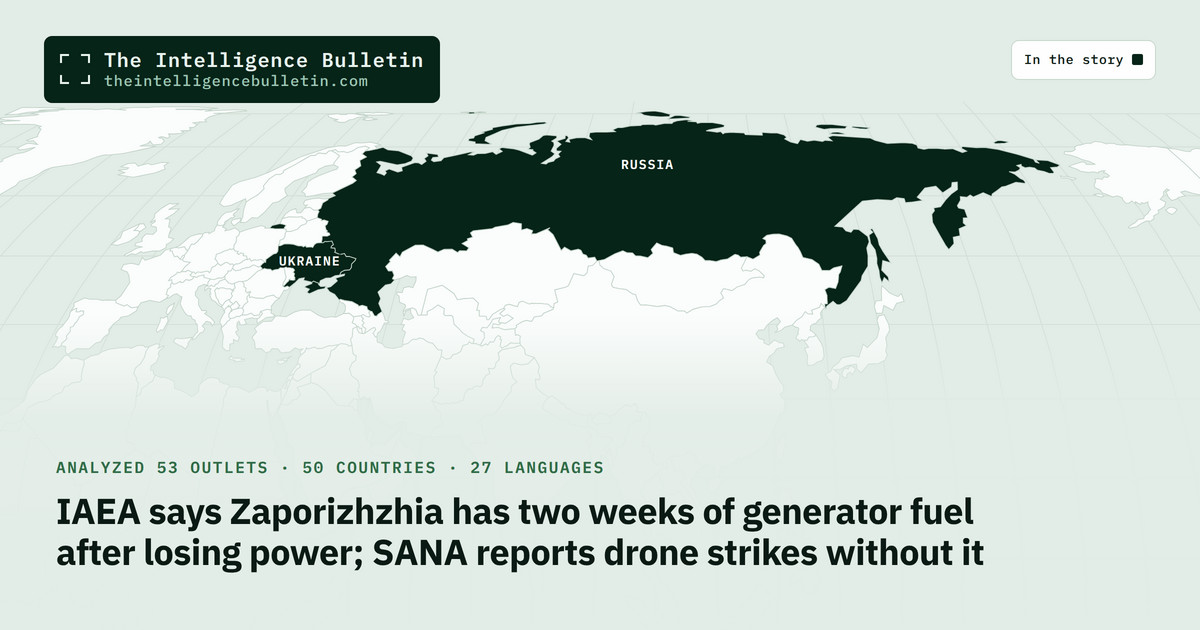
See the 50 countries
Argentina, Armenia, Austria, Azerbaijan, Bangladesh, Belarus, Bosnia and Herzegovina, Brazil, Bulgaria, Canada, China, Colombia, Croatia, Cyprus, Egypt, Georgia, Germany, Greece, Hungary, Japan, Kyrgyzstan, Latvia, Lithuania, Madagascar, Moldova, Montenegro, Morocco, Netherlands, Norway, Poland, Qatar, Romania, Russia, Serbia, Slovakia, Slovenia, South Korea, Spain, Sweden, Switzerland, Syria, Taiwan, Thailand, Turkey, Tuvalu, Ukraine, United Arab Emirates, United Kingdom, United States, Vietnam
The Russian-controlled Zaporizhzhia plant lost external power on November 8 and is cooling its reactors on diesel generators; the IAEA puts fuel at about two weeks, while SANA omits that window and frames the outage within mutual drone strikes.
Across the press: The IAEA’s two-week fuel window appears only in Daily Mail and Asharq Al-Awsat’s Reuters text, while SANA’s Russian-aligned account omits it.
Source base: 5 outlets quoted (Turkey, United Kingdom, Japan, Syria), selected from 53 analyzed. 3 read in full, 2 by their headlines only.
- 2 of 5 · one shared reportThe plant has enough diesel fuel to run a limited number of emergency generators for about two weeks.IAEA, quoted in Daily Mail and Asharq Al-Awsat.
- 3 of 5 · one shared reportThe Ferosplavna line was shut down by automatic protection, and radiation levels on site and in the surveillance zone are normal.The plant’s Russian-installed management in a statement on the MAX messenger app, carried by Daily Mail, SANA and Asharq Al-Awsat.
- 2 of 5 · one shared reportRussian strikes on Dnipropetrovsk energy infrastructure left more than 600,000 residents without power.Ukraine’s DTEK, as reported by Daily Mail and SANA.
- 1 of 5 · Daily Mail onlyThe death toll from the Komyshuvakha aid-centre strike has risen to 55, with more people possibly still under the rubble.President Volodymyr Zelensky, quoted in Daily Mail; emergency services had previously put the toll at 50.
- 5 of 5 · reported separatelyThe Russian-controlled Zaporizhzhia plant lost its external electricity supply and is again using backup diesel generators for reactor cooling.IAEA and the plant’s Russian-installed management, carried by Daily Mail, Nikkei Asia via Reuters, Asharq Al-Awsat via Reuters, and SANA; Anadolu’s headline adds that this is the 27th complete loss.
- November 10-11The Abu Dhabi trilateral talks; whether the outage and grid strikes become negotiating leverage, as Zelensky has suggested.
- Coming daysRestoration of power to Dnipropetrovsk’s more than 600,000 residents and repair of Kharkiv and Zhytomyr infrastructure, showing whether the grid damage is contained.
- Coming daysA final death toll from the Komyshuvakha aid-site strike, as Zelensky says more people may still be under the rubble.
- Still openWhat is the true death toll and number of people still trapped in Komyshuvakha, given the selected sources report 26, 29, 33 or 37 dead and 27, 38 or more than 50 missing? · Will the November 11-12 Abu Dhabi talks proceed as announced, and has Kyiv formally accepted the dates and named its delegation?
- 07 Nov · Zelenskyy counts nine wounded, Klitschko five, as Russia strikes Kyiv s grid and bridge before Abu Dhabi talks
- 04 Nov · Russia s aif.ru reports clean military strikes on Ukraine s grid as Kyiv Post counts civilian dead before Abu Dhabi talks
- 03 Nov · Russia struck an aid site after the Oleshky truce; Ukraine says 31 dead, wire says 29, Bulgarian press 26
Full analysis
What happened Why it matters How each country tells it Room for disagreement Our assessment Sources and evidence
What happened
On Sunday, November 8, the Russian-controlled Zaporizhzhia nuclear power plant in southeastern Ukraine lost its external electricity supply and is again cooling its reactors on backup diesel generators, according to the plant’s Russian-installed management and the UN’s nuclear watchdog, the IAEA. Anadolu Agency’s headline names the event as the 27th complete loss of external power. Daily Mail, Nikkei Asia and Asharq Al-Awsat carry the same Reuters-fed core, and SANA includes the outage in its roundup.
Zaporizhzhia, Europe’s largest nuclear plant with six reactors, produces no electricity but needs power supplied by two external links to keep nuclear fuel cool. It lost its off-site supply after the Ferosplavna power line disconnected. The IAEA said "the cause and location of the latest disconnection are not yet known," while enough fuel reserves remain to operate a limited number of emergency diesel generators for about two weeks, a figure that appears in the Daily Mail and Asharq Al-Awsat texts. The plant’s Russian-installed management said "automatic protection" shut the line, radiation levels on site and in the surveillance zone were normal, and staff were monitoring all equipment parameters in a statement posted on the MAX messenger app.
The outage is part of a long pattern. In early September, a local ceasefire brokered by the IAEA took effect to allow repairs to restore external power, which had been out since August 20. Asharq Al-Awsat notes the IAEA said on October 23 that the main Dniprovska power line remained unavailable. Russia seized the plant in the first weeks of the war that began with its February 2022 invasion, and Moscow and Kyiv have since regularly accused each other of military action that compromises nuclear safety.
The same night brought wider damage across Ukraine. Ukrainian air defenses shot down or neutralized 137 of 164 drones launched by Russia since Saturday evening, SANA reports. Russian strikes on energy infrastructure in the central Dnipropetrovsk region left more than 600,000 residents without power, Ukraine’s DTEK said, a figure carried by Daily Mail and SANA; in the northeastern Kharkiv region, Mayor Mykola Baksheyev said nearly 250,000 customers lost power after a drone hit a critical infrastructure facility. President Volodymyr Zelensky said 140 apartment buildings in the Zhytomyr region were left without heating as temperatures hovered around freezing, and that a Russian FPV drone struck Komyshuvakha, where rescue work was still under way at the aid-distribution site hit the previous week; he raised that attack’s death toll to 55, from the emergency services’ previous 50, and said more people may still be under the rubble.
SANA fills in the Russian side of the same night: Belgorod regional governor Alexander Shuvayev said one civilian was killed and three injured in 138 Ukrainian attacks, and Russian air defenses intercepted or disabled 106 drones over the region, while the Defense Ministry reported 142 drones destroyed over several regions and Kursk’s governor said another 267 were shot down. The Russian Defense Ministry also claimed a strike on an electrical substation near Beloshitsy in the Zhytomyr region that it said supplied military-industrial facilities, plus a hit on a container ship southwest of Odesa.
Why it matters
What is at stake is not the plant’s output—it generates no electricity—but whether its nuclear fuel can be kept cool. The IAEA’s estimate of about two weeks of diesel for a limited number of emergency generators is the real clock, because if external power is not restored by then, the safety margin disappears. Anadolu’s headline, naming this the 27th complete loss, turns the event from a one-off fault into a chronic condition. The same night, Russian strikes knocked out power to more than 600,000 people in Dnipropetrovsk and damaged heating in Zhytomyr, deepening the strain on a grid that must also supply the plant. TIB reported on 7 November that Russia had hit Kyiv’s energy facilities, and on 3 November that the Komyshuvakha aid-site strike killed at least 26 people, with later Ukrainian official tolls of 31 or 33; the toll now stands at 55 in Zelensky’s latest statement.
The political stakes are as live as the technical ones. SANA frames the entire night as a mutual exchange of drone strikes, carrying Russian casualty and air-defense claims; Daily Mail ties the nuclear outage to Russian strikes and civilian blackouts; Asharq Al-Awsat runs the wire account without assigning blame. The IAEA has not said why the Ferosplavna line disconnected. That gap is where the story will be contested, especially with trilateral talks scheduled in Abu Dhabi for Tuesday and Wednesday, and Zelensky accusing Russia of intensifying strikes to pressure Kyiv at those talks.
How each country tells it
- Anadolu Agency · Turkey · original reportingOnly the headline could be read; it frames the outage through the IAEA’s count of the plant’s 27th complete loss of external power, making this a chronic institutional nuclear-safety failure.
- Daily Mail · United Kingdom · carries ReutersFrames the outage as a countdown to catastrophe: about two weeks of generator fuel, 600,000 people blacked out, and a new drone hit at the Komyshuvakha aid site where Zelensky raises the death toll to 55.
- Nikkei Asia · Japan · wire copyRuns the Reuters dispatch in the coolest register, logging that the plant ‘again relies on backup power’ without escalation language, casualty figures, or the watchdog’s 27th-time count.
- Syrian Arab News Agency (SANA) · Syria · original reportingCompresses the day into Russia and Ukraine exchanging heavy drone strikes and treats the plant’s loss of external power as a by-product of that exchange, omitting the two-week fuel window and the 600,000 blackout figure.
- Asharq Al-Awsat · Saudi Arabia · wire copyHandles the outage as neutral world news: the Reuters lead with the IAEA statement and no assignment of blame, followed by unrelated Iran and US political items.
Room for disagreement
The strongest case that this outage is worse than the IAEA’s measured language suggests comes from the reporting itself. The agency says the reason for the disconnection is unknown, while the same night’s strikes left hundreds of thousands without power and hit the Komyshuvakha rescue site again. SANA shows the exchange of attacks continuing at scale, with Russian regions claiming hundreds of intercepted drones. If the Ferosplavna line failed because of damage from fighting, the two-week diesel reserve is not a cushion but a deadline, and previous restorations are no guarantee that grid repair crews can reach the line while attacks continue. On that view, the recurrence is itself the warning.
Our assessment
It is very unlikely that this specific loss of external power leads to a release of radioactive material. The core safety facts are corroborated independently: the plant’s Russian-installed management and the IAEA both report the outage, and both record that radiation levels are normal. The IAEA’s roughly two-week fuel buffer gives time, and the plant has come back from repeated outages before, including through the IAEA-brokered repair ceasefire in September. The most alarming number and the blame frame never converge in one account—Daily Mail and Asharq Al-Awsat carry the two-week clock without a political cause, while SANA provides the mutual-strike context and omits that clock—so the worst reading is not supported by the reporting with direct access to the plant.
What would change this: an IAEA or plant-management confirmation that external power cannot be restored, or that diesel fuel replenishment is blocked, would turn a recoverable outage into a genuine emergency.
Sources and evidence
Press quoted
- What actually caused the Ferosplavna line to disconnect, and is the Russian-installed management’s ‘automatic protection’ account compatible with the IAEA’s statement that the cause and location are not yet known?
- Is external power being restored, and is there a realistic risk that the roughly two-week diesel reserve runs out before reconnection, given that this is the plant’s 27th complete loss of external power?
- Did the same Russian strikes that blacked out 600,000 people in Dnipropetrovsk also knock out the plant’s external line, and does Ukraine’s government attribute the nuclear plant outage to Russia?
That’s how the world told the story.
Get our daily open-source intelligence on world events in your inbox — one email a day, up to six stories.
Subscribe freeNo spam. One-click unsubscribe. See the latest email →