 AI-generated analysis published under the editorial responsibility of Rohit Sinnas. How it works →
See the 34 countries
Australia, Austria, Azerbaijan, Bulgaria, Canada, China, France, Germany, Hungary, India, Indonesia, Ireland, Israel, Jamaica, Kenya, Lebanon, Morocco, Netherlands, New Zealand, Nigeria, Pakistan, Philippines, Poland, Portugal, Saudi Arabia, Singapore, South Korea, Switzerland, Syria, Turkey, United Arab Emirates, United Kingdom, United States, Uruguay
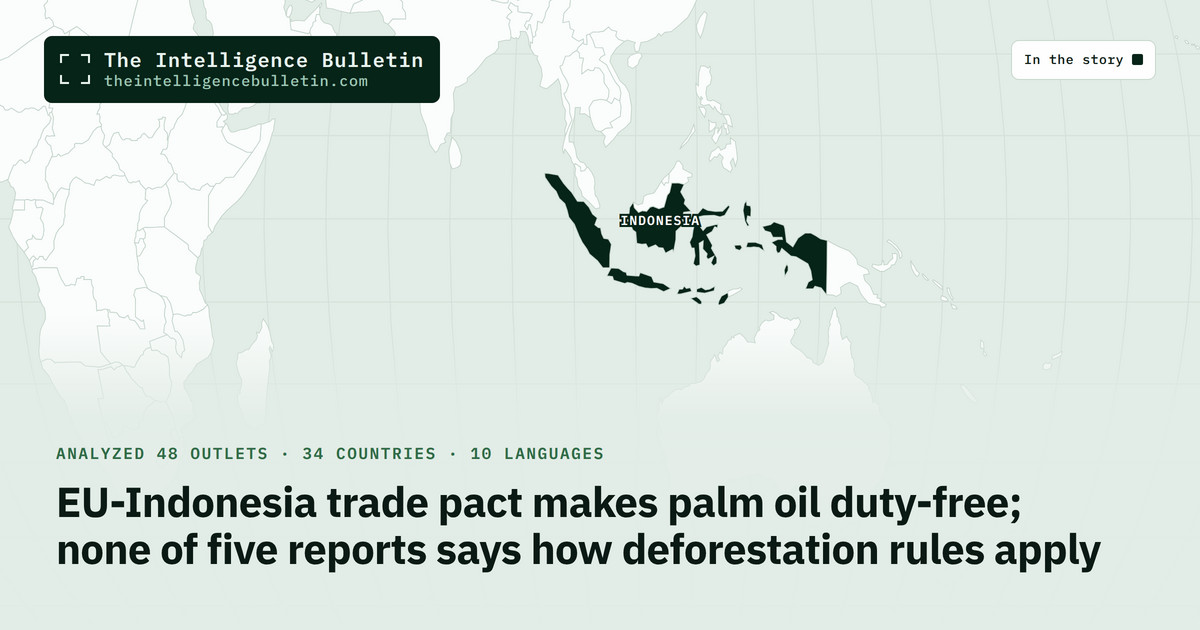
The EU and Indonesia signed a trade and investment pact in Brussels on November 21 that scraps most tariffs, palm oil’s included. Jakarta targets January 1, 2027, but the European Parliament must still consent, and no report says how EU deforestation rules apply.
Across the press: Indonesia’s Beritasatu lists palm oil first among day-one duty-free goods; AFP’s copy calls it a deforestation stumbling block settled by a dedicated protocol.
Source base: 5 outlets read in full (Indonesia, France, Austria, Singapore, Pakistan), selected from 48 analyzed.
- 4 of 5 · reported separatelyIndonesia and the EU signed the Comprehensive Economic Partnership Agreement and a separate Investment Protection Agreement in Brussels on November 21, ending talks that began in July 2016.Beritasatu’s own reporting; AFP copy carried by BFMTV and CNA; The News International
- 4 of 5 · reported separatelyAbout 90 percent (90.4 percent of tariff lines, per Airlangga) of Indonesian goods enter the EU duty-free from entry into force, including palm oil, footwear and textiles, with 8.37 percent phased out over 3 to 15 years or through quotas.Indonesian Economic Affairs Minister Airlangga Hartarto, quoted by Beritasatu and in AFP copy; The News International gives the 90.4 percent figure; only Beritasatu gives the phased share
- 5 of 5 · reported separatelyIndonesia removes tariffs on more than 98 percent of EU tariff lines, saving EU exporters more than €600 million a year in duties (€650 million in Šefčovič’s words to Beritasatu).EU Trade Commissioner Maroš Šefčovič and the EU, via Beritasatu, AFP copy, The News International and the WKÖ release
- 3 of 5 · reported separatelyThe deal includes a dedicated protocol on palm oil and cooperation mechanisms on sustainability, after deforestation disputes stalled the talks.AFP copy citing the agreement’s terms; The News International separately adds binding Paris Agreement commitments
- 5 of 5 · reported separatelyThe pact can apply provisionally only after European Parliament consent and Indonesian ratification, and Jakarta is targeting January 1, 2027.Beritasatu citing the Indonesian government for the date; AFP copy and The News International say 2027 or early next year; the WKÖ urges rapid Parliament approval
- December 11, 2026President Prabowo Subianto visits Brussels, per von der Leyen, the first leaders’ meeting since the signing and a test of political momentum behind ratification.
- Before provisional applicationThe European Parliament votes on consent, where the civil-society opposition BFMTV reports could slow the pact.
- Before provisional applicationIndonesia’s House of Representatives (DPR) ratifies the deal, a step Airlangga said the government is still preparing.
- January 1, 2027Jakarta’s target date for provisional application, which shows whether both legislatures moved within six weeks of signing.
Full analysis
What happened Why it matters How each country tells it Room for disagreement Our assessment Sources and evidence
What happened
On Saturday, November 21, the European Union and Indonesia signed a Comprehensive Economic Partnership Agreement and a separate Investment Protection Agreement at the European Commission’s headquarters in Brussels. The signing closes negotiations that opened in July 2016 and, according to Beritasatu, reached substantive agreement in Bali in September 2025. The Agence France-Presse dispatch carried by BFMTV and CNA lists who attended: Commission President Ursula von der Leyen and Indonesia’s economic affairs minister, Airlangga Hartarto, along with EU Trade Commissioner Maroš Šefčovič and Indonesian Trade Minister Budi Santoso. "This is one of the most ambitious deals the European Union has concluded in Asia," von der Leyen said. She added that together the two sides represent "a market of 730 million people" and that President Prabowo Subianto will visit Brussels on December 11.
The core of the deal is tariffs, and each government described its gains in its own terms. Beritasatu quotes Airlangga saying that 90.4 percent of Indonesian tariff lines go to zero on the first day. Another 8.37 percent are phased out over three to 15 years or through tariff quotas. He named the early winners in order: palm oil and its derivatives first, then garments, fabric, accessories, footwear, leather shoes, sneakers, sports shoes and sandals. The AFP copy rendered his figure as about 90 percent of Indonesia’s exports, and BFMTV’s headline used that version. Tariff lines and export value are different measures, and none of the five texts gives the duty-free share by value.
On the European side, Beritasatu reports Šefčovič telling the ceremony that tariffs fall on more than 98 percent of lines, covering almost all trade value, within 15 years. He put the savings for EU exporters at about €650 million a year, while the AFP copy gives the EU’s figure as more than €600 million. The Austrian Economic Chamber (WKÖ) says in a press release that 80 percent of lines are freed when the deal takes effect and 96 percent of trade after five years. The News International adds two details. Indonesia’s 50 percent tariff on EU cars is phased out over five years, and the EU kept rice, sugar, eggs, fresh bananas and ethanol out of liberalization. Brussels, via AFP, projects that EU exports to Indonesia will rise almost 40 percent within 15 years. It also expects GDP by 2042 to be €16 billion higher for the EU and €27 billion higher for Indonesia than it would be without the deal.
Trade between the two starts out lopsided. Goods trade reached about €28.9 billion in 2025, and BFMTV’s version of the AFP text breaks it down: the EU imported €18.7 billion from Indonesia and exported €10.2 billion. Beritasatu adds more than €9 billion in services trade in 2024 and close to €25 billion of European investment in Indonesia. Brussels says the investment pact opens electric vehicles, electronics and pharmaceuticals, and Beritasatu’s list adds critical minerals and renewable energy.
Palm oil is what held the talks up. The AFP copy calls palm oil and deforestation stumbling blocks and says the pact answers them with cooperation mechanisms on regulation and sustainability and a dedicated palm-oil protocol. The News International says both sides also commit to their Paris Agreement climate obligations. Only BFMTV’s version of the dispatch adds that many European and Indonesian civil-society organizations oppose the deal, and it names none. Beritasatu’s full text mentions neither deforestation nor the protocol nor any opposition.
None of this applies yet. The European Parliament must consent and Indonesia must ratify before the deal can apply provisionally. Beritasatu reports that Jakarta is targeting January 1, 2027, while AFP says early next year. Airlangga said the government is still preparing ratification with the House of Representatives (DPR). The WKÖ called for "rasch grünes Licht" (quick green light) at EU level.
Why it matters
For Indonesia, the deal turns a decade-long fight with Europe over palm oil into duty-free access for palm oil, which tops the minister’s own list. For European makers of machinery and cars, it removes tariffs as steep as 50 percent on vehicles in a country of more than 280 million people. The WKÖ says Indonesia expects growth of almost 5 percent this year. It also cites easier access to raw materials needed for digitalization and the energy transition.
The reporting leaves open the question that will matter most in Europe: how duty-free palm oil fits with the EU’s own deforestation rules. None of the five texts says. The protocol is named, but none of them describes what it contains.
Both governments placed the signing within a wider realignment. Airlangga described it as a milestone amid a changing trade map, geopolitical and geoeconomic tension and rising protectionism. The AFP copy places it within an EU push to diversify trade as it faces challenges from the United States and China. Neither names US tariffs, and no text mentions nickel. The set includes no American, Chinese or Malaysian outlet and quotes no environmental group in its own words. The view of this deal as a hedge against Washington and Beijing therefore belongs to the two governments, and nothing here tests it.
How each country tells it
- Beritasatu · Indonesia · original reportingDatelined Brussels, it presents the deal as an export win, built on Airlangga Hartarto’s line-by-line list of goods at zero tariff from day one, with palm oil first, followed by garments and every kind of shoe.
- BFMTV · France · wire copyIt runs the same agency text as CNA, with von der Leyen’s ‘most ambitious’ quote, the roughly 40 percent EU export rise and Prabowo’s December 11 Brussels visit, under a headline that puts duty-free Indonesian textiles and palm oil first.
- ots.at · Austria · carries Wirtschaftskammer Österreich (WKÖ)This is a press release from the Austrian Economic Chamber (WKÖ) urging rapid European Parliament approval, citing €342 million in extra Austrian export potential by 2031 and easier access to Indonesian raw materials for digital and energy-transition supply chains.
- CNA · Singapore · wire copyIt gives the standard agency account of the ceremony: the ‘ambitious’ quote, the 730-million-person market, the 98 percent EU tariff removal, the roughly 90 percent Indonesian figure, and the palm-oil protocol presented as easing deforestation concerns.
- The News International · Pakistan · original reportingA compact, unbylined summary centered on the terms, including the 98.5 percent and 90.4 percent tariff-line figures and Indonesia’s 50 percent tariff on EU cars, which is phased out over five years.
Room for disagreement
The case for the January date is real. Jakarta announced it publicly, and the 14 months between substantive agreement and signing gave both sides time to prepare. Neither AFP’s "early next year" nor The News International’s "2027" rules it out. European business is also pushing hard. Citing the ITC Export Potential Map, the WKÖ puts Austria’s additional export potential at about €342 million by 2031, and Austrian goods exports to Indonesia, worth €244 million last year, rose more than 21 percent in the first half of 2026. The opposition, by contrast, appears in a single sentence of one outlet’s text, with no group named. The deal’s sponsors designed the palm-oil protocol and the Paris commitments to blunt exactly that opposition. Read this way, the signing was the hard part and ratification will follow.
Our assessment
It is unlikely that the agreement applies provisionally by Jakarta’s January 1 target. The signing left about six weeks for two separate legislative steps, a European Parliament consent vote and DPR ratification, and Airlangga himself said ratification is still being prepared. AFP’s "early next year" is already looser than Jakarta’s date. BFMTV’s report of civil-society opposition in both Europe and Indonesia points to where a Parliament vote could slow. The January date is an Indonesian government target, reported by an Indonesian outlet that quotes only officials, and Jakarta has reason to project momentum ahead of Prabowo’s Brussels visit. Four independent sources agree on the tariff terms: Beritasatu’s own reporting, the AFP copy, The News International and the WKÖ release. What the deal does is therefore settled. When it takes effect, and on what conditions palm oil enters Europe, is not.
What would change this: the European Parliament scheduling a consent vote in December and the DPR ratifying before year’s end.
Sources and evidence
Press quoted
- Can the European Parliament give its consent in the roughly six weeks before Jakarta’s January 1, 2027 target for provisional application, and will the separate Investment Protection Agreement need ratification by each member state’s parliament?
- Once palm oil enters the EU duty-free, how will it be treated under the EU’s deforestation due-diligence rules, which none of these five texts mention, and what does the dedicated palm-oil protocol actually require of Indonesian producers?
- Is the EU’s projected export gain roughly 40 percent within 15 years, about €4 billion on 2025’s €10.2 billion base as AFP reports, or more than €6 billion as Beritasatu reports the EU estimating?
That’s how the world told the story.
Get our daily open-source intelligence on world events in your inbox — one email a day, up to six stories.
Subscribe freeNo spam. One-click unsubscribe. See the latest email →