One Story. Many Angles.
Russian sources stress defensive resolve while Baltic and Polish coverage center the threat to regional security.
The reporting converges on Putin’s exact phrasing at Valdai yet splits on intent and appropriate reply. Russian domestic coverage from Rossiyskaya Gazeta isolates the word ‘immediately’ as proof of unhesitating defense without consultation or pause, framing Moscow as reacting to NATO pressure rather than initiating it. The Moscow Times relays the full Valdai context including Putin’s denial of offensive plans and emphasis on Russia’s unique weapons advantage. Lithuanian reporting centers the direct risk to Baltic states from heightened rhetoric and nearby drills, treating the warning as a regional security alert. Polish commentary goes further by arguing NATO and Poland should openly discuss counter-deterrence options for Kaliningrad despite nuclear signals, viewing credible threats to the exclave as essential leverage. Indian analysis steps back to note the strategic flashpoint without assigning blame, highlighting how both sides interpret the same exercises as defensive or aggressive. The pattern reveals that frontline states treat the statement as an immediate escalation risk while distant observers see it as routine signaling in a multipolar standoff.
Perspective Analysis
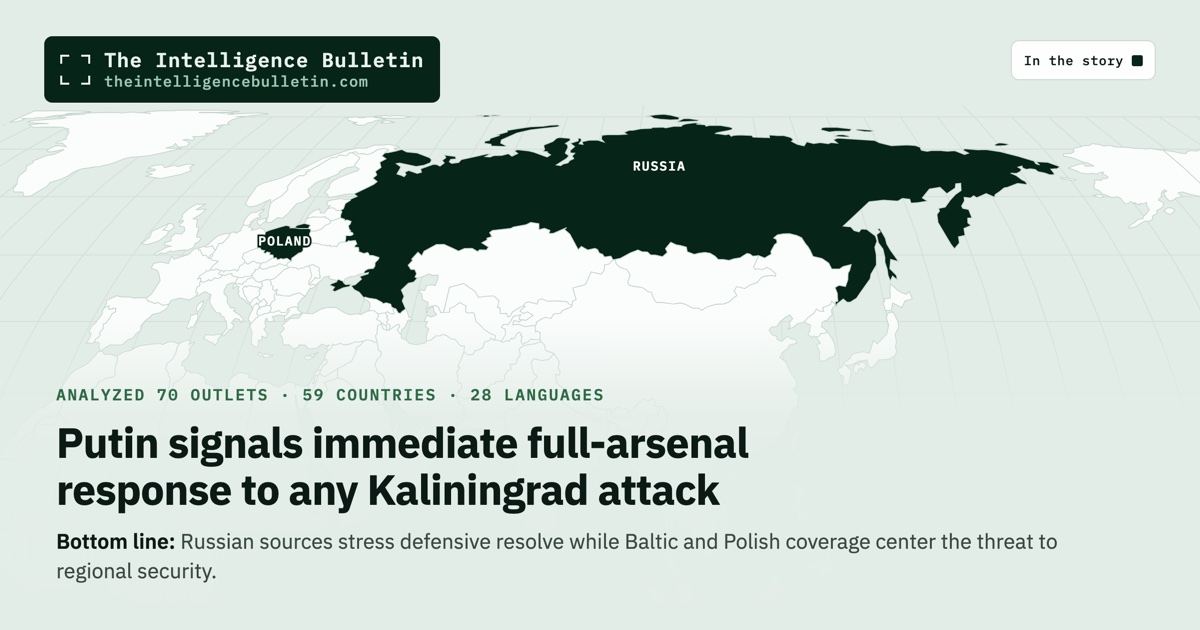
Russian President Vladimir Putin addressed the Valdai Discussion Club on October 1 and stated that any direct attack on the Russian Federation, specifically naming Kaliningrad, would place the question of deploying all weapons at Russia’s disposal on the agenda immediately and without fail. He described the step as inevitable once an attack began. The exclave lies between Poland and Lithuania on the Baltic Sea, separated from the rest of Russia by NATO territory, and hosts the main Baltic naval base along with nuclear-capable Iskander missiles. Putin added that Russia had no intention of attacking any European country and sought peaceful coexistence, while noting that France and Britain possess nuclear weapons and that Russia holds competitive advantages in other systems no other nation matches.
The statement followed a written Russian diplomatic note delivered to NATO earlier in the week. Russian embassies in Belgium, Britain, and Ireland conveyed that Moscow would employ its entire arsenal, including nuclear weapons, should NATO states attempt to isolate Kaliningrad through an air or naval blockade. The note cited recent NATO exercises in the Baltic region, including Baltic Sentry, Steadfast Dart, and BALTOPS, as evidence of unprecedented activity near Russian borders. NATO Secretary General Mark Rutte confirmed receipt of the communication. NATO spokesperson Allison Hart replied that the alliance remains defensive and that none of its activities or exercises pose a risk to any part of Russia. Rutte emphasized that nuclear threats do not help the situation.
Putin returned to the same theme at Valdai, accusing European governments and NATO of raising tensions through repeated military drills in the Baltic Sea and attempts to intercept Russian vessels. He framed these actions as escalation and said European citizens should understand that Russia would respond to aggression. Kremlin spokesman Dmitry Peskov later told journalists that Russia holds no plans to use nuclear weapons and accused Europeans of stirring hysteria on the subject while urging them to control emotions and examine the situation objectively. Peskov pointed to Russia’s military doctrine documents, which outline conditions for certain weapons use solely to protect territorial integrity and state existence.
Lithuanian coverage placed the remarks against the backdrop of recent NATO drills near Kaliningrad and Russian accusations of provocation. It reported Putin’s warning that the full range of weapons would enter consideration in the event of an attack on the exclave, while noting NATO’s rejection of the premise and its insistence that it poses no threat. Polish commentary examined the same exchange through the lens of historical claims on the territory once known as Königsberg and argued that NATO and Poland should retain credible options to neutralize the exclave if needed, even under nuclear rhetoric, because credible deterrence requires demonstrating the ability to shift fighting onto aggressor territory. Indian reporting described the episode as the latest flashpoint in a security dilemma where NATO presents its exercises as protective measures and Russia interprets the same moves as preparation for aggression or blockade.
The accounts converge on the core sequence. Four separate outlets recorded Putin’s Valdai phrasing that an attack would trigger immediate consideration of the entire arsenal. Three outlets independently cited the Russian diplomatic note and its explicit inclusion of nuclear weapons. The same three recorded NATO’s rebuttal that it is a defensive alliance whose activities threaten no Russian territory. Putin’s denial of offensive plans against Europe appeared in the same three reports. These points rest on direct attribution to the Valdai forum remarks and the diplomatic exchanges rather than secondary interpretation.
Divergence appears in emphasis and recommended response. Rossiyskaya Gazeta singled out the adverb “immediately” as the decisive element, interpreting it to mean Russia would forgo consultations, pauses, or expressions of concern. The Moscow Times placed the same sentence inside Putin’s longer remarks on escalation cycles, his denial of plans to attack Europe, and his reference to Russia’s unique weapons as a competitive edge. LRT framed the warning as a direct regional security alert for Baltic states, linking it to nearby drills and Russian charges of provocation. Rzeczpospolita treated the rhetoric as an escalation tactic and urged Poland and NATO to discuss counter-deterrence openly rather than yield the initiative. LiveMint stepped back to note that both sides read the identical exercises in opposing ways and situated the episode inside broader multipolar competition without assigning primary fault.
The pattern shows that outlets in states bordering the exclave treat the statement as an immediate security signal requiring visible countermeasures, while Russian domestic framing presents it as a measured reply to prior Western moves. The exiled Moscow Times supplies the widest single Russian account by retaining both the defensive claim and the acknowledgment of nuclear implications. Distant coverage registers the exchange as routine signaling rather than a discrete crisis. No source in the set reported an energy truce component; the record centers on military posture and the exclave’s vulnerability to isolation.
What to Watch
The corroborated record indicates that Russia has now placed on paper a threshold for full-arsenal response tied specifically to Kaliningrad’s connectivity. NATO’s reply leaves the exercises and drills unchanged while rejecting the blockade premise. Frontline states therefore face the practical question of whether existing deterrence measures suffice or whether additional signaling is required to keep the threshold from being tested. The convergence across independent chains on the precise wording of the Valdai statement and the content of the diplomatic note supplies the strongest available ground for treating the hardening as deliberate rather than rhetorical flourish.