May 22, 2026 – Global Headlines

Map of the countries in the story: May 22, 2026 – Global Headlines

1UCP Motion Pushes Smith Toward Alberta Separation Referendum
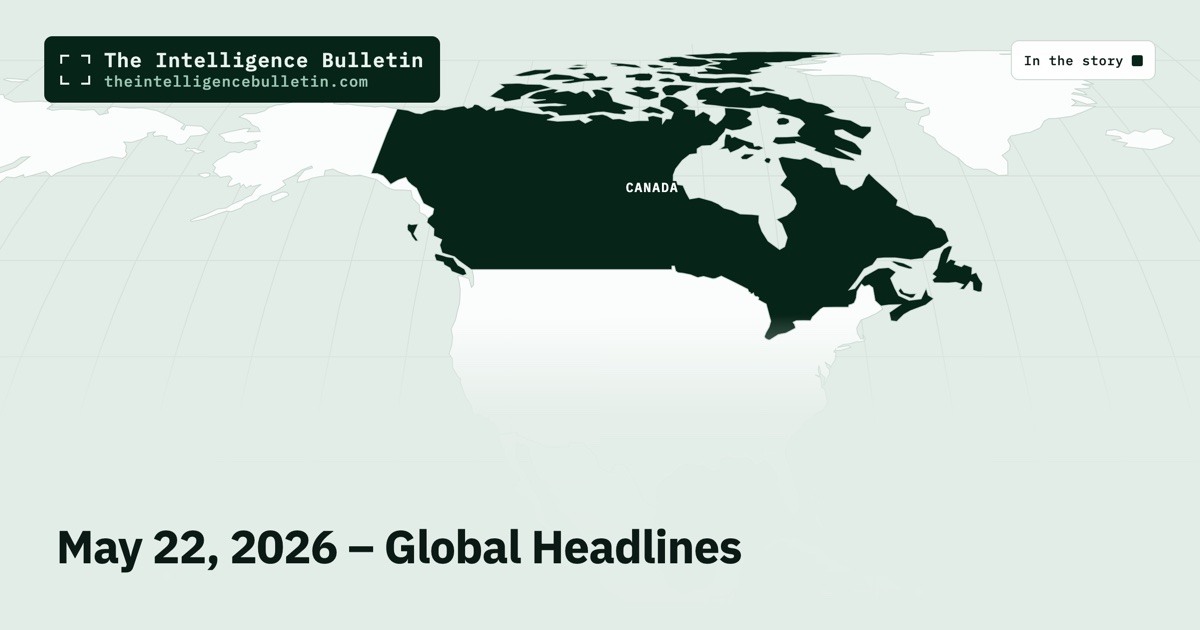
Map of the countries in the story: May 22, 2026 – Global Headlines
Story gist: On May 21 2026 United Conservative members on an Alberta legislature committee in Edmonton introduced a motion directing Premier Danielle Smith and her cabinet to hold a provincewide referendum on Alberta’s status in Canada this October. The move originates from separatist elements inside the governing party and carries an implicit threat to oust Smith if she resists. It exposes friction between provincial autonomy demands and federal unity pressures inside the United Conservative government.
One Story. Many Angles.
🇨🇦
Canada
nationalpost.com
Danielle Smith to put pro-Canada referendum question to Albertans
Read →
🇨🇦
Canada
thestar.com
Danielle Smith announces Alberta vote on whether to start work on separation referendum
Read →
🇨🇦
Canada
calgaryherald.com
Alberta Premier Smith announces referendum to stay in Canada — or to have another referendum
Read →
Perspective Analysis

The most revealing detail across coverage is how quickly Canadian outlets recast an internal UCP revolt as a controlled decision by Premier Danielle Smith herself. National Post frames the coming vote as a pro-Canada question designed to head off outright separation, reflecting its national-conservative preference for managed federalism over open rupture. Toronto Star instead emphasizes the destabilizing risk, portraying Smith’s announcement as an unnecessary concession that hands separatists legitimacy and weakens Ottawa. Calgary Herald sits closer to the provincial grievance line, presenting the referendum as a binary choice between staying or preparing another vote, which quietly validates long-standing Alberta complaints about federal overreach. These differences are not accidental; they track each paper’s structural position. A national conservative daily defends the federation by softening the motion’s edge. A progressive national outlet sees any referendum language as inherently threatening to national cohesion. The regional Alberta paper reflects local elite calculations that treating separation talk as routine politics keeps the UCP intact. What the coverage collectively shows is that no major Canadian outlet treats the motion as a genuine bottom-up separatist surge; all locate the agency inside the governing party’s internal discipline problem. That convergence suggests the story is less about Alberta leaving Canada than about whether Danielle Smith can still control her own caucus.


2GOP Cancels House Vote on Iran War Powers Resolution

Story gist: On May 21 2026 House Republican leaders canceled a planned vote on a resolution to limit President Donald Trump’s authority for military action against Iran without congressional approval. The measure had been advanced by Democrats including Hakeem Jeffries and Gregory Meeks to enforce constitutional checks. It was withdrawn in Washington DC after appearing close to passage with some Republican support. The decision prevents immediate constraints on unilateral executive action toward Iran.
One Story. Many Angles.
🇺🇸
US
nypost.com
GOP calls off vote on Iran war resolution that was on the verge of passing
Read →
🇺🇰
UK
theguardian.com
House Republicans cancel vote on war powers resolution to end US war in Iran
Read →
🇨🇦
Canada
cp24.com
Iran news: Republicans call off vote on Iran war resolution
Read →
Perspective Analysis

House Republican leaders pulled a war-powers resolution that was reportedly on the verge of passing, an unusual move that reveals how quickly partisan lines reassert themselves once executive latitude is at stake. The New York Post frames the cancellation as prudent management of a hastily drafted measure that could tie the president’s hands at a sensitive moment with Iran, aligning with its defense of Republican institutional priorities. The Guardian instead presents the withdrawal as deliberate evasion of accountability, underscoring Democratic arguments that Congress must reclaim its role before any escalation occurs. CP24, writing from Ottawa, places the episode in a wider diplomatic frame, noting that allies worry about unpredictable U.S. military moves and the absence of clear legislative guardrails. This convergence on the basic sequence of events yet divergence in emphasis shows how domestic outlets treat the episode as a test of party loyalty while the Canadian outlet registers the downstream effects on regional stability. The pattern echoes earlier Trump-era clashes over Syria and Yemen authorizations, where procedural maneuvers repeatedly delayed formal congressional votes until momentum dissipated.


3Trump Announces Additional 5,000 US Troops for Poland

Story gist: On May 21, 2026, US President Donald Trump announced the deployment of 5,000 additional American troops to Poland. The move was tied to his relationship with Polish President Karol Nawrocki as part of routine force rotations. No casualties or immediate incidents accompanied the decision. The announcement underscores ongoing US military presence on NATO’s eastern flank.
One Story. Many Angles.
🇹🇷
Turkey
aa.com.tr
US to send 5,000 additional troops to Poland: Trump
Read →
🇦🇿
Azerbaijan
news.az
5,000 more American troops heading to Poland, Trump says
Read →
🇺🇸
United States
article.wn.com
Trump, facing GOP blowback, sends 5,000 troops to Poland
Read →
Perspective Analysis

Turkish and Azerbaijani coverage treats the troop increase as a predictable extension of American commitments in a region both countries watch closely for shifts in Russian and NATO positioning. Anadolu Agency frames the announcement through Ankara’s lens of managing alliance obligations while preserving independent maneuvering room in the Black Sea, where extra US forces could alter balances without directly involving Turkish troops. News.az places the same numbers inside a post-Soviet calculation, noting how the deployment sits alongside Russian reactions and Azerbaijan’s own balancing act between Moscow, Ankara and Washington. In contrast, the US domestic report from article.wn.com inserts an internal political qualifier, highlighting Republican criticism of the decision and portraying it as inconsistent with earlier Trump-era restraint on overseas commitments. This domestic emphasis reveals a fault line: European and post-Soviet outlets register the move primarily as an external security signal, while the American source reads it through the filter of Washington factional politics. The limited variation across the three outlets actually points to a shared recognition that the deployment itself carries low immediate risk yet fits into longer-running calculations about NATO cohesion and Russian tolerance. Turkey and Azerbaijan both avoid speculating on Polish domestic reactions, keeping the focus on how the extra brigade-level presence might affect their own corridor calculations rather than Warsaw’s electoral math.


4Alcolumbre Blocks Reading of Banco Master CPI Requests

Story gist: On May 21 2026 Senate President Davi Alcolumbre rejected reading requests to create a CPMI into Banco Master during a joint session in Brasília. The decision prevented immediate advancement of the inquiry commission despite pressure from Flávio Bolsonaro Nikolas Ferreira and opposition lawmakers. The move followed a dispute involving Banco Master and came after PT and opposition members submitted the petitions. Alcolumbre later apologized to parliamentarians for the procedural refusal.
One Story. Many Angles.
🇧🇷
Brazil
camara.leg.br
Alcolumbre denies requests to read bills for creation of CPI on Banco Master
Alcolumbre nega pedidos de leitura de requerimentos para criação de CPI do Banco Master
Read →
🇧🇷
Brazil
estadao.com.br
Alcolumbre rules out reading requests to create Master CPI now asked by PT members and opposition
Alcolumbre descarta ler requerimentos para criar CPI do Master agora pedida por petistas e oposição
Read →
🇧🇷
Brazil
noticias.r7.com
Alcolumbre avoids installing Banco Master CPMI and apologizes to parliamentarians
Alcolumbre evita instalar CPMI do Banco Master e pede desculpas a parlamentares
Read →
Perspective Analysis

The most revealing detail across coverage is how uniformly Brazilian outlets treat Alcolumbre’s refusal as a procedural fact rather than a partisan rupture yet each still layers its own institutional or audience cue onto that fact. camara.leg.br records the Senate president simply denying the reading of the requests which matches the official record of a joint session where no commission was installed that day. estadao.com.br adds the explicit detail that the petitions came from petistas and the opposition framing the block as the latest move in a running contest over congressional investigative power. noticias.r7.com shifts the emphasis to Alcolumbre’s personal apology to frustrated lawmakers turning the same refusal into a moment of parliamentary drama that resonates with a broader audience. This convergence on the core event alongside small but consistent framing differences shows how even a narrow procedural decision in Brasília is read through each outlet’s established lens without any source inventing a larger scandal. The low market sensitivity noted in the underlying data further explains why the story registers mainly as institutional housekeeping inside Brazil rather than an immediate economic or international trigger.


5Israel Releases and Deports Gaza Flotilla Activists

Story gist: On May 21 2026 Israeli authorities freed activists from the Global Sumud flotilla held at Ktziot prison and prepared their deportation. The group was detained after the navy seized their vessels in international waters while they attempted to reach Gaza. The action follows reports of harsh detention conditions and underscores persistent disputes over maritime access to the territory.
One Story. Many Angles.
🇹🇷
Turkey
yenisafak.com
Activists held by Israel recount experiences: ‘Real heroes are the resisters’
İsrail’in alıkoyduğu aktivistler yaşadıklarını anlattı: ‘Gerçek kahramanlar direnişçilerdir’
Read →
🇮🇹
Italy
leggo.it
Flotilla, the account of the Italian activist after release: ‘On that Israeli ship a concentration camp was set up’
Flotilla, il racconto dell’attivista italiano dopo il rilascio: «Su quella nave israeliana è stato allestito un campo di concentramento»
Read →
🇸🇬
Singapore
channelnewsasia.com
Israel deports all foreign activists from Gaza flotilla
Read →
Perspective Analysis

The swift release and planned deportation of the flotilla activists from Ktziot prison reveals a calculated Israeli effort to neutralize an immediate diplomatic irritant rather than prolong a confrontation that could draw wider attention to naval interdiction tactics. Turkish coverage from Yeni Şafak frames the episode as further proof of resistance heroism, aligning with Ankara’s long-standing rivalry with Israel and its domestic emphasis on Palestinian solidarity to bolster regional influence. Italian reporting in Leggo instead amplifies an activist’s comparison of shipboard conditions to a concentration camp, reflecting a European activist tradition that prioritizes personal testimony to sustain pressure on Israeli policy. By contrast, Channel NewsAsia limits itself to the bare sequence of interception, detention and deportation, consistent with Singapore’s preference for concise factual accounts that avoid entanglement in Middle East narratives. This split underscores how outlets rooted in states with active stakes in the Israeli-Palestinian arena—Turkey through political positioning, Italy through civil-society networks—inject emotive detail, while a non-aligned Asian voice treats the event as a routine consular matter. The absence of broader market or systemic fallout in the GDELT data further explains why the story registers mainly as a human-interest episode outside the region rather than a strategic turning point.
May 21, 2026 – Global Headlines

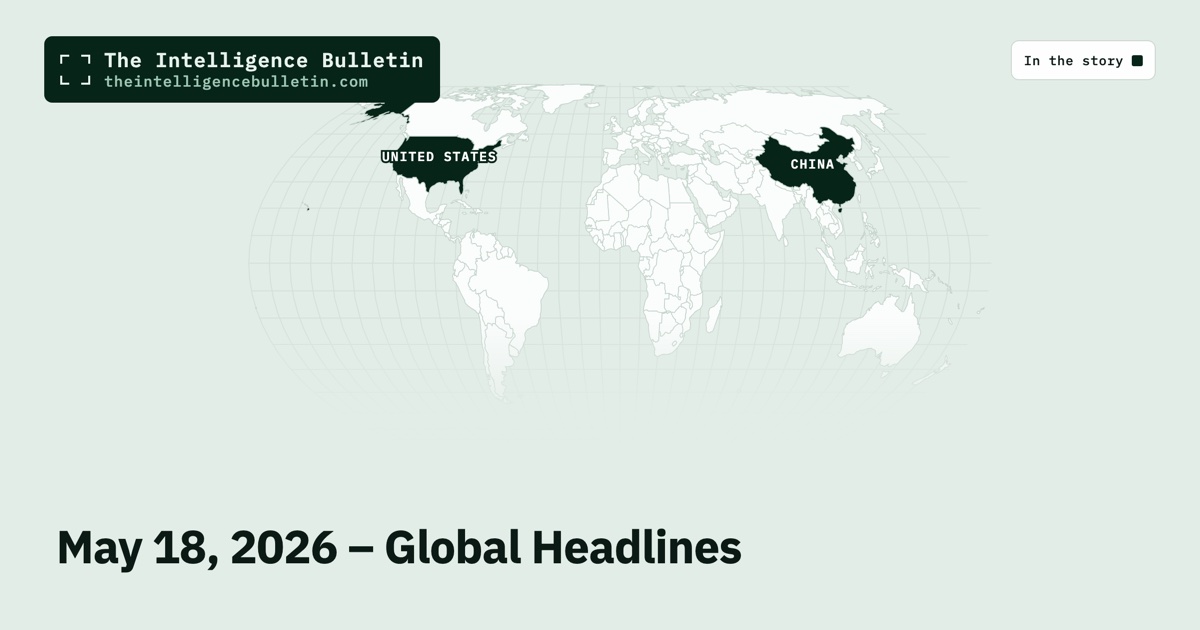
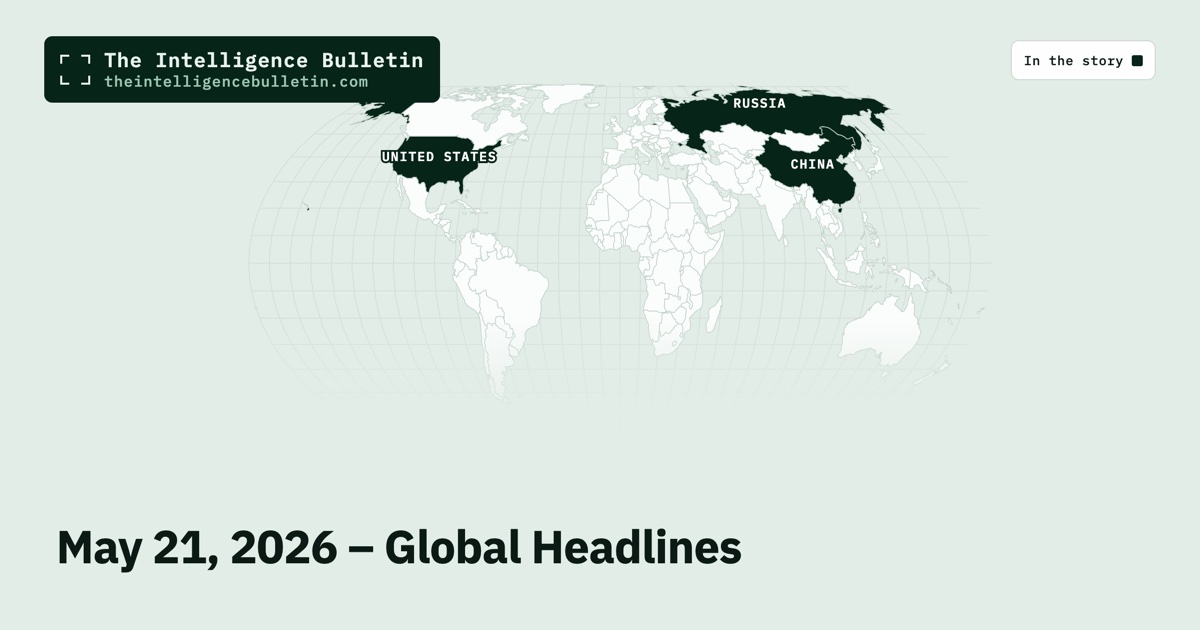
Map of the countries in the story: May 21, 2026 – Global Headlines

1Xi and Putin Extend Treaty to Strengthen China-Russia Ties

Map of the countries in the story: May 21, 2026 – Global Headlines
Story gist: On May 21, 2026, Chinese President Xi Jinping and Russian President Vladimir Putin met at the Great Hall of the People in Beijing. They agreed to extend the China-Russia Treaty of Good-Neighborliness and Friendly Cooperation while signing documents on economy, education, science and technology. The talks deepened bilateral coordination between the two countries. This occurs against a backdrop of prior U.S.-China trade announcements and diplomatic overtures.
One Story. Many Angles.
🇺🇸
United States
wknofm.org
Putin and Xi hail their friendship and growing energy trade at meeting in Beijing
Read →
🇨🇳
China
china.org.cn
Xi, Putin hail ‘new stage’ of ties in Beijing meeting
Read →
🌐
Latin America
noticiaslatam.lat
Putin-Xi meeting reaffirms ‘new century of Eurasia’, analysts observe
La reunión de Putin con Xi reafirma el nuevo siglo de Eurasia
Read →
Perspective Analysis

Beijing’s decision to host Putin for a treaty extension right after Washington announced fresh U.S. farm purchases from China reveals a deliberate balancing act. Chinese state media describes the summit as the arrival of a “new stage” of partnership, emphasizing concrete agreements on energy, media and technology rather than abstract geopolitics. Western coverage, by contrast, focuses narrowly on energy volumes and personal rapport without acknowledging any larger realignment. Latin American outlets go further, casting the encounter as confirmation of an emerging Eurasian century that explicitly challenges Western dominance. The pattern is consistent with earlier reporting on Trump’s public praise for Xi ahead of a planned visit: Beijing is keeping channels open to Washington on trade while locking in long-term security and economic links with Moscow. What stands out is the absence of any mention of Ukraine or sanctions relief in the official readouts; both capitals appear content to let the extended treaty serve as quiet insurance against future pressure. The contrast in emphasis—personal friendship in U.S. reports, institutional upgrading in Chinese ones, and systemic multipolarity in Spanish-language accounts—shows how the same meeting is being used to advance very different narratives about who still sets the terms of great-power relations.


2US Indicts Raúl Castro for 1996 Brothers to the Rescue Shootdown

Story gist: On May 20 2026 U.S. authorities in Miami indicted former Cuban President Raúl Castro and five co-defendants over the 1996 fatal shootdown of two Brothers to the Rescue planes. The charges include conspiracy to kill U.S. nationals, destruction of aircraft, and murder. The action follows a May 14 meeting in Havana between CIA Director John Ratcliffe and Cuban Interior Ministry officials on law-enforcement cooperation. It marks an abrupt escalation in long-standing bilateral friction over the incident.
One Story. Many Angles.
🇺🇸
US
theepochtimes.com
Ex-Cuban Dictator Indicted for Americans’ Deaths
Read →
🇨🇺
Cuba
barrigaverde.net
Cuba describes US accusation against Raúl Castro as infamous political provocation
Cuba califica de infame provocación política acusación de EE.UU. contra Raúl Castro
Read →
🇹🇷
Turkey
aa.com.tr
Cuban president responds to US indictment of former leader Raul Castro
Read →
Perspective Analysis

Just days after U.S. and Cuban security officials met in Havana to discuss law-enforcement cooperation, federal prosecutors in Miami unsealed an indictment that treats the 1996 Brothers to the Rescue shootdown as an ongoing criminal conspiracy rather than a closed Cold War chapter. The move converts what Havana had presented as a tentative diplomatic opening into a unilateral legal offensive. The Epoch Times frames the charges as long-delayed justice against a communist regime, underscoring Raúl Castro’s personal role and the deaths of U.S. citizens. Barriga Verde, reflecting official Cuban messaging, rejects the indictment outright as an “infame provocación política” meant to destabilize the island’s leadership. Anadolu Agency reports the Cuban rebuttal while situating the story within wider non-Western skepticism toward U.S. legal extraterritoriality. The convergence on the basic facts—the date, the planes, the Miami venue—makes the divergence in interpretation more telling: American conservative outlets link the case to anti-communist accountability, Cuban state media defend sovereignty against perceived interference, and Turkish state coverage uses the episode to illustrate limits on Washington’s reach. This pattern mirrors the abrupt pivot from the Ratcliffe talks reported on May 15 to the indictment five days later, showing how domestic political incentives in the United States can override incremental bilateral signals.


3Trump and Netanyahu Clash Over Iran Approach in Heated Call

Story gist: U.S. President Donald Trump and Israeli Prime Minister Benjamin Netanyahu held a heated phone call on May 20, 2026. The leaders disagreed on next steps toward Iran and a new proposal to end the conflict. Netanyahu reportedly ended the conversation upset. The exchange highlights strains in bilateral coordination on regional security.
One Story. Many Angles.
🇺🇸
US
us.cnn.com
Trump and Netanyahu diverge on Iran war’s future in tense phone call
Read →
🇪🇸
Spain
mundiario.com
Trump assures that Netanyahu will do everything he asks on Iran
Trump asegura que Netanyahu hara todo lo que el pida sobre Iran
Read →
🇩🇪
Germany
focus.de
Reports: Heated phone call between Trump and Netanyahu
Berichte: Hitziges Telefonat zwischen Trump und Netanjahu
Read →
Perspective Analysis

Spanish outlet mundiario.com presents the call as confirmation of Trump’s leverage, with Netanyahu portrayed as ready to follow U.S. instructions on Iran. In contrast, CNN stresses policy divergence and friction under the current administration, while focus.de registers the event mainly as diplomatic tension without assigning clear winners. This split reveals how each outlet’s domestic lens shapes the same facts: American coverage ties the disagreement to Trump-era policy management, Spanish reporting accentuates U.S. primacy in the alliance, and German reporting treats the episode as routine transatlantic strain. The low market sensitivity recorded in event data suggests financial actors see little immediate disruption, yet the Goldstein-scale reading of 0.2875 signals measurable political friction. Prior TIB reporting on Trump’s recent China and Cuba engagements shows a pattern of publicized high-level calls that test alliance cohesion rather than resolve it. Readers therefore see not just one tense conversation but the structural limits of personal diplomacy when core interests on Iran remain misaligned.


4Trump Warns Cuba Against Hosting Hostile Operations

Story gist: On May 20 2026 President Donald Trump issued a White House message denouncing Cuba as a rogue state and declaring that the United States would not tolerate hostile military intelligence or terror operations near its territory. He reaffirmed US support for freedom and political change for the Cuban people. The statement follows CIA Director John Ratcliffe’s May 14 talks in Havana on law enforcement and security cooperation.
One Story. Many Angles.
🇷🇺
Russia
actualidad.rt.com
Trump says there will be no escalation with Cuba
Trump afirma que no habra una escalada con Cuba
Read →
🇺🇸
United States
cubaheadlines.com
Trump Warns U.S. Will Not Tolerate Cuba as a Host for Hostile Military and Terrorist Activities
Read →
🇺🇸
United States
cubaheadlines.com
Trump Warns Cuban Regime on Cuban Independence Day: Look What Happened to Maduro
Read →
Perspective Analysis

The clearest signal in this coverage is how little appetite Russian state media shows for portraying any genuine rupture. Actualidad.rt.com led with the claim that Trump had ruled out escalation, turning a presidential warning into evidence of restraint and thereby offering Moscow a quiet counter-narrative at a moment when US-Cuban friction might otherwise be useful. Cuban-American outlets took the opposite tack. Cubaheadlines.com framed the same message as an explicit threat, first stressing that Washington would not accept Cuba as a base for hostile activity and then, in a second dispatch, linking the warning directly to the fate of Nicolás Maduro. That Venezuela analogy is not accidental; it supplies a ready-made script for regime-change expectations among readers who have watched sanctions tighten since the Obama-era thaw collapsed. The timing matters. Only six days earlier a CIA delegation had sat with Cuban Interior Ministry officials in Havana to discuss law enforcement cooperation. The rapid shift from those closed talks to a public White House rebuke suggests Washington is managing two tracks at once: quiet operational contacts alongside louder political signaling. Russian coverage erases the second track; exile media erases the first. Both choices reveal more about the outlets’ respective patrons than about any new facts on the ground.


5Xi and Putin Condemn US and Israel Strikes on Iran

Story gist: On May 20 2026 Chinese President Xi Jinping and Russian President Vladimir Putin issued a joint statement in Beijing. The declaration stated that US and Israeli military attacks on Iran violated international law and threatened Middle East stability. The statement was released during Putin’s official visit to China and published by the Kremlin. It marks a coordinated diplomatic response from Beijing and Moscow targeting Washington and Tel Aviv.
One Story. Many Angles.
🇨🇳
China
china.org.cn
Xi, Putin jointly meet press
Read →
🇹🇷
Turkey
aa.com.tr
Putin calls China trip ‘successful, fruitful and very intensive’ after talks with Xi
Putin calls China trip successful, fruitful and very intensive after talks with Xi
Read →
🇺🇸
United States
zerohedge.com
Xi Warns US Against New Iran Strikes, Denounces ‘Law Of The Jungle’, As Putin Talks Energy Leverage In Beijing Summit
Xi Warns US Against New Iran Strikes, Denounces Law Of The Jungle, As Putin Talks Energy Leverage In Beijing Summit
Read →
Perspective Analysis

The joint statement from Beijing carries weight because it pairs two leaders who rarely issue synchronized public rebukes of specific US military moves. China.org.cn presents the encounter as a unified stand against Western overreach, folding the Iran condemnation into a broader narrative of resisting external interference. AA.com.tr instead stresses the practical diplomatic yield of the talks and flags Turkey’s direct interest in avoiding wider regional fallout given its NATO ties and shared border dynamics with Iran. Zerohedge amplifies the energy-leverage angle and the phrase “law of the jungle,” using the summit to underscore how Moscow and Beijing can exploit sanctions-era oil flows. The convergence across these outlets lies in acknowledging the statement’s existence and its explicit targeting of Washington and Tel Aviv; the divergence appears in which secondary consequence each outlet chooses to foreground. Chinese coverage treats the event as affirmation of an alternative pole, Turkish reporting situates it within immediate neighborhood risk calculations, and the US alternative outlet frames it as evidence that sanctions have created exploitable dependencies rather than isolation. This pattern shows how the same diplomatic text is read first as identity reinforcement in Beijing, then as stability management in Ankara, and finally as proof of sanctions blowback in Washington.


May 20, 2026 – Global Headlines

Map of the countries in the story: May 20, 2026 – Global Headlines

1Trump Settlement Bars IRS Audits of Family and Companies

Map of the countries in the story: May 20, 2026 – Global Headlines
Story gist: On May 19 2026 the Trump administration created a $1.776 billion Treasury and Justice Department fund to settle the president’s IRS lawsuit over tax records. The arrangement was presented as compensation for victims of government weaponization and effectively shields Donald Trump, Donald Trump Jr. and Eric Trump from future tax probes. Key actors include Todd Blanche and the IRS, with Democrats such as Chuck Schumer voicing opposition in Washington. The deal uses existing settlement mechanisms to close the matter permanently.
One Story. Many Angles.
🇺🇸
United States
alternet.org
Legal analysts dismantle Trump’s ‘corrupt’ secret settlement
Read →
🇵🇰
Pakistan
thenews.com.pk
Trump IRS settlement blocks future probes into his family tax issues
Read →
🇦🇺
Australia
afr.com
US tax authorities barred from pursuing claims against Donald Trump, Donald Trump jnr and Eric Trump
Read →
Perspective Analysis

The most striking feature across the coverage is how uniformly outlets record the settlement’s practical effect: the IRS is now barred from pursuing the Trump family or its companies on the very tax issues that sparked the original lawsuit. Australian Financial Review frames this as a clean legal closure with lasting financial consequences for both sides, treating the exemption as a durable structural change rather than a temporary political fix. That emphasis on permanence aligns with the outlet’s focus on predictable business rules and the long-term cost of litigation. In contrast, Alternet presents the same facts as evidence of deliberate institutional corruption, highlighting legal analysts who see the fund as an overt transfer of public money to protect one individual from accountability. The Pakistani outlet The News adopts a cooler register, describing the outcome as another instance of U.S. domestic favoritism that erodes institutional norms without expressing surprise or outrage. What unites these accounts is the absence of any serious dispute over the core mechanics: the settlement uses existing Treasury and Justice authorities to end IRS scrutiny rather than litigating the underlying tax claims to judgment. This convergence suggests the arrangement’s legal architecture is unusually clear even to ideologically distant observers. The deeper tension lies in whether such a mechanism normalizes the use of large settlement funds to resolve disputes involving a sitting president’s private finances, a question left largely implicit but visible in every account’s choice of emphasis.


2Putin Arrives in Beijing for State Visit with Xi Jinping

Story gist: Russian President Vladimir Putin arrived in Beijing on May 19, 2026, for a state visit with Chinese President Xi Jinping. The leaders plan to discuss bilateral ties, energy cooperation including Power of Siberia 2, and international issues. The meeting reaffirms the strategic partnership between Russia and China amid global sanctions and trade shifts. Outcomes may center on economic deals that sidestep Western restrictions.
One Story. Many Angles.
🇨🇳
China
china.org.cn
Putin arrives in Beijing for state visit to China
Read →
🇺🇸
United States
theepochtimes.com
Trump’s Visit Overshadows Putin in China
Read →
🇮🇩
Indonesia
viva.co.id
Tiba di China, Apa yang Sebenarnya Diincar Putin dari Xi Jinping?
Read →
Perspective Analysis

Coverage of Putin’s arrival reveals a quiet consensus that the visit’s real weight lies in energy pipelines and sanctions evasion rather than grand declarations of alliance. Chinese state media presents the encounter as routine consolidation of a multipolar order, with china.org.cn focusing on protocol and partnership language that avoids any hint of external pressure. That framing aligns with Beijing’s long-term narrative of stable relations that predate the Ukraine conflict and continue regardless of Western moves. By comparison, theepochtimes.com positions the same meetings as secondary to Donald Trump’s earlier China trip, arguing that US engagement has already diluted whatever symbolic value Putin hoped to extract. This angle reflects an editorial priority on undercutting CCP narratives by tying every Russian advance to American leverage. Indonesian outlet viva.co.id takes a narrower, transactional lens suited to an ASEAN reader, asking explicitly what Putin wants from Xi in concrete energy and trade terms without invoking ideology or US rivalry. The divergence tracks structural incentives: state outlets in China must project continuity, diaspora or opposition media in the United States seek to diminish Beijing’s optics, and Southeast Asian reporting stays fixed on downstream commercial effects for its own markets. Across all three, the absence of military or ideological language is consistent, underscoring that current Russia-China coordination remains narrowly economic and pipeline-driven rather than a broader strategic bloc.


3Senate Advances Bill to Constrain Trump Iran War Powers

Story gist: On May 19 2026 the US Senate in Washington advanced legislation requiring congressional approval for any continued involvement in the Iran conflict or forcing withdrawal. The procedural vote included a key yes from Republican Sen. Bill Cassidy. It follows President Trump’s May 12 rejection of an Iranian ceasefire proposal. The measure tests limits on executive war powers amid ongoing US-Iran tensions.
One Story. Many Angles.
🇺🇸
US
breitbart.com
Sen. Cassidy Reverses Vote on Iran Resolution After Losing Primary
Read →
🇺🇸
US
theamericanconservative.com
Senate Advances Resolution to Curb Trump’s Iran War Powers
Read →
🇮🇱
Israel
haaretz.com
U.S. Senate Passes Symbolic War Powers Resolution as Trump Vows ‘Very Quick’ End
Read →
Perspective Analysis

The Senate vote landed at a telling moment: just days after Trump publicly dismissed an Iranian ceasefire overture and declared talks dead. What stands out across the coverage is how little attention the actual substance of the bill received compared with the domestic political theater it immediately triggered. Breitbart framed the entire episode around Sen. Cassidy’s reversal, presenting it as post-primary score-settling by a defeated Republican rather than a substantive check on presidential authority. The American Conservative, by contrast, treated the advance of the resolution as a legitimate and overdue reassertion of congressional restraint, consistent with its long-standing skepticism of open-ended Middle East commitments. Haaretz placed the development inside Israel’s immediate security calculus, noting the resolution’s largely symbolic character while underscoring Trump’s simultaneous pledge of a “very quick” resolution to the conflict. The divergence reveals a deeper pattern: American outlets are reading the vote through the lens of Republican internal fractures and institutional power, while the Israeli source registers it primarily as background noise to the risk that US actions could still draw Israel deeper into direct confrontation with Tehran. This split in emphasis tracks the differing stakes each audience perceives when Congress momentarily tugs at the leash on executive Iran policy.


4US Warns of Ongoing Coup Attempt Against Bolivian President Paz

Story gist: On May 20 2026 US Deputy Secretary of State Christopher Landau told the Conference of the Americas in Washington that protests against Bolivian President Rodrigo Paz amount to an active coup. He urged Brazil and Colombia to support Paz and described the unrest as politically motivated and tied to organized crime. The statement positions the United States as a direct actor in the crisis. It follows days of demonstrations in Bolivia challenging the president’s authority.
One Story. Many Angles.
🇲🇽
Mexico
aristeguinoticias.com
United States claims there is a ‘coup in progress’ in Bolivia
Estados Unidos afirma que hay ‘un golpe de Estado en marcha’ en Bolivia
Read →
🇦🇷
Argentina
lanacion.com.ar
US Under Secretary of State said Bolivia faces an attempt at a ‘coup d’etat’
El subsecretario de Estado de EE.UU. dijo que Bolivia se enfrenta a un intento de “golpe de Estado”
Read →
🇨🇷
Costa Rica
teletica.com
Bolivia faces a ‘coup d’etat’, says US Under Secretary of State
Bolivia se enfrenta a un “golpe de Estado”, dice subsecretario de Estado de EE. UU.
Read →
Perspective Analysis

The United States has once again stepped into a Bolivian political crisis by labeling street protests a coup in progress, a move that instantly recalls earlier interventions in the Andes yet drew remarkably uniform reporting across three Latin American outlets. Aristegui Noticias framed the warning as classic US overreach into Mexican readers’ own backyard, where skepticism of Washington’s regional lectures runs deep. La Nación, by contrast, presented the same remarks with a cooler eye toward any left-leaning government in La Paz, treating the organized-crime link as plausible rather than pretextual. Teletica, speaking from a Central American vantage, stressed the diplomatic ripple effects for democratic stability without assigning blame. What stands out is how little any of the three disputed the factual core of Landau’s claim; instead each outlet’s domestic lens quietly shaped whether the US voice appeared intrusive, prudent, or simply inevitable. That convergence on the event itself, rather than on its moral valence, reveals how quickly regional media now treat American statements as structural facts of Andean politics rather than external surprises.


5US Sanctions Cuban Officials After Havana Security Talks

Story gist: On May 19 2026 the US Treasury Department and OFAC imposed sanctions on senior Cuban government and security officials tied to Raúl Castro and the Interior Ministry. The measures follow CIA Director John Ratcliffe’s May 14 delegation visit to Havana for law-enforcement and regional-security discussions. Cuban authorities responded by warning of potential violence if pressure escalates. The action marks a shift from dialogue toward renewed economic restrictions under the Trump administration.
One Story. Many Angles.
🇺🇸
US
theepochtimes.com
US Announces New Sanctions on Cuban Regime
Read →
🇳🇿
New Zealand
nzherald.co.nz
Cuba warns of ‘bloodbath’ if US attacks, as Washington adds pressure with sanctions
Read →
🇪🇸
Spain
lacronicabadajoz.com
United States increases pressure on Cuba by sanctioning more members of the Government and security apparatus
Estados Unidos aumenta su presión sobre Cuba al sancionar a más integrantes del Gobierno y el aparato de seguridad
Read →
Perspective Analysis

The rapid move from CIA-led talks in Havana to fresh sanctions reveals how little room the Trump administration sees for incremental cooperation with Havana. After Ratcliffe’s delegation met Interior Ministry counterparts on May 14 to discuss law-enforcement issues, Washington chose targeted asset freezes that directly hit the security elites who control internal repression and migration policy. This sequence underscores that the United States still treats Cuban security structures as the decisive lever rather than the diplomatic opening some had hoped the Ratcliffe visit represented.

US conservative outlets framed the sanctions as overdue accountability, explicitly endorsing the Treasury’s designation of regime figures. New Zealand coverage instead led with Havana’s “bloodbath” warning, treating the Cuban statement as the central development and casting the sanctions as one more step in an escalatory cycle. Spanish reporting stayed with the mechanics of incremental pressure, describing the additions to existing lists without invoking regime rhetoric or imminent conflict.

The Takeaway

The divergence is structural. Outlets that view Cuba through a Cold-War lens see sanctions as moral clarity; those focused on regional stability register the risk of Cuban retaliation on migration or regional influence operations. The absence of any market or trade angle across the coverage further signals that these sanctions are understood as political instruments, not economic statecraft, even as they arrive only days after bilateral security talks appeared to open a narrow channel.


May 19, 2026 – Global Headlines

Map of the countries in the story: May 19, 2026 – Global Headlines

1Teen Gunmen Kill Three at San Diego Mosque Before Dying by Suicide

Map of the countries in the story: May 19, 2026 – Global Headlines
Story gist: On May 19 2026 two teenage suspects opened fire at the Islamic Center of San Diego killing three adult men including a security guard. Both gunmen died from apparent self-inflicted gunshot wounds. Authorities are treating the attack as a possible hate crime. The incident has drawn scrutiny from U.S. officials and international Muslim communities focused on victim protection and consular verification.
One Story. Many Angles.
🇺🇸
US
redstate.com
Report: Alleged Gunmen in San Diego Mosque Attack Identified
Read →
🇵🇰
Pakistan
thenews.com.pk
Father of 8, killed in San Diego mosque shooting ‘sacrificed his life’ to protect others
Read →
🇮🇩
Indonesia
nasional.kompas.com
Indonesian Consulate Confirms No Indonesian Citizens Were Victims in San Diego Mosque Shooting
KJRI Pastikan Tak Ada WNI Jadi Korban Penembakan di Masjid San Diego
Read →
Perspective Analysis

The San Diego mosque shooting stands out less for the violence itself than for how quickly different outlets stripped away the hate-crime label in favor of narrower institutional concerns. RedState’s reporting centered on the rapid identification of the teenage suspects and the precise sequence of events inside the Islamic Center, avoiding any sustained discussion of motive or community impact. That choice aligns with a domestic conservative preference for incident facts over broader narratives of religious targeting. In contrast, The News International from Pakistan framed one victim as a father of eight who died shielding others, turning the story into an account of sacrifice within the local Muslim community rather than an American law-enforcement matter. The emphasis reflects Pakistan’s consistent pattern of covering attacks on mosques through the lens of communal resilience. Indonesian outlet Kompas took the narrowest diplomatic route, confirming through the consulate that no Indonesian nationals were among the dead; its headline bypassed motive, victims, and U.S. politics entirely to reassure readers that the state had already verified the safety of its citizens abroad. What unites the coverage is the absence of sustained attention to the FBI’s hate-crime investigation or to figures such as Gavin Newsom and Todd Gloria who might normally appear in domestic stories of this type. Instead each outlet defaulted to its core institutional audience—U.S. conservatives seeking suspect details, Pakistani readers seeking communal dignity, and Indonesian readers seeking consular reassurance—revealing how a single incident in California fractures along pre-existing lines of national and ideological priority rather than converging on a shared account of religious violence.


2Putin Arrives in Beijing Days After Trump Visit

Story gist: Russian President Vladimir Putin landed in Beijing on May 18, 2026, for a two-day meeting with Chinese President Xi Jinping. The visit includes talks on bilateral ties and 21 official signings. It follows President Trump’s recent China trip and farm-goods purchase agreement announced the prior week. The timing raises questions about how Russia and China are coordinating amid shifting US engagement.
One Story. Many Angles.
🇲🇽
Mexico
pulsoslp.com.mx
Putin travels to China to strengthen strategic alliance
Putin viaja a China para fortalecer alianza estratégica
Read →
🇨🇳
China
analist.nl
CGTN: Top-level diplomacy consolidates growing cooperation between China and Russia
CGTN: Diplomatie op het hoogste niveau consolideert de groeiende samenwerking tussen China en Rusland
Read →
🇩🇪
Germany
schwaebische-post.de
Kremlin chief Putin travels to China a few days after Trump
Kreml-Chef Putin reist wenige Tage nach Trump nach China
Read →
Perspective Analysis

The most telling detail is how little any outlet treats the Putin-Xi meeting as a direct counter to Trump’s diplomacy. Instead they register it as the latest step in a relationship that has already absorbed the shock of Trump’s May 15 praise for Xi and the subsequent $17 billion annual US farm-goods deal. Mexican coverage from pulsoslp.com.mx simply records the strengthening of a strategic partnership, omitting any US reference and thereby presenting the alignment as an autonomous fact rather than a reaction. CGTN material carried by analist.nl goes further, describing the highest-level diplomacy as consolidating already-growing cooperation, language that quietly erases the American variable altogether. Only the German report in schwaebische-post.de flags the calendar: Putin traveling “a few days after Trump.” That single phrase does the work of reminding readers that Moscow and Beijing are still calibrating their moves to Washington’s latest signals, even when the signals themselves appear conciliatory. The convergence across these outlets therefore points to a deeper structural reality: both Russia and China now treat high-level contact with each other as routine infrastructure, not crisis response, regardless of whether the latest US president arrives bearing tariffs or purchase orders.


3Trump Rejects Iran’s Nuclear Counteroffer as Talks Stall

Story gist: On May 18 2026 a U.S. official said nuclear talks with Iran remain deadlocked and warned that without a shift in Tehran’s position the sides could end up negotiating with bombs. The statement follows President Trump’s rejection of Iran’s latest counteroffer. The United States is the source actor and Iran the target in the event. The warning comes one day after Trump declared the talks on life support.
One Story. Many Angles.
🇮🇱
Israel
ynetnews.com
US says Iran’s new proposal ‘insufficient’ as Trump weighs military options
Read →
🇵🇰
Pakistan
pakistantoday.com.pk
Pakistan Sends Iran Revised Proposal to US to End War
Read →
🇨🇦
Canada
nationalpost.com
Trump warns Iran time running out on deal
Read →
Perspective Analysis

The clearest signal in this cluster is how quickly the stalled nuclear file has moved from diplomatic deadlock to explicit military language. U.S. officials framed the choice for Tehran as change position or face bombs, a formulation that echoes the May 13 rejection of Iran’s ceasefire proposal yet escalates the stakes. Israeli coverage in ynetnews.com immediately linked the warning to open consideration of military options, reflecting Israel’s long-standing focus on Iranian nuclear capabilities as an existential threat rather than a negotiable issue. Pakistani reporting instead highlighted Islamabad’s role in delivering Iran’s revised proposal, underscoring Pakistan’s self-image as a regional mediator between Tehran and Washington. Canadian outlet nationalpost.com stayed closest to the Trump administration’s timeline language, presenting the warning as evidence that time is simply running out. These angles converge on the same core fact: the talks are frozen and the United States has shifted to coercive rhetoric. What differs is the secondary actor each outlet chooses to foreground, revealing how geography and alliance shape which pressure point receives emphasis. The continuity with TIB’s May 13 reporting shows the pattern: each new Iranian proposal is met with swift U.S. dismissal, followed by public statements that raise the military threshold. No outlet in the set disputes the sequence; they differ only in which capital they place at the center of the next move.


4Trump DOJ Creates $1.7 Billion Fund After Dropping IRS Lawsuit

Story gist: On May 18, 2026, the U.S. Department of Justice announced a $1.7 billion Anti-Weaponization Fund tied to settlement of a lawsuit against the Internal Revenue Service. President Trump dropped claims over leaks of his tax returns and alleged prior weaponization of government agencies. The fund targets compensation for claimed victims of political persecution, involving figures such as Donald Jr., Todd Blanche, and scrutiny from Democrats including Jamie Raskin. The action occurred in Washington, D.C., with Treasury Department oversight.
One Story. Many Angles.
🇺🇸
US
yahoo.com
Trump Admin Seems Unable To Answer Questions About New $1.7 Billion Fund That May Go To Jan. 6 Rioters
Read →
🇺🇸
US
eldiariony.com
Trump Government creates $1.7 billion fund to compensate allies alleging political persecution
Gobierno de Trump crea fondo de $1,700 millones para compensar a aliados que alegan persecución política
Read →
🇺🇸
US
inlandnewstoday.com
INT: DOJ sets up $1.8B ‘anti-weaponization’ fund after Trump drops IRS lawsuit
Read →
Perspective Analysis

The swift creation of the $1.7 billion fund reveals a calculated reset of accountability standards inside the second Trump administration. By dismissing the IRS lawsuit over tax-return leaks, the Justice Department converted a personal grievance into an institutional vehicle that now distributes public money to those alleging prior persecution. Yahoo framed the move as opaque and potentially open to Jan. 6 defendants, highlighting unanswered questions about eligibility and oversight. Inland News Today adopted the administration’s own language of an “anti-weaponization” fund, presenting the step as overdue correction rather than new largesse. El Diario NY, writing for Spanish-speaking readers, emphasized restitution for allies who say they faced selective enforcement, avoiding any mention of rioters or political risk. These choices track domestic fault lines more than foreign ones: outlets aligned with the administration stress rectification of past overreach, while skeptical voices focus on possible beneficiaries and lack of transparency. The absence of international coverage is itself telling; the episode registers as an internal U.S. accounting adjustment rather than a development with immediate global stakes, even though the actors—Justice, Treasury, IRS—normally command wider attention when their powers shift. The fund’s scale and the speed of its announcement suggest the White House intends to lock in precedent before congressional pushback can form.


5Rajnath Singh Opens Vietnam Visit to Expand Defence Ties

Story gist: On 18 May 2026 India’s Defence Minister Rajnath Singh arrived in Hanoi to begin a visit also covering South Korea. The agenda centres on deepening strategic military cooperation, defence-industrial partnerships and maritime collaboration between India and Vietnam. Vietnamese officials including Defence Minister Phan Van Giang hosted the talks. The trip occurs as both countries seek to diversify security options in the Indo-Pacific.
One Story. Many Angles.
🇮🇳
India
news.webindia123.com
Focus on deepening strategic military cooperation: Rajnath Singh undertakes visit to Vietnam, S Korea
Read →
🇮🇳
India
bignewsnetwork.com
Focus on deepening strategic military cooperation: Rajnath Singh undertakes visit to Vietnam, S Korea
Read →
🇮🇳
India
calcuttanews.net
Will strengthen robust, mutually trusted defence partnership: Indian Ambassador on Rajnath Singh’s visit to Vietnam
Read →
Perspective Analysis

Indian coverage presents the visit as a straightforward expansion of trusted bilateral defence links rather than a pointed move against any third party. Webindia123 and Big News Network both headline the same phrasing about “deepening strategic military cooperation,” reflecting how New Delhi’s official line travels unchanged through domestic aggregators. Calcutta News narrows the frame slightly by quoting the Indian ambassador on a “robust, mutually trusted defence partnership,” underscoring Vietnam-specific trust-building over broader Indo-Pacific rhetoric. This consensus across outlets reveals that, for Indian media, the story’s value lies in documenting incremental progress in a relationship that has quietly grown since the 2016 comprehensive strategic partnership upgrade. The inclusion of the Neutral Nations Repatriation Commission among the cluster’s entities hints at deeper historical resonance—India’s Korean War-era role still surfaces in bilateral defence dialogues—yet none of the sources dwell on it, preferring forward-looking language on joint production and maritime coordination. The absence of any counter-narrative in the sampled Indian sources suggests the visit is viewed domestically as low-risk and high-consensus, part of a longer pattern of Rajnath Singh’s outreach that already includes recent upgrades with the Netherlands. Readers therefore see not a dramatic geopolitical pivot but the steady institutionalisation of defence ties that both capitals treat as insurance against over-dependence on any single supplier or security partner.


May 18, 2026 – Global Headlines

Map of the countries in the story: May 18, 2026 – Global Headlines

1China to Buy $17 Billion in US Farm Goods Annually

Map of the countries in the story: May 18, 2026 – Global Headlines
Story gist: On May 17 2026 the White House announced that China will purchase at least $17 billion of American agricultural products each year through 2028. The bilateral agreement also includes mutual tariff reductions on select goods still under negotiation. The deal follows President Trump’s recent public praise of ties with Xi Jinping ahead of his China visit and comes amid ongoing trade talks between the two countries.
One Story. Many Angles.
🇺🇸
United States
finance.yahoo.com
US Says China Agrees to Spend Billions on Agricultural Goods
Read →
🇺🇸
United States
benzinga.com
US Says China To Buy At Least $17 Billion Worth Agricultural Goods Annually After Trump-Xi Meet
Read →
🇭🇰
Hong Kong
scmp.com
China will buy at least US$17 billion of US farm goods annually, White House says
Read →
Perspective Analysis

The announcement lands days after President Trump described his relationship with Xi Jinping as fantastic and signaled trade would dominate their upcoming meeting. What stands out is how uniformly the outlets treat the White House fact sheet as the authoritative record rather than probing Chinese confirmation or implementation details. Finance Yahoo frames the commitment as a straightforward export victory for American farmers, while Benzinga highlights the optics for the Trump administration’s negotiating record. South China Morning Post reports the same dollar figure and timeline but situates the purchases within a broader diplomatic exchange that includes reciprocal tariff relief. This convergence suggests the story’s core fact has hardened quickly across markets and regional lenses, revealing a shared journalistic reliance on the initial US disclosure even as Beijing’s Ministry of Commerce has yet to issue its own statement. The absence of Beijing-sourced pushback or caveats in the first 24 hours may indicate either rapid internal alignment or a deliberate pause while negotiators finalize the still-pending levy cuts.


2Taiwan’s Lai Rejects Security Sacrifices Amid Trump-Xi Arms Talks

Story gist: On May 17, 2026, Taiwan President Lai Ching-te stated in Taipei that the island’s security ‘will never be sacrificed or negotiated.’ His remarks responded directly to U.S. President Donald Trump’s recent comments on arms sales and upcoming U.S.-China talks in Beijing. The statement underscores Taiwan’s determination to maintain autonomy amid shifting bilateral negotiations between Washington and Beijing.
One Story. Many Angles.
🇮🇳
India
livemint.com
Lai Says Taiwan Won’t Be Sacrificed as Trump Weighs Arms Deal
Read →
🇫🇷
France
la1ere.franceinfo.fr
La sécurité de Taïwan ne peut faire l’objet d’un marchandage, affirme son président
Read →
🇦🇺
Australia
abc.net.au
Taiwanese president says country will not be sacrificed after Trump-Xi meeting
Read →
Perspective Analysis

Lai Ching-te’s blunt refusal to let Taiwan become bargaining collateral reveals how quickly the island’s fate can be pulled into the orbit of U.S.-China personal diplomacy, especially after Trump’s public praise of Xi Jinping just days earlier. Indian coverage through livemint.com situates the episode inside Quad calculations, treating Lai’s words as evidence that smaller Indo-Pacific states must assert their own red lines rather than wait for Washington to cut deals. Australian reporting on abc.net.au instead folds the story into alliance management, stressing that any U.S. arms transaction with Beijing risks eroding the very deterrence Australia relies upon across the Pacific. French public broadcaster la1ere.franceinfo.fr, writing from its Pacific edition, frames the same statement as a rebuke of transactional bilateralism, contrasting it with the multilateral guardrails Europe prefers. The convergence across these outlets is telling: none treats Lai’s declaration as routine domestic rhetoric. Instead each reads it as a structural warning that Taiwan’s security is now being tested inside a personal channel between two leaders whose last meeting produced no visible restraints on arms flows. That shared reading exposes how little room regional capitals feel they have left once Washington and Beijing begin trading concessions directly.


3Modi and Jetten Upgrade India-Netherlands Ties to Strategic Partnership

Story gist: On May 16, 2026, Indian Prime Minister Narendra Modi met Dutch Prime Minister Rob Jetten at the Catshuis in The Hague. The leaders elevated bilateral relations to a strategic partnership covering semiconductors, defence, sustainability and innovation, with an ASML-Tata Electronics agreement signed. King Willem-Alexander hosted events that referenced historical Indian connections including Rajendra Chola. Coverage highlights investment rankings alongside Modi’s warnings on global crises.
One Story. Many Angles.
🇮🇳
India
loksatta.com
PM Modi expresses concern over global crises and poverty during Netherlands visit
PM Modi Netherlands Visit: This decade disastrous for world; Modi’s concern in Netherlands
Read →
🇷🇺
Russia
russiaherald.com
India-Netherlands strategic partnership
Read →
🇮🇳
India
indiatvnews.com
Netherlands among India’s top five investors
Read →
Perspective Analysis

The most striking element is how Modi’s remarks on a ‘disastrous’ decade for the world land differently depending on the outlet. Loksatta frames the entire visit around those warnings and poverty risks, treating the partnership as secondary to India’s broader concerns. IndiaTVNews instead leads with Netherlands ranking among India’s top five investors and lists the MoUs as straightforward economic wins. RussiaHerald takes a third path, stressing Dutch praise for Modi and positioning the deal as a non-Western success in innovation and semiconductors. This split reveals more than editorial preference. Indian national outlets have institutional incentives to emphasize investment inflows during a strategic visit, while a regional Marathi paper can highlight global instability without the same pressure. Russian coverage, by contrast, uses the same facts to signal multipolar options for India. Since TIB reported the upgrade itself on May 17, the follow-on angles have moved from the announcement to these selective emphases, showing how quickly the story fragments along domestic priorities once the core event is confirmed.


4India Flags Attacks on Hormuz Shipping at UN Council

Story gist: On May 17, 2026, India’s Permanent Representative Parvathaneni Harish spoke at a UN Economic and Social Council meeting in New York. He stated that targeting commercial vessels in the Strait of Hormuz endangers crews and violates freedom of navigation under international law. The remarks targeted unspecified attackers amid heightened regional tensions. India’s intervention highlights its direct interest in protecting energy supply routes through the chokepoint.
One Story. Many Angles.
🇮🇳
India
orissapost.com
At UN, India flags concerns over targeting of vessels in Strait of Hormuz
Read →
🇮🇳
India
newindianexpress.com
Targeting commercial ships impeding navigation in Strait of Hormuz unacceptable: India’s UN envoy
Read →
🇮🇳
India
indiatvnews.com
Targeting commercial shipping impeding navigation in Hormuz unacceptable: India’s UN envoy
Read →
Perspective Analysis

India chose the UN Economic and Social Council to voice alarm over attacks on shipping in the Strait of Hormuz just days after Washington rebuffed Tehran’s ceasefire overtures. All three Indian outlets carried essentially the same account of Harish’s remarks, underscoring that New Delhi views any disruption in the narrow waterway as an immediate threat to its oil imports and broader trade. Orissa Post placed the statement in a regional maritime-security frame, while The New Indian Express and India TV News stressed the legal principle of free navigation, yet none deviated from the core message delivered at UN headquarters. This uniformity across a regional daily, a national broadsheet and a television portal reveals how tightly coordinated the diplomatic signal has become inside India’s foreign-policy apparatus. The timing is not accidental: with Trump still publicly dismissive of Iranian proposals and with BRICS members watching energy-route stability, New Delhi is using the UN podium to register its red line without naming any single actor. The absence of counter-narratives in the coverage further indicates that, for now, Indian outlets see no domestic political gain in questioning the envoy’s line. Instead, the reporting quietly reinforces India’s long-standing doctrine that commercial traffic through Hormuz must remain sacrosanct, a position that aligns with its growing naval reach and its dependence on Gulf crude.


5Pope Leo XIV Forms Vatican Internal AI Study Group

Story gist: On May 17 2026 Pope Leo XIV approved an internal Vatican study group on artificial intelligence. The group will coordinate representatives from dicasteries and pontifical academies to align information sharing projects and policy on AI ethics and governance. The initiative follows the papacy of Francis and precedes Leo XIV’s first encyclical. Coverage across outlets centers on the move as an institutional step rather than a technological deployment.
One Story. Many Angles.
🇩🇴
Dominican Republic
elnacional.com.do
The pope approves the creation of a Vatican commission on artificial intelligence
El papa aprueba la creación de una comisión vaticana sobre la inteligencia artificial
Read →
🇨🇦
Canada
lactualite.com
Pope Leo XIV creates a working group on artificial intelligence
Le pape Léon XIV crée un groupe de travail sur l’intelligence artificielle
Read →
🇺🇸
United States
santafenewmexican.com
Pope creates artificial intelligence study group as Vatican prepares to release his first encyclical
Read →
Perspective Analysis

The quiet establishment of a Vatican AI study group draws attention less for its immediate policy impact and more for what it signals about the new pope’s priorities amid accelerating global tech regulation. Dominican Republic outlet elnacional.com.do presents the decision through a Catholic lens rooted in developing-world concerns over faith and moral authority, framing AI oversight as an extension of traditional doctrine rather than innovation policy. In contrast lactualite.com from Quebec treats the announcement as a philosophical and regulatory development, reflecting Canada’s post-religious secular outlook that views the Vatican primarily as one actor among many shaping AI norms. The Santa Fe New Mexican links the group explicitly to the timing of Leo XIV’s forthcoming encyclical, underscoring an American focus on institutional process and the Vatican’s potential role in broader tech governance debates. These framings converge on the core fact of internal coordination yet diverge in emphasis: Latin American coverage stresses continuity with longstanding Church teaching on human dignity, Canadian reporting highlights procedural modernity, and U.S. wire copy situates the step within encyclical preparation. The absence of market sensitivity or geopolitical actors in the event data explains why outlets avoid speculation about immediate influence on companies like NVIDIA or EU regulators. Instead the coverage reveals a shared recognition that the Vatican’s move functions as a normative signal, arriving as governments and firms race to define AI guardrails. This consensus across ideologically distinct outlets suggests the story’s resonance lies in the Church’s enduring claim to ethical authority even in a field dominated by Silicon Valley and Brussels.


May 17, 2026 – Global Headlines

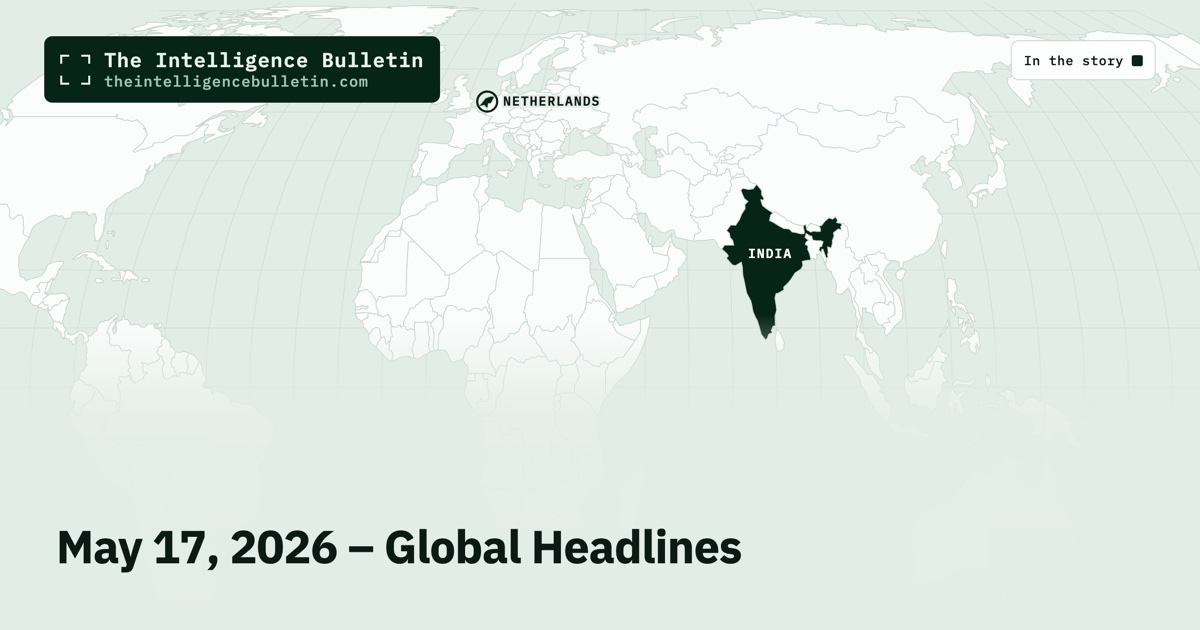
Map of the countries in the story: May 17, 2026 – Global Headlines

1India and Netherlands Upgrade Ties to Strategic Partnership

Map of the countries in the story: May 17, 2026 – Global Headlines
Story gist: On May 16, 2026, Prime Minister Narendra Modi met Dutch Prime Minister Rob Jetten at the Catshuis in The Hague. The two leaders elevated bilateral relations to a strategic partnership covering semiconductors, defence, sustainability and innovation. An ASML-Tata Electronics agreement was signed during the visit. The upgrade builds on existing investment flows with the Netherlands ranking among India’s top five foreign investors.
One Story. Many Angles.
🇮🇳
India
loksatta.com
PM Modi expresses concern over global crises during Netherlands visit
PM Modi Netherlands Visit: This decade disastrous for world; Modi’s concern in Netherlands
Read →
🇷🇺
Russia
russiaherald.com
India-Netherlands strategic partnership
Read →
🇮🇳
India
indiatvnews.com
Netherlands among India’s top five investors
Read →
🇮🇳
India
dailyexcelsior.com
PM Modi meets Dutch royals discusses technology innovation
Read →
🇮🇳
India
ianslive.in
PM Modi holds official bilateral talks with Netherlands counterpart Rob Jetten
Read →
Perspective Analysis

The most striking feature of coverage is how little the partnership upgrade itself is questioned. Indian outlets treat the elevation as a natural extension of existing economic ties, noting that the Netherlands already sits among India’s five largest investors and that the ASML-Tata deal simply formalises semiconductor ambitions long discussed in Delhi. This pragmatic tone contrasts with the single Marathi-language piece that folds the visit into warnings about global disorder and poverty, suggesting the domestic audience is being prepared for a more turbulent decade rather than celebrated for a diplomatic win. Russian Herald’s framing adds another layer by presenting the same agreements as evidence of multipolar technology cooperation that bypasses traditional Western gatekeepers. What none of the reports dwell on is the timing: the upgrade occurs while both capitals navigate U.S. export controls on advanced chips and while Europe seeks to diversify supply chains away from East Asia. The royal meeting with King Willem-Alexander receives only passing mention in one Indian regional paper, yet it quietly underscores the Netherlands’ preference for using monarchy as a low-friction channel for sensitive technology discussions. In short, the coverage reveals a shared assumption that strategic partnerships can be expanded on commercial terms even as the underlying technology competition intensifies.


2Venezuela Deports Alex Saab to US in Rare Cooperation Move

Story gist: On May 17, 2026, Venezuela deported Colombian-Venezuelan businessman Alex Saab to the United States. Saab had been held on bribery charges linked to his role as a frontman for President Nicolás Maduro. The deportation followed U.S. criminal investigations and marked an unexpected act of cooperation between Caracas and Washington. Neighboring countries including Colombia and Brazil are watching for effects on sanctions and regional diplomacy.
One Story. Many Angles.
🇻🇪
Venezuela
el-carabobeno.com
Saime confirmed the deportation of Alex Saab to the US, under the claim that he is a Colombian citizen
Saime confirmó la deportación de Alex Saab a EE.UU., bajo el alegato de que es ciudadano colombiano
Read →
🇫🇮
Finland
yle.fi
Venezuela deports Maduro’s former ally to the United States again
Venezuela karkotti Maduron entisen liittolaisen toistamiseen Yhdysvaltoihin
Read →
🇮🇳
India
livemint.com
Venezuela Deports Saab as Government Steps Up US Cooperation
Read →
🇨🇴
Colombia
pulzo.com
Alex Saab deported to the United States: Venezuela sent him to authorities
Alex Saab deportado a Estados Unidos: Venezuela lo envió a autoridades
Read →
🇧🇷
Brazil
em.com.br
Venezuela deports to the US businessman accused of being Maduro’s frontman
Venezuela deporta aos EUA empresário acusado de ser laranja de Maduro
Read →
Perspective Analysis

Venezuela’s decision to hand over Alex Saab reveals a pragmatic calculation inside the Maduro government that has gone largely unremarked in the coverage. El Carabobeño framed the move as the regime cynically invoking Saab’s Colombian citizenship to deflect domestic blame, a reading that fits its long-standing opposition stance yet still recorded the legal pretext the government itself offered. Yle, by contrast, treated the deportation as straightforward evidence of international legal pressure succeeding, reflecting Finland’s institutional focus on accountability mechanisms rather than Venezuelan politics. LiveMint highlighted the business angle of renewed U.S. engagement, consistent with an Indian outlet attuned to Global South governments weighing sanctions relief against domestic optics. Pulzo emphasized cross-border security fallout for Colombia, unsurprising given its proximity and history of managing Venezuelan migration and crime networks. Estado de Minas struck the most skeptical note, viewing the handover through the lens of Lula-era diplomacy that has long questioned unilateral U.S. sanctions. The shared factual core across these outlets—that Caracas chose to deliver a once-protected associate—suggests the Maduro inner circle now sees selective cooperation as a narrower but necessary survival tactic rather than a broader policy shift.


3Putin Eases Citizenship for Transnistria Residents

Story gist: On May 16, 2026, Russian President Vladimir Putin signed a decree simplifying Russian citizenship procedures for residents of Transnistria, the Moscow-backed breakaway region in Moldova. The move targets the estimated 200,000 people holding Russian passports or eligible for them in the territory that has maintained de facto independence since 1990. It follows Putin’s recent public hints that the broader Russia-Ukraine war is nearing its end. Moldova and neighboring states view the decree as an effort to deepen Moscow’s leverage in the frozen conflict zone.
One Story. Many Angles.
🇲🇩
Moldova
protv.md
Putin extends Moscow’s influence in Transnistria: Residents on the left bank of the Dniester will receive Russian citizenship more easily
Putin extinde influența Moscovei în regiunea transnistreană
Read →
🇵🇱
Poland
wiadomosci.wp.pl
Kremlin opens a new gate. Putin signed a decree for Transnistria
Kreml otwiera nową furtkę. Putin podpisał dekret dla Naddniestrza
Read →
Perspective Analysis

The decree lands at a telling moment, just days after Putin signaled that Russia’s war with Ukraine may be approaching its conclusion. Rather than framing the citizenship change as a routine administrative adjustment, outlets in the region immediately cast it as a deliberate extension of influence into a territory that has long served as a Russian foothold on NATO’s doorstep. ProTV in Moldova, operating in a country that still claims sovereignty over Transnistria, presents the move as direct encroachment on Chisinau’s authority, underscoring how easily Moscow can convert legal residency rules into political tools. Polish coverage from wiadomosci.wp.pl echoes this concern but sharpens it into geopolitical maneuvering, describing the decree as a fresh mechanism for the Kremlin to keep the region tethered even as battlefield dynamics shift. What stands out is the absence of any counter-narrative suggesting humanitarian or administrative motives; both sources treat the policy as self-evidently strategic, reflecting their proximity to the security consequences of a permanently Russian-leaning enclave inside Moldova. This convergence reveals how the story is read less as domestic Russian policy and more as the next chapter in managing frozen conflicts while the active war in Ukraine winds down.


4Trump Warns Taiwan Against Independence After Xi Meeting

Story gist: U.S. President Donald Trump met Chinese President Xi Jinping in Beijing on May 15, 2026. Hours later, Trump publicly cautioned Taiwan against declaring independence. The warning came during remarks following the bilateral summit focused on trade and regional stability. It marks a shift in tone from prior U.S. support for Taiwan amid ongoing China tensions.
One Story. Many Angles.
🇦🇷
Argentina
arroyodiario.com.ar
After his meeting with Xi Jinping, Trump warns Taiwan against any idea of independence
Tras su reunion con Xi Jinping, Trump advierte a Taiwan contra cualquier idea de independencia
Read →
🇩🇴
Dominican Republic
acento.com.do
Trump warns Taiwan against declaring its independence hours after meeting with Xi Jinping in Beijing
Trump advierte a Taiwan en contra de declarar su independencia horas despues de reunirse con Xi Jinping en Pekin
Read →
🇮🇳
India
navbharattimes.indiatimes.com
Donald Trump Taiwan Warning China, effect of Jinping’s threat? Trump makes statement against Taiwan’s independence, says – we do not want war
Donald Trump Taiwan Warning China, Jinaping ki dhamki ka asar? Taiwan ki azadi ke khilaf Trump ne diya bayan
Read →
Perspective Analysis

Trump’s post-summit caution to Taiwan reveals how quickly personal diplomacy with Xi can recalibrate U.S. signaling on the island. Argentine coverage in arroyodiario.com.ar frames the episode through Latin America’s lens of great-power economic leverage, noting Trump’s remarks as a pragmatic concession that protects trade deals rather than ideological commitments. In contrast, acento.com.do relays BBC Mundo material that embeds the warning inside broader Western concerns over democratic norms and alliance credibility, treating the statement as a potential erosion of the status quo that has kept peace since 1949. Indian reporting from navbharattimes.indiatimes.com places the exchange inside South Asia’s competitive triangle, highlighting how any U.S. softening on Taiwan could free Beijing to intensify pressure along the Himalayas. Across these accounts the common thread is not disagreement over facts but recognition that Trump’s direct engagement with Xi has produced an immediate, public boundary on Taiwanese actions, echoing the May 14 praise for Xi ties that preceded the Beijing visit. This convergence suggests outlets view the episode less as rupture than as evidence that personal rapport now shapes red lines once managed through formal channels.


5India and UAE Sign Energy and Defence Pacts in Modi Visit

Story gist: On May 16, 2026, Prime Minister Narendra Modi met UAE leaders including Khalid bin Mohamed bin Zayed Al Nahyan during a state visit. India and the UAE signed agreements covering energy supplies through Indian Strategic Petroleum Reserves Limited and Abu Dhabi National Oil Company plus defence cooperation involving both nations’ ministries. Vikram Misri represented Indian diplomatic efforts alongside UAE officials such as Hamdan bin Zayed Al Nahyan. The deals target India’s energy security and expanded strategic ties between the two countries.
One Story. Many Angles.
🌐
UAE
arabherald.com
India-UAE sign major agreements to enhance strategic partnership in defence cooperation
Read →
🇮🇳
India
dailyexcelsior.com
India, UAE sign landmark energy, defence pacts during Modi’s visit
Read →
Perspective Analysis

The joint emphasis on energy security and defence hardware reveals a pragmatic convergence between New Delhi and Abu Dhabi that goes beyond routine diplomatic pleasantries. Arab Herald presents the pacts as a Gulf initiative that strengthens regional leverage through closer Indian alignment, highlighting how Abu Dhabi National Oil Company commitments secure long-term export routes while defence clauses add military depth. Daily Excelsior, by contrast, centers the narrative on Modi’s personal diplomacy delivering concrete gains for Indian Strategic Petroleum Reserves Limited and Ministry of External Affairs priorities. Both accounts converge on the same core outcome without evident friction because the underlying interests align tightly: the UAE gains a reliable large-market partner outside traditional Western channels, while India locks in diversified crude supplies and technology transfers at a moment when global energy routes face repeated disruption. This shared framing underscores how energy and defence have become the default currency of India-Gulf relations, eclipsing older cultural or labour-migration themes that once dominated coverage. The absence of any critical notes on implementation timelines or pricing terms in either outlet further signals that the agreements are being treated as foundational rather than transactional, a structural choice that reflects the strategic weight both capitals now assign to the partnership.