 AI-generated analysis published under the editorial responsibility of Rohit Sinnas. How it works →
1Xi and Putin Extend Treaty to Strengthen China-Russia Ties
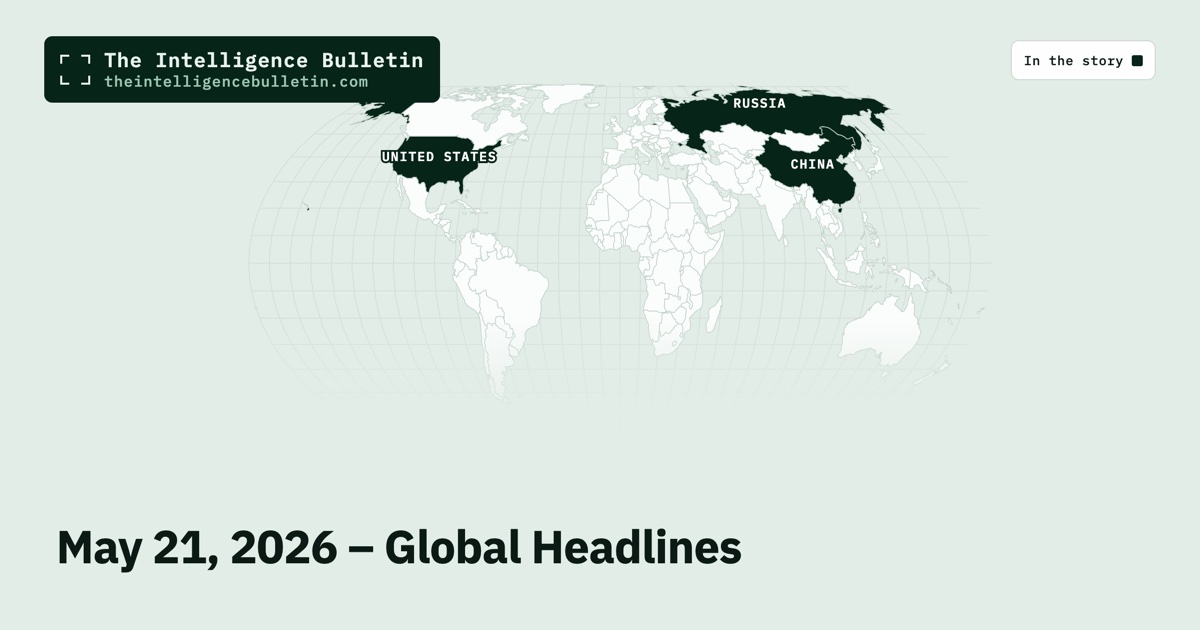
Beijing’s decision to host Putin for a treaty extension right after Washington announced fresh U.S. farm purchases from China reveals a deliberate balancing act. Chinese state media describes the summit as the arrival of a “new stage” of partnership, emphasizing concrete agreements on energy, media and technology rather than abstract geopolitics. Western coverage, by contrast, focuses narrowly on energy volumes and personal rapport without acknowledging any larger realignment. Latin American outlets go further, casting the encounter as confirmation of an emerging Eurasian century that explicitly challenges Western dominance. The pattern is consistent with earlier reporting on Trump’s public praise for Xi ahead of a planned visit: Beijing is keeping channels open to Washington on trade while locking in long-term security and economic links with Moscow. What stands out is the absence of any mention of Ukraine or sanctions relief in the official readouts; both capitals appear content to let the extended treaty serve as quiet insurance against future pressure. The contrast in emphasis—personal friendship in U.S. reports, institutional upgrading in Chinese ones, and systemic multipolarity in Spanish-language accounts—shows how the same meeting is being used to advance very different narratives about who still sets the terms of great-power relations.
2US Indicts Raúl Castro for 1996 Brothers to the Rescue Shootdown
Just days after U.S. and Cuban security officials met in Havana to discuss law-enforcement cooperation, federal prosecutors in Miami unsealed an indictment that treats the 1996 Brothers to the Rescue shootdown as an ongoing criminal conspiracy rather than a closed Cold War chapter. The move converts what Havana had presented as a tentative diplomatic opening into a unilateral legal offensive. The Epoch Times frames the charges as long-delayed justice against a communist regime, underscoring Raúl Castro’s personal role and the deaths of U.S. citizens. Barriga Verde, reflecting official Cuban messaging, rejects the indictment outright as an “infame provocación política” meant to destabilize the island’s leadership. Anadolu Agency reports the Cuban rebuttal while situating the story within wider non-Western skepticism toward U.S. legal extraterritoriality. The convergence on the basic facts—the date, the planes, the Miami venue—makes the divergence in interpretation more telling: American conservative outlets link the case to anti-communist accountability, Cuban state media defend sovereignty against perceived interference, and Turkish state coverage uses the episode to illustrate limits on Washington’s reach. This pattern mirrors the abrupt pivot from the Ratcliffe talks reported on May 15 to the indictment five days later, showing how domestic political incentives in the United States can override incremental bilateral signals.
3Trump and Netanyahu Clash Over Iran Approach in Heated Call
Spanish outlet mundiario.com presents the call as confirmation of Trump’s leverage, with Netanyahu portrayed as ready to follow U.S. instructions on Iran. In contrast, CNN stresses policy divergence and friction under the current administration, while focus.de registers the event mainly as diplomatic tension without assigning clear winners. This split reveals how each outlet’s domestic lens shapes the same facts: American coverage ties the disagreement to Trump-era policy management, Spanish reporting accentuates U.S. primacy in the alliance, and German reporting treats the episode as routine transatlantic strain. The low market sensitivity recorded in event data suggests financial actors see little immediate disruption, yet the Goldstein-scale reading of 0.2875 signals measurable political friction. Prior TIB reporting on Trump’s recent China and Cuba engagements shows a pattern of publicized high-level calls that test alliance cohesion rather than resolve it. Readers therefore see not just one tense conversation but the structural limits of personal diplomacy when core interests on Iran remain misaligned.
4Trump Warns Cuba Against Hosting Hostile Operations
The clearest signal in this coverage is how little appetite Russian state media shows for portraying any genuine rupture. Actualidad.rt.com led with the claim that Trump had ruled out escalation, turning a presidential warning into evidence of restraint and thereby offering Moscow a quiet counter-narrative at a moment when US-Cuban friction might otherwise be useful. Cuban-American outlets took the opposite tack. Cubaheadlines.com framed the same message as an explicit threat, first stressing that Washington would not accept Cuba as a base for hostile activity and then, in a second dispatch, linking the warning directly to the fate of Nicolás Maduro. That Venezuela analogy is not accidental; it supplies a ready-made script for regime-change expectations among readers who have watched sanctions tighten since the Obama-era thaw collapsed. The timing matters. Only six days earlier a CIA delegation had sat with Cuban Interior Ministry officials in Havana to discuss law enforcement cooperation. The rapid shift from those closed talks to a public White House rebuke suggests Washington is managing two tracks at once: quiet operational contacts alongside louder political signaling. Russian coverage erases the second track; exile media erases the first. Both choices reveal more about the outlets’ respective patrons than about any new facts on the ground.
5Xi and Putin Condemn US and Israel Strikes on Iran
The joint statement from Beijing carries weight because it pairs two leaders who rarely issue synchronized public rebukes of specific US military moves. China.org.cn presents the encounter as a unified stand against Western overreach, folding the Iran condemnation into a broader narrative of resisting external interference. AA.com.tr instead stresses the practical diplomatic yield of the talks and flags Turkey’s direct interest in avoiding wider regional fallout given its NATO ties and shared border dynamics with Iran. Zerohedge amplifies the energy-leverage angle and the phrase “law of the jungle,” using the summit to underscore how Moscow and Beijing can exploit sanctions-era oil flows. The convergence across these outlets lies in acknowledging the statement’s existence and its explicit targeting of Washington and Tel Aviv; the divergence appears in which secondary consequence each outlet chooses to foreground. Chinese coverage treats the event as affirmation of an alternative pole, Turkish reporting situates it within immediate neighborhood risk calculations, and the US alternative outlet frames it as evidence that sanctions have created exploitable dependencies rather than isolation. This pattern shows how the same diplomatic text is read first as identity reinforcement in Beijing, then as stability management in Ankara, and finally as proof of sanctions blowback in Washington.
That’s how the world told the story.
Get our daily open-source intelligence on world events in your inbox — one email a day, up to six stories.
Subscribe freeNo spam. One-click unsubscribe. See the latest email →