One Story. Many Angles.
US outlets stress missing body-camera footage and legal process while Venezuelan coverage centers the victim’s untreated pain inside detention.
The reporting across five outlets shows broad agreement on the core sequence—shooting during a DoorDash stop, transfer to detention with bullet in place, and lawyer statements about pain and isolation—yet splits sharply on what the episode illustrates. CBS News, drawing on law-enforcement sources, centers the procedural gap that the shooting officer wore no body camera, a detail that escalates scrutiny of accountability mechanisms under expanded enforcement. NBC News and the South China Morning Post, the latter carrying AFP copy, foreground Garces Perez’s own account of pain and the rushed hospital release, treating the medical neglect claim as the immediate human story. La Verdad, reporting from Venezuela, relays the attorney’s X posts almost verbatim and adds the counter-claim that Garces Perez entered legally through the prior administration’s app, directly challenging the DHS narrative of illegal entry under Biden. Der Spiegel alone frames the incident as a predictable outcome of Trump’s second-term deportation drive, citing the pattern of violent encounters and placing the bullet-in-body detail inside a wider critique of migration policy. The convergence on the lawyer’s medical allegations across independent chains makes those claims the most corroborated element; the entry-method dispute remains single-source from the attorney. No outlet supplies an on-record ICE account of the chase or shots fired, leaving the tactical details contested by omission rather than contradiction.
Perspective Analysis
On September 20, 2026, an ICE officer shot 28-year-old Venezuelan Wilber Rafael Garces Perez in the upper torso while Garces Perez delivered food for DoorDash in Austin, Texas. Garces Perez had been driving a blue Toyota Corolla when, according to his attorney Kate Lincoln-Goldfinch, an unmarked black truck sideswiped his vehicle, chased him after he made a U-turn, and then agents fired. A witness who spoke to Noticias Telemundo described hearing gunshots and seeing agents surround the car. Austin police released dash-cam and body-camera footage from responding local officers that captured the aftermath but not the moments leading to the shots. Garces Perez was taken to a hospital, treated for the wound near his clavicle, and then transferred into ICE custody at the South Texas Detention Complex in Pearsall.
Department of Homeland Security statements, reported by CBS News, NBC News and La Verdad, described Garces Perez as subject to a final deportation order after entering the country illegally during the Biden administration. He was listed in stable condition and held pending removal. Lincoln-Goldfinch countered that Garces Perez had entered legally through the CBP One application in 2024, applied for asylum, and held a valid work permit. She said a notice to appear had been mailed to an outdated address, leading to an in-absentia deportation order. The attorney filed a habeas petition; on September 21 a U.S. District Court judge ordered Garces Perez to appear in person for a hearing on September 30, blocking deportation until then.
From detention Garces Perez spoke by phone on September 21. He told reporters he remained in pain, that doctors had not removed the bullet because of its proximity to the spinal cord, and that ICE had pressed the hospital for a quick release. He reported receiving only an unknown pill for pain relief after arriving at the facility around 4 a.m., sleeping on the floor in a cold room, and later experiencing loss of feeling on his left side. Lincoln-Goldfinch posted on social media that another detainee described officers handling Garces Perez roughly, after which he lost sensation in his arm and leg and was returned to a hospital in restraints. CBS News reported that Representative Joaquin Castro visited the detention center and learned Garces Perez was receiving only Tylenol and ibuprofen. Democratic Representative Greg Casar called for his immediate release to medical care.
The officer who fired has not been publicly identified. CBS News, citing law-enforcement sources, reported that the officer joined ICE the previous year after serving as a Border Patrol agent and was not wearing a body camera. Homeland Security Secretary Markwayne Mullin had stated earlier in September that all ICE officers would receive body cameras by the end of the month. No on-record account from ICE or the officer has described the sequence of the vehicle pursuit or the decision to shoot. Austin police chief Lisa Davis stated that the local investigation would be impartial but added that officers under her command were not involved in the shooting itself.
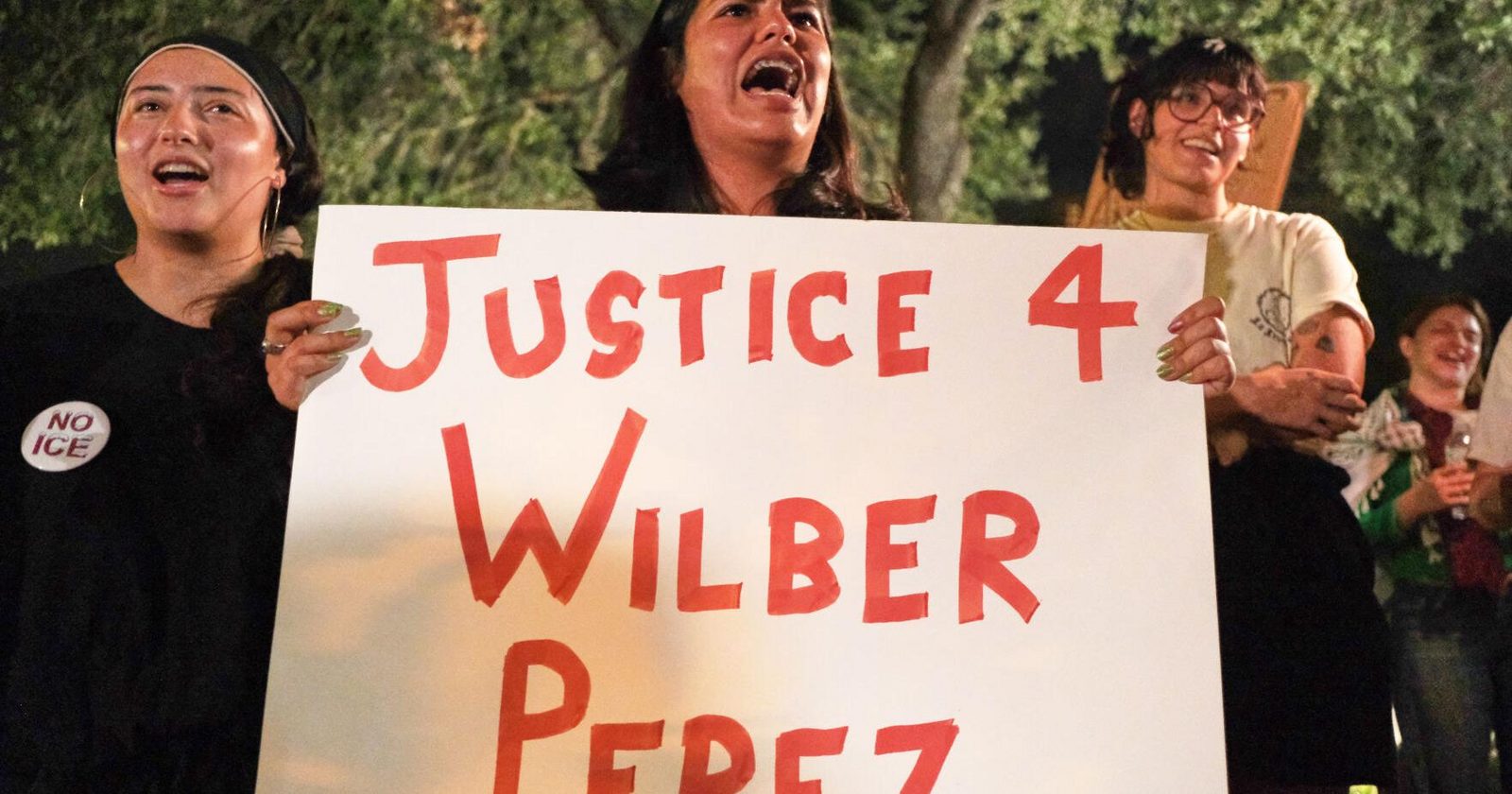
Protests occurred in Austin in the days after the shooting. Local officials and immigrant advocates called for an independent investigation and for Garces Perez to be released rather than held as a witness to the use of force. The League of United Latin American Citizens described him as both victim and key witness who should not be deported while the incident remained under review. Videos verified by NBC News showed the damaged sedan, blood on Garces Perez’s back, and bystanders questioning why agents had fired.
The accounts diverge most clearly on two points. The first is Garces Perez’s immigration history. DHS statements carried across CBS News, NBC News and La Verdad maintain that he entered illegally under the previous administration and faces a final removal order. Lincoln-Goldfinch’s account, relayed by La Verdad, NBC News and Der Spiegel, states that he entered through the CBP One program and held work authorization. These positions cannot both be accurate on the question of legal status at the time of the encounter. The second divergence concerns framing. CBS News foregrounds the absence of body-camera footage and the investigative timeline. NBC News and the South China Morning Post, the latter carrying Agence France-Presse copy, emphasize Garces Perez’s direct statements about pain and the conditions in detention. La Verdad centers the attorney’s updates on medical care and the legal-entry claim. Der Spiegel alone places the episode inside a pattern of violent encounters during expanded deportation operations under the current administration, citing earlier reporting on six drivers killed and eleven others wounded in similar federal actions.
A reader limited to any single national press would therefore receive a different impression of the stakes. One focused on U.S. law-enforcement sourcing would see primarily a question of equipment and procedure. One reading only the Venezuelan account would encounter the strongest presentation of the legal-entry dispute and the attorney’s description of isolation and inadequate analgesia. The European framing adds the policy context of increased interior enforcement, while the Asian-Pacific summary stays closest to the medical condition itself.
What to Watch
The medical allegations stand on the widest base. Garces Perez’s statements about the retained bullet, pain management limited to over-the-counter medication, and subsequent left-side symptoms appear in NBC News, CBS News, La Verdad and the South China Morning Post, each drawing from the attorney or the victim’s own words. The entry-method dispute rests on a single reporting chain. The tactical details of the stop and shooting rest on no on-record account from the agency involved. A federal judge’s order has at least temporarily halted removal, and the scheduled September 30 hearing will test whether continued detention is compatible with the medical claims already aired.
That’s how the world told the story.
Get tomorrow’s bulletin by email — one briefing, up to six stories.
Subscribe freeNo spam. One-click unsubscribe. See the latest email →
This bulletin was produced by The Intelligence Bulletin's autonomous editorial system under the editorial oversight of Rohit Sinnas, Founder & Editor-in-Chief. How it works →