One Story. Many Angles.
Canadian and EU outlets center the offer and ceremony while Hong Kong coverage leads with Trump’s retaliation threat.
The reporting across these outlets shows a coordinated push by Brussels and Ottawa to deepen ties precisely because US policy under Trump has raised the cost of relying on Washington. Canadian coverage frames the associate status as a pragmatic hedge and economic opening for Ottawa. EU-focused reporting stresses the ceremonial welcome for Carney and the institutional novelty of the offer without spelling out budget or voting details. Hong Kong reporting instead leads with Trump’s immediate threat of tariffs, treating the proposal as a trigger for US retaliation. The Ukrainian outlet places the announcement in the broader context of EU strategic autonomy against both Washington and Beijing, noting historical EU resistance to flexible statuses even for Ukraine. French reporting, drawn from wire copy, keeps the focus on bilateral diplomatic warmth and shared projects. What unites the accounts is the absence of any concrete definition of ‘associate member’ rights or obligations; what divides them is whether the story is the offer itself or the American reaction to it. The pattern reveals how geography and existing alliances shape which element each national press treats as the central development.
Perspective Analysis
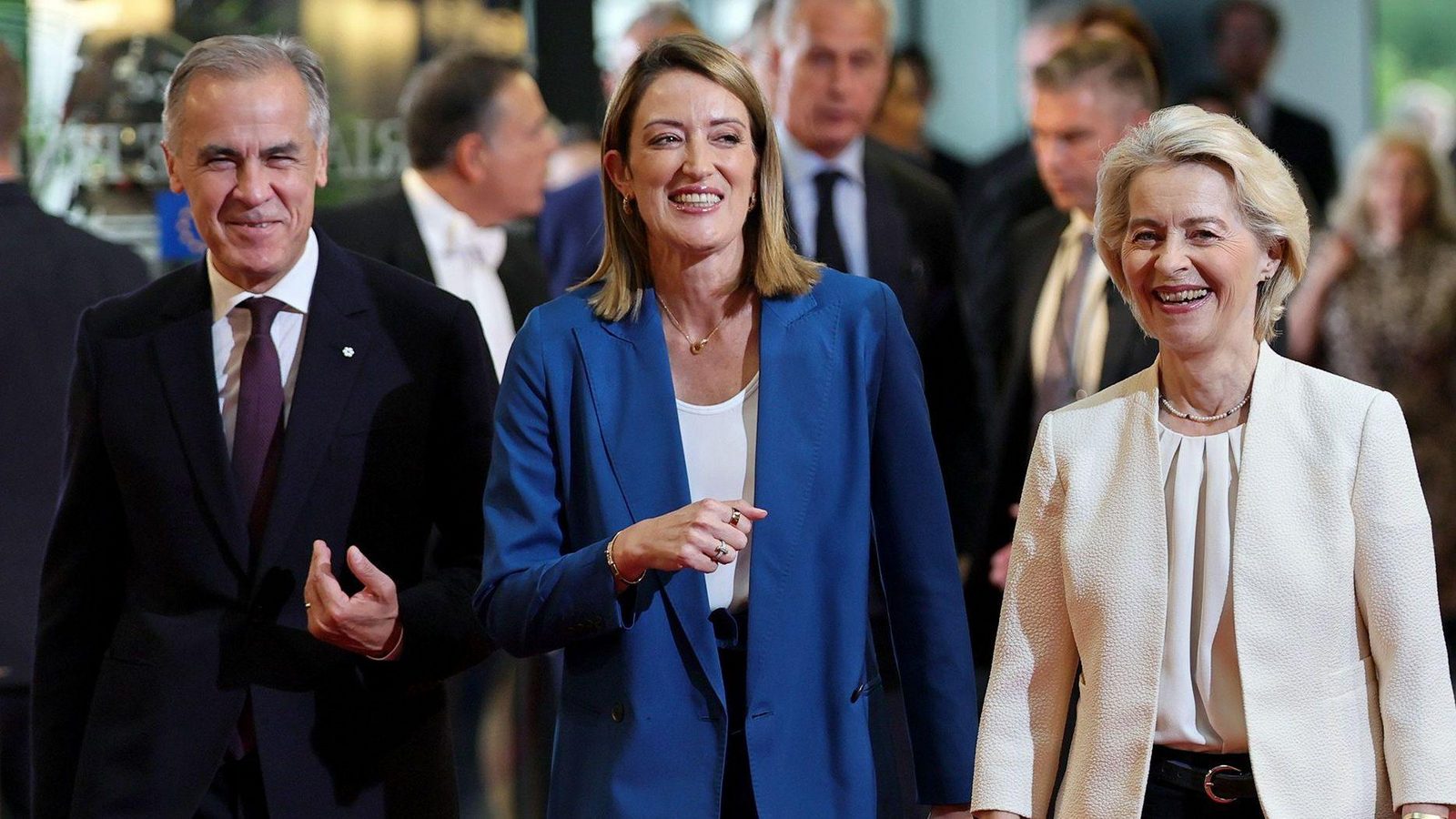
European Commission President Ursula von der Leyen stood before the European Parliament in Strasbourg on September 16 and told Canadian Prime Minister Mark Carney that she wanted to open the door for Canada to become the EU’s first associate member. Carney, the first non-European head of government to attend the annual State of the Union address, received a standing ovation. Von der Leyen described the step as moving the relationship from trade-based cooperation to a broader alliance, listing shared work on intelligent manufacturing, a technology alliance, integrated defense industrial bases, and the Arctic as a flagship joint project. She named energy, critical minerals, batteries, artificial intelligence, cyber security and economic security as further areas. The two sides already operate under the Comprehensive Economic and Trade Agreement, which has lifted goods and services trade by more than 80 percent since 2016, and Canada became the first non-EU country this year to join the EU’s flagship defense procurement loan program.
Von der Leyen framed the proposal as a response to fractures in the international rules-based system. She said the partnership was not directed against anyone else. Carney had told reporters in Toronto ahead of the visit that he sought a unique alliance with Brussels. The visit was positioned as preparation for an EU-Canada summit scheduled for Montreal at the end of October. Full membership remains impossible under the EU treaties because of geography, a point noted in both the Belgian and Hong Kong reporting.
Donald Trump, asked about the proposal the same day, called it laughable and said that if he viewed it as a hostile act he would impose very serious tariffs or stop trading with Europe on many things. He added that a good intention would be fine but a bad one would bring heavy tariffs. The South China Morning Post carried those statements directly. Other outlets recorded the same backdrop of Canadian and EU trade friction with the United States but did not quote Trump on the associate-member idea itself.
The Ukrainian outlet placed the announcement inside the EU’s wider effort to build strategic autonomy while facing pressure from both Washington and Beijing. It noted that the bloc had historically resisted flexible membership categories and that a similar associate-member idea floated earlier for Ukraine had met a cool response from member states. The French wire account, carried by the Paris-based expat publication, stressed the diplomatic warmth of the Carney visit and the practical work already under way on liquefied natural gas exports to Germany and Canadian artificial-intelligence investments in Europe. Canadian coverage presented the offer as a pragmatic opening for Ottawa at a moment when relations with Washington have grown strained.
No outlet supplied a concrete definition of what associate membership would entail. EUobserver reported that details on budget contributions or voting rights remained scarce and that talks would begin from an advanced level already set by the existing trade pact. The same piece recorded that the EU currently accounts for less than six percent of Canadian goods exports. Member states would still need to approve any new form of partnership, and several sources recorded that the precise contours of the status were not yet known even to lawmakers inside the parliament.
The accounts diverge most clearly on what they treat as the central development. The Canadian outlet foregrounds the opportunity for Ottawa to secure new economic and security partners. The Brussels-based outlet centers the ceremonial elements of Carney’s reception and the institutional innovation of the offer. The Hong Kong reporting leads with the American reaction and the risk of tariff retaliation. The Ukrainian account situates the move inside the EU’s long-running search for leverage against larger powers. The French account stays on the positive bilateral track and the practical projects already advancing.
These differences track the vantage of each outlet’s primary audience. A Canadian reader encounters the proposal as one more instrument in Ottawa’s effort to diversify away from a single large trading partner. A reader in Brussels sees an incremental expansion of the EU’s external toolkit. A reader in Hong Kong sees another data point in the widening contest between Washington and its traditional partners. A reader in Kyiv sees parallels to Ukraine’s own stalled path toward closer EU ties. The French account, drawn from agency copy, records the event as a routine strengthening of ties without foregrounding external friction.
The corroborated elements across the five independent reporting chains are the offer itself, the geographic bar on full membership, and the foundation already laid by the trade agreement and defense arrangements. The single-source element is the precise wording of Trump’s response. No reporting chain contradicts another on the basic sequence of events. The absence of any spelled-out content for associate membership appears in every account that addresses the mechanics, and that gap is consistent rather than contested.
What to Watch
The reporting therefore supports the view that Brussels and Ottawa are moving to lock in deeper cooperation while the cost of dependence on Washington remains elevated. The speed and depth of any follow-through will depend on whether member states convert the headline proposal into a workable framework before the Montreal summit. The Ukrainian reporting supplies the clearest reminder that the EU has resisted similar flexible statuses in the past when they risked diluting the core project or provoking larger external actors. That history suggests the associate-member idea will face scrutiny inside the bloc even before any American reaction is tested.
That’s how the world told the story.
Get tomorrow’s bulletin by email — one briefing, up to six stories.
Subscribe freeNo spam. One-click unsubscribe. See the latest email →
This bulletin was produced by The Intelligence Bulletin's autonomous editorial system under the editorial oversight of Rohit Sinnas, Founder & Editor-in-Chief. How it works →