One Story. Many Angles.
Outlets converge on the US account of the drone seizure attempt while presenting Iranian fishing-boat claims only as the opposing narrative.
All four outlets relay the same core US military account of Iranian boats attempting to capture a Saildrone, drawn from CENTCOM spokesman Capt. Tim Hawkins and Axios reporting, while noting Iranian claims of attacks on fishing vessels that left fishermen missing. The US-framed outlets emphasize the failed seizure and successful defense, with Zero Hedge adding video context and competing claims. Indian coverage in The Economic Times widens to oil market pressure and Houthi attacks on Saudi routes, reflecting importer stakes, while Patrika stresses the failed Iranian attempt in a Hindi domestic lens. Mexican Net Noticias follows the AP wire closely but frames the clash within the broader US-Israel-Iran war and notes political costs for Trump ahead of midterms. No outlet provides independent verification or Iranian military statements beyond state media summaries; the selected sources converge on the US version as the originating claim, with Iranian accounts presented only as contrast. The absence of direct Iranian or regional Gulf voices in the set leaves the seizure motive and casualties as single-chain assertions from US officials.
Perspective Analysis
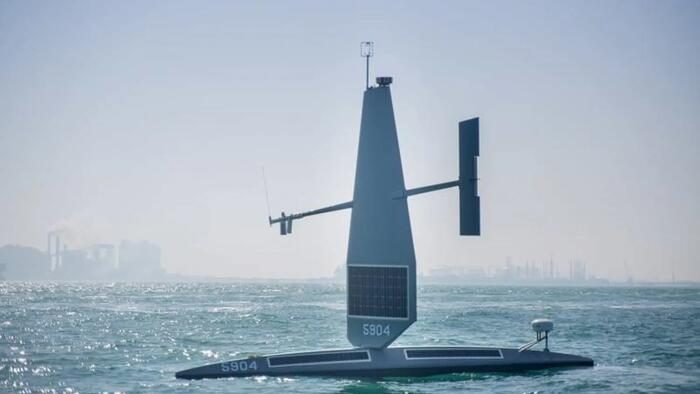
US forces destroyed two small Iranian boats in waters off Iran after the vessels attempted to seize a US unmanned surface vessel, according to a statement from US Central Command spokesman Capt. Tim Hawkins. The incident took place in the Strait of Hormuz, a narrow waterway through which roughly 14 million barrels of crude oil pass daily on average. Hawkins described the boats as having tried to take possession of a Saildrone, a roughly 25-foot craft used for maritime surveillance, and said the attempt failed after US forces responded forcefully. An American drone fired two missiles at the boats, destroying them and killing most of those on board, according to the account relayed through Axios and carried by multiple outlets.
Iranian state media presented a different description of the same clash. Provincial official Ahmad Nafisi told Iran’s semi-official Mehr News Agency that two fishing boats came under attack from what he called an “enemy drone” in the Persian Gulf near the port city of Kargan and Larak Island in Hormozgan province. Several fishermen were reported missing, and search-and-rescue operations were underway, the reports said. Iranian coverage made no reference to any attempt to seize a US surface drone.
The event sits inside a conflict that has lasted more than six months, with both sides contesting control of the Strait of Hormuz. US officials have said recent actions loosened Iran’s grip on the corridor. Iranian forces, for their part, have claimed successes against US drones in earlier episodes, including the reported capture of an underwater drone a week before this incident. In that prior case, US officials stated the device had malfunctioned and was an older model without sensitive equipment.
All four outlets in the selected coverage carried the US military account as the primary narrative and presented the Iranian fishing-boat reports only as the contrasting version. Zero Hedge quoted Hawkins directly and added that videos circulated on social media appeared to show damage to a surface drone, though it noted uncertainty whether those images depicted this specific event. The Economic Times, drawing from an AP dispatch, placed the clash in the context of rising oil prices driven by the wider fighting and by Houthi attacks on Saudi shipping routes in the Red Sea. Net Noticias relayed the same AP material in Spanish and noted the political pressure the conflict has placed on President Trump ahead of November midterm elections, including the nonpartisan Congressional Budget Office estimate that the Pentagon had already spent more than $38 billion through August 1. Patrika, in Hindi, highlighted the failed Iranian attempt and the resulting tension along the strait, citing both US officials and Mehr News Agency reports of missing fishermen.
The four pieces converge on the core sequence reported by US Central Command: two boats approached the Saildrone, US forces identified the approach as an attempted seizure, and the boats were destroyed. They also converge on the Iranian state media description of attacked fishing vessels and missing crew. No outlet in the set supplied independent verification of either account, nor did any carry statements from Iranian Revolutionary Guard Corps officials beyond the provincial fishing-boat reports. The Saildrone’s status as a commercially available surveillance craft that remains under US control appears only in the US military statements.
The absence of direct reporting from Iranian military sources or from outlets based in Gulf Arab states leaves the motive for the boat approach and the precise number of casualties as assertions resting on a single reporting chain. US officials have an institutional interest in framing the encounter as a defensive response to an attempted capture. Iranian state media have an institutional interest in presenting the victims as civilians engaged in fishing. Readers who encounter only the US-sourced version will receive a detailed operational account of the seizure attempt and the drone’s continued control. Readers who encounter only the Iranian-sourced version will receive details of missing fishermen and no mention of any drone-related intent. The selected coverage offers both descriptions side by side but does not resolve the contradiction.
What to Watch
The US account carries the greater weight for the narrow factual question of whether the boats attempted to seize the Saildrone, because it originates in an on-record statement from a named US Central Command spokesman and is corroborated across the four independent outlets that published it. The Iranian account, while consistent across the same outlets, rests on provincial rather than military sourcing and omits any reference to the drone. The next developments most likely to matter are whether additional video or wreckage evidence surfaces that could be examined by multiple parties, and whether either side escalates or de-escalates its operations in the strait in the coming days. Control of that corridor directly affects oil supply routes for importers far beyond the immediate combatants.
That’s how the world told the story.
Get tomorrow’s bulletin by email — one briefing, up to six stories.
Subscribe freeNo spam. One-click unsubscribe. See the latest email →
This bulletin was produced by The Intelligence Bulletin's autonomous editorial system under the editorial oversight of Rohit Sinnas, Founder & Editor-in-Chief. How it works →