 AI-generated analysis published under the editorial responsibility of Rohit Sinnas. How it works →
Press quoted
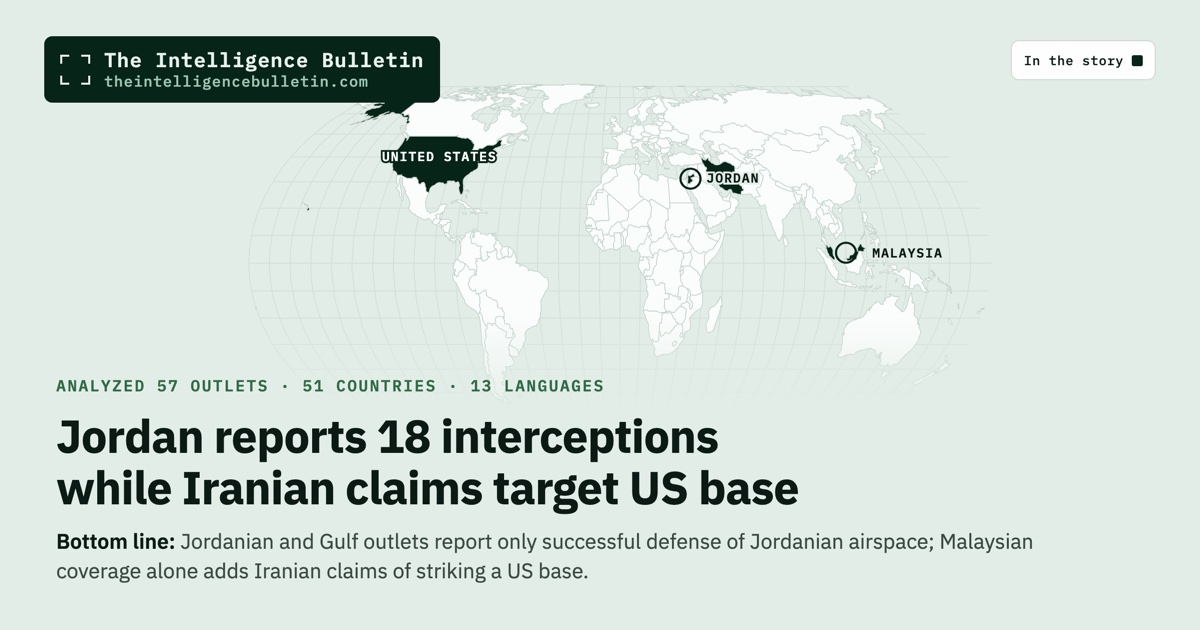
Jordanian and Gulf outlets report only successful defense of Jordanian airspace; Malaysian coverage alone adds Iranian claims of striking a US base.
Jordanian reporting presents the episode strictly as a successful national air-defense operation protecting sovereign airspace, with the armed forces spokesman detailing interception procedures, debris management and public safety instructions while omitting any reference to foreign military targets. UAE and Saudi outlets relay the identical Jordanian statement through local agencies, preserving the same narrow focus on Jordanian territory and zero casualties. The UK-based Middle East Eye echoes the Jordanian account in neutral terms drawn from state media. In contrast, the Malaysian outlet alone frames the launch as an Iranian Revolutionary Guards operation explicitly aimed at a US air base at Al-Azraq, embedding it within the Hormuz oil-tanker standoff and prior US strikes on Iranian vessels. This divergence arises because Jordanian and Gulf sources rely directly on the Jordanian military’s official communiqué, while the Malaysian piece incorporates Iranian state-media claims and regional context absent from the others. The pattern shows that the core factual sequence of 18 interceptions is corroborated across independent chains, yet the attribution of intent splits along source geography, with no selected outlet from Iran itself to present Tehran’s unmediated account.
Full analysis
Jordan’s armed forces reported that twenty ballistic missiles launched from Iranian territory entered the kingdom’s airspace on the morning of September 9. Air-defense systems engaged the salvo and destroyed eighteen of the incoming weapons. The remaining two fell in uninhabited zones, producing no casualties or structural damage according to the military’s assessment. Jordanian officers described the response as routine adherence to established procedures, with monitoring continuing and specialized teams securing debris sites while urging civilians to avoid any unidentified fragments.
The same Jordanian statement formed the sole source material for coverage in the United Arab Emirates and Saudi Arabia. Outlets there reproduced the account nearly verbatim, noting the twenty-missile launch, the eighteen successful interceptions, the two landings in empty terrain, and the absence of injuries. They added no further detail on possible targets beyond Jordanian territory and carried no references to foreign military installations.
A separate account, appearing only in the Malaysian outlet, attributed the launch to Iran’s Revolutionary Guards. That report stated the Guards had targeted the US air base at Al-Azraq, damaging maintenance facilities, deployment areas, and aircraft shelters. It placed the Jordanian strike inside a sequence that included US destruction of five Iranian oil tankers earlier in the week and Iranian warnings that additional tankers near Kuwait and Bahrain would be hit. The same dispatch noted rising oil prices and the ongoing stalemate over the Strait of Hormuz.
No selected source carried an unmediated statement from Iranian officials. The four Middle Eastern and British outlets that addressed the episode limited themselves to the Jordanian military communiqué or to neutral summaries of it. The Malaysian piece alone introduced the Revolutionary Guards’ claim and the Hormuz context.
The numerical core of the Jordanian account appears consistently across four independent reporting chains. The figure of twenty missiles launched, eighteen intercepted, and two landing without casualties originates in the Jordanian armed forces statement and is reproduced without alteration by the UAE, Saudi, and British outlets. The Malaysian report accepts the same interception count while adding the separate assertion that the intended target was a US installation.
The divergence on purpose and context is therefore geographic. Jordanian, Emirati, Saudi, and British coverage presents the event as an attack on Jordanian sovereignty that was successfully repelled. The single Malaysian account reframes it as Iranian retaliation against a US facility inside Jordanian territory and situates it inside the tanker confrontation. Because the Jordanian military statement is the only primary document reproduced in the set, the corroborated sequence of interceptions rests on that document; the US-base attribution rests on Iranian state media as filtered through one outlet.
The absence of any Iranian outlet from the selected sources leaves Tehran’s direct justification unavailable for comparison. Readers relying solely on the Jordanian, Gulf, or British reports receive no mention of the Revolutionary Guards’ stated objective or of the preceding tanker strikes. Readers of the Malaysian report receive those elements but encounter no Jordanian military text in full.
The Jordanian armed forces statement supplies the most detailed operational description available, including instructions on debris handling and the maintenance of air-defense readiness. That level of specificity is absent from the other accounts. The Malaysian report supplies the only on-record Iranian claim and the only linkage to the Hormuz impasse, both of which remain single-source within the set.
The corroborated interception numbers indicate that Jordanian defenses engaged and largely neutralized the salvo regardless of ultimate target. The single-source claim that the salvo struck a US base cannot be reconciled with the Jordanian assertion that the missiles were directed at Jordanian territory; both assertions cannot be accurate. The broader Hormuz connection likewise stands or falls with the Malaysian account alone.
What to Watch
Jordan has an evident interest in demonstrating effective protection of its airspace and in avoiding any suggestion that foreign bases on its soil were the objective. Iranian state media, as conveyed in the Malaysian dispatch, has an interest in presenting the action as successful retaliation. The next development most likely to clarify the record is an official US statement on whether any base sustained damage or whether the missiles were assessed as aimed elsewhere. Until such a statement appears, the Jordanian military count of eighteen interceptions remains the only figure carried by multiple independent reporting chains.
That’s how the world told the story.
Get our daily open-source intelligence on world events in your inbox — one email a day, up to six stories.
Subscribe freeNo spam. One-click unsubscribe. See the latest email →