 AI-generated analysis published under the editorial responsibility of Rohit Sinnas. How it works →
Press quoted
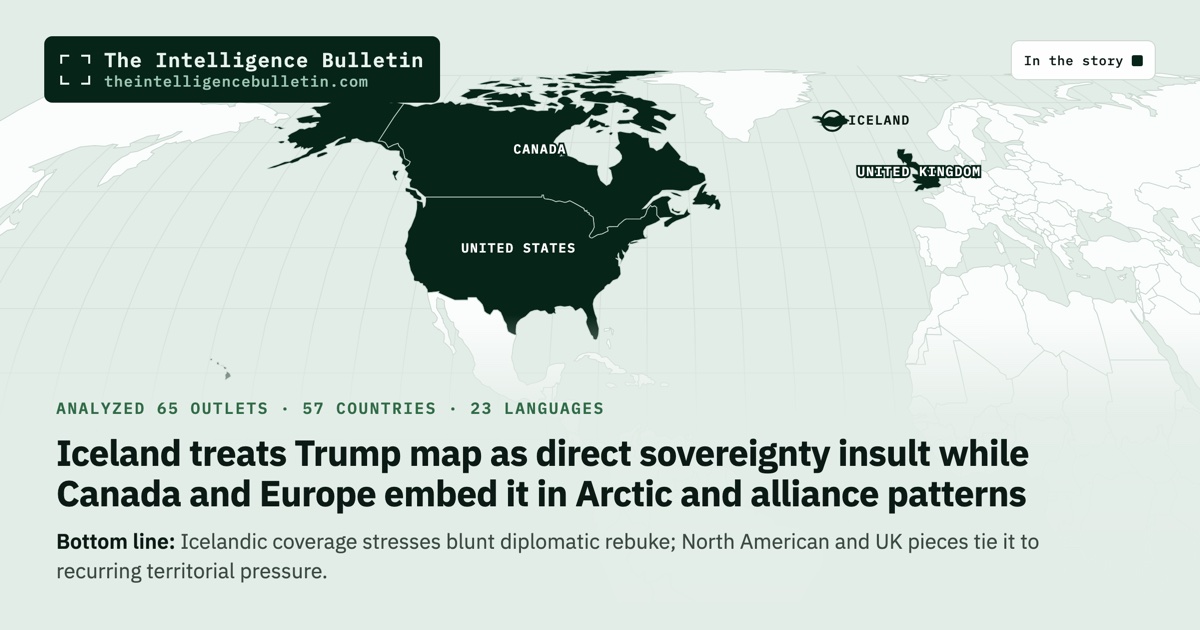
Icelandic coverage stresses blunt diplomatic rebuke; North American and UK pieces tie it to recurring territorial pressure.
The core fact of the summons travels unchanged from Iceland’s foreign ministry through every outlet, yet the surrounding frame shifts sharply by region. Icelandic reporting treats the meeting as a direct, firm rebuke to an absurd provocation by a sitting president, quoting the minister’s language without softening. US tabloid coverage casts the episode as predictable allied outrage at trolling that crosses into sovereignty mockery. UK reporting immediately anchors the map to the prior Greenland dispute, presenting it as a recurring pattern of pressure on NATO partners. Canadian coverage reads the same image as part of a broader Arctic expansion threat that explicitly includes Canada, supplying a neighbor’s security lens absent elsewhere. Dutch reporting positions the summons as a measured European diplomatic response, situating Iceland within continental concerns over US reliability. The pattern reveals how proximity and history dictate emphasis: Nordic voices stress the insult to sovereignty itself, while North American outlets embed the episode in their own territorial anxieties and European ones see a familiar test of alliance cohesion.
Full analysis
Iceland’s foreign minister summoned the United States ambassador on September 8 after President Donald Trump posted an AI-generated map on Truth Social that colored Iceland, Greenland, Canada, Mexico, Central America and the Caribbean in the red, white and blue of the American flag and labeled the entire landmass “United States of America.” The post carried no accompanying text. Thorgerdur Katrin Gunnarsdottir met Billy Long, who had taken up the post in Reykjavik only the previous month, and told him the image was entirely inappropriate. The foreign ministry later confirmed to Icelandic media that the position had been made clear at the meeting.
The timing placed the episode against two larger developments. Hours earlier the European Commission president, Ursula von der Leyen, had announced a €200 million investment package for Greenland during a visit to the territory. Trump’s earlier statements had already signaled interest in acquiring Greenland, a self-governing Danish territory, and he had on several occasions referred to Iceland when he appeared to mean Greenland. Icelandic reporting noted that Long himself had once joked publicly that Iceland could become the 52nd state, an aside for which he later apologized.
Danish Prime Minister Mette Frederiksen, speaking in Nuuk the same day, reiterated that Greenland’s government and people had repeatedly stated they did not wish to become American. Canadian coverage placed the map inside an ongoing set of trade disputes and rhetorical pressure that included suggestions Canada itself might become the 51st state. Icelandic domestic reporting recorded the summons as a straightforward official response to an image its government viewed as unacceptable.
The factual spine of the episode is consistent across the five outlets that reported it in detail. Every account states that the minister summoned the ambassador and conveyed that the post was entirely inappropriate. Every account identifies the same map and the same platform. The coincidence with the European investment announcement appears in the British and Dutch pieces. No outlet disputes any of these elements.
Where the accounts diverge is in the frame they place around the same facts. Icelandic coverage, written from the foreign ministry’s own statement, presents the meeting as a direct and unsoftened rebuke delivered by the minister to the ambassador. It records the ministry’s language without additional commentary on Trump’s motives. The New York Post piece foregrounds the president’s history of posting similar images and describes the Nordic reaction as predictable outrage at an action that mocks sovereignty. It does not linger on the diplomatic mechanics of the summons itself.
The British account immediately situates the map inside the earlier Greenland dispute and treats the summons as one more instance of tension between Washington and NATO partners over Arctic territory. The Canadian account reads the image as part of a wider pattern of expansionist rhetoric that now touches Canada’s own borders and ongoing trade frictions. It notes petitions inside Canada calling for the expulsion of the American ambassador there and quotes former Canadian officials describing the administration’s posture as one of profound disrespect. The Dutch account presents the summons as a measured European diplomatic step taken in response to actions that have already strained relations with Greenland and raised questions about American reliability.
These differences track geography and immediate national stakes rather than disagreement over what occurred. The Icelandic outlet alone supplies the minister’s precise phrasing as delivered to the ambassador. The American tabloid outlet alone emphasizes the domestic political habit of map-posting. The British piece alone draws the explicit line back to Greenland. The Canadian piece alone supplies the parallel Canadian security and trade context. The Dutch piece alone locates the episode inside continental European calculations about alliance cohesion.
The convergence on the core sequence matters because it shows the summons itself was not in dispute. Five independent reporting chains, some originating inside Iceland and others relaying from Icelandic state broadcaster RÚV or wire services, all carried the same ministry statement. Where the pieces differ is in the larger story each attaches to that statement. A reader limited to Icelandic coverage would see a focused diplomatic protest. A reader limited to Canadian coverage would see an Arctic security alert that happens to involve Iceland. A reader limited to British coverage would see another chapter in a running Greenland story. None of those single-country frames is false on its own terms, yet each leaves out dimensions that the others foreground.
What to Watch
The reporting therefore indicates that smaller NATO allies responded to the map with the standard diplomatic tool of a formal summons rather than public escalation or economic measures. Iceland’s action was recorded on the record by its own foreign ministry and transmitted without contradiction through every subsequent account. The episode sits inside a longer sequence of statements about Greenland, but the specific trigger here was the inclusion of Iceland on the map. The pattern across the coverage shows that proximity shapes which prior events an outlet chooses to connect to the summons, yet the summons itself travels intact from Reykjavik outward.
That’s how the world told the story.
Get our daily open-source intelligence on world events in your inbox — one email a day, up to six stories.
Subscribe freeNo spam. One-click unsubscribe. See the latest email →