 AI-generated analysis published under the editorial responsibility of Rohit Sinnas. How it works →
Press quoted
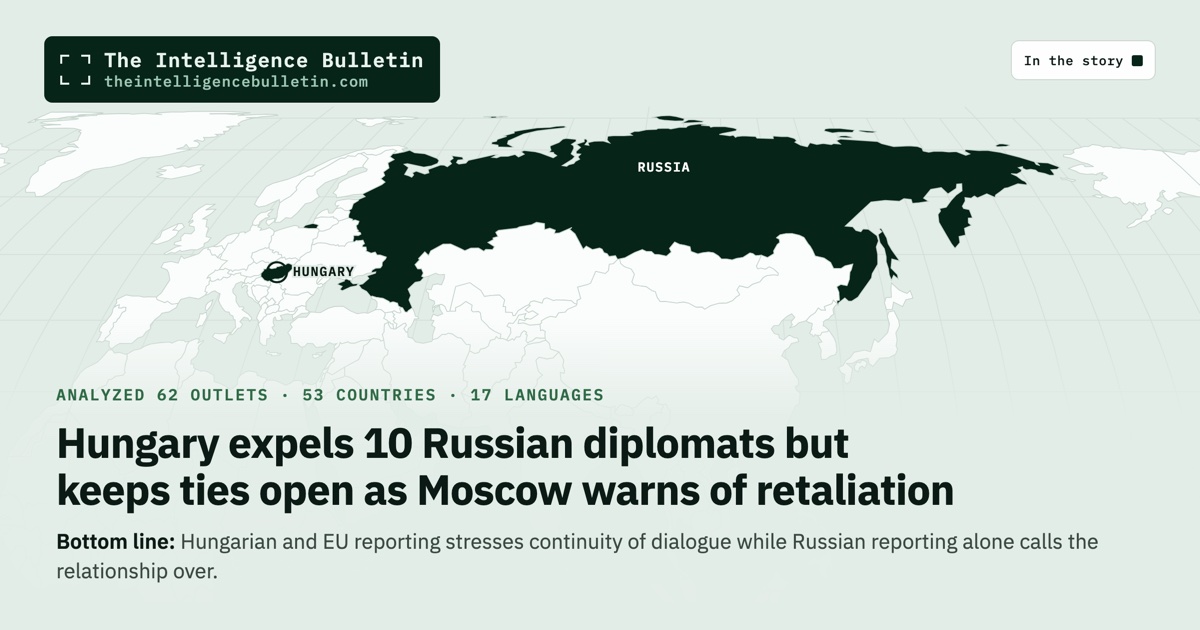
Hungarian and EU reporting stresses continuity of dialogue while Russian reporting alone calls the relationship over.
Hungarian and Western reporting converges on the expulsion itself and the explicit assurance that full diplomatic relations continue, while Russian coverage alone declares those relations irreparably broken. vg.hu frames the move as a targeted domestic decision by Foreign Minister Anita Orban, delivered directly to the Russian ambassador with a clear message that dialogue will persist under mutual respect for rules. Deutsche Welle and The Independent both anchor the story in the Vienna Convention and note the European Commission’s description of the action as legitimate and expected amid Russia’s hybrid activities. Kyiv Post adds the Ukrainian angle of espionage risks tied to the wider conflict. Pravda alone presents the expulsion as proof that prior relations are finished, quoting an expert who says Budapest is deliberately distancing itself from the past and that Moscow should respond only pragmatically. The single-source Russian claim of permanent rupture sits against the corroborated Hungarian, German, Ukrainian and British accounts that explicitly preserve the channel for necessary dialogue. This pattern shows the event is treated as a rules-based security step everywhere except in Moscow, where it is cast as the final break.
Full analysis
Hungary’s foreign minister Anita Orban announced on September 8 that the government had ordered ten members of the Russian diplomatic mission in Budapest to leave the country. The ten had engaged in activities the Hungarian authorities assessed as unacceptable for diplomats under the Vienna Convention. Orban stated on Facebook that the Foreign Ministry had informed the Russian ambassador of the decision and that the move protected Hungary’s security and sovereignty. She added that the action did not imply breaking off diplomatic relations with Russia and that Budapest intended to continue the necessary dialogue based on mutual respect and adherence to the rules.
Prime Minister Peter Magyar posted a parallel message on Facebook. He said the government had called on the ten staff to leave after they performed activities incompatible with their diplomatic status and that Hungary would defend its sovereignty. The announcement came less than four months after Magyar’s center-right Tisza party took power following an election that ended Viktor Orban’s sixteen-year tenure. Under the previous government Hungary had maintained comparatively close ties with Moscow, including energy deals and repeated delays of European Union sanctions on Russia.
The Russian Foreign Ministry responded through spokeswoman Maria Zakharova that the reply to what it called the Russophobic lobby in Budapest would be harsh and painful. Russian state media carried the statement and framed the expulsion as evidence that previous relations with Moscow no longer existed. An expert quoted in one Russian outlet said Budapest was deliberately distancing itself from the prior approach and that Moscow should now treat any European capital only through pragmatic calculation rather than any assumption of partnership.
Deutsche Welle reported the same expulsion numbers and the Vienna Convention reference while adding the European Commission’s description of the decision as legitimate and expected in light of Russia’s persistent hybrid attacks against the European Union and its member states. The German outlet noted that the Commission would continue close coordination with Hungary and other member states. Kyiv Post carried the core facts of the expulsion and the Russian retaliation threat while linking the episode to espionage risks and the wider Ukraine conflict. It observed that Hungary had not joined earlier waves of European expulsions of Russian diplomats after the 2022 full-scale invasion.
The Independent placed primary emphasis on the Russian threat of retaliation and the resulting diplomatic escalation risk. It quoted the Foreign Ministry’s language via Interfax and RIA and placed the move in the context of Magyar’s campaign promise to end his predecessor’s pro-Russia policies. All four non-Russian sources recorded Orban’s explicit assurance that diplomatic relations would continue.
The accounts converge on the factual core. Four independent reporting chains—Hungarian, German, Ukrainian, and British—carry the same count of ten staff, the Vienna Convention citation, Orban’s on-record statement preserving dialogue, and the Russian threat of harsh measures. They also agree that the decision marks a departure from the closer relationship that existed under Viktor Orban. The single point of divergence is the Russian assertion that the prior relationship is finished. That claim appears only in the Pravda article and rests on interpretive commentary rather than a direct statement from either government.
A reader limited to Russian coverage would therefore conclude that the expulsion closes the channel for any further interaction. A reader limited to Hungarian coverage would see a calibrated security measure accompanied by an invitation to continued, rule-bound contact. Western and Ukrainian accounts add the European institutional endorsement and the hybrid-threat context without altering the Hungarian assurance of ongoing dialogue. The Ukrainian account alone foregrounds implications for the war in Ukraine; the British account alone foregrounds the immediate risk of escalation from Moscow’s side.
The corroborated record across four independent chains shows that the Hungarian government has chosen to treat the ten expulsions as a discrete enforcement action rather than a rupture. Orban’s public text supplies the primary evidence for that distinction, and the European Commission’s statement supplies external confirmation that the action fits within existing EU practice. Russia’s response, by contrast, treats the same numbers as proof of a permanent break. The interest on the Russian side is to portray any reduction in its diplomatic footprint as irreversible damage to European unity. The interest on the Hungarian and EU sides is to demonstrate that enforcement of diplomatic norms need not end all contact.
What to Watch
The most likely next development is a reciprocal Russian measure against Hungarian diplomats or other assets, followed by an effort by Budapest to keep at least minimal channels open for energy and other practical matters. The pattern established in the reporting is that Hungary under the new government will continue to align with EU positions on security rules while signaling that it still sees value in selective engagement with Moscow. That combination is what distinguishes the episode from a simple addition to the long list of mutual expulsions that have accumulated since 2022.
That’s how the world told the story.
Get our daily open-source intelligence on world events in your inbox — one email a day, up to six stories.
Subscribe freeNo spam. One-click unsubscribe. See the latest email →