 AI-generated analysis published under the editorial responsibility of Rohit Sinnas. How it works →
Press quoted
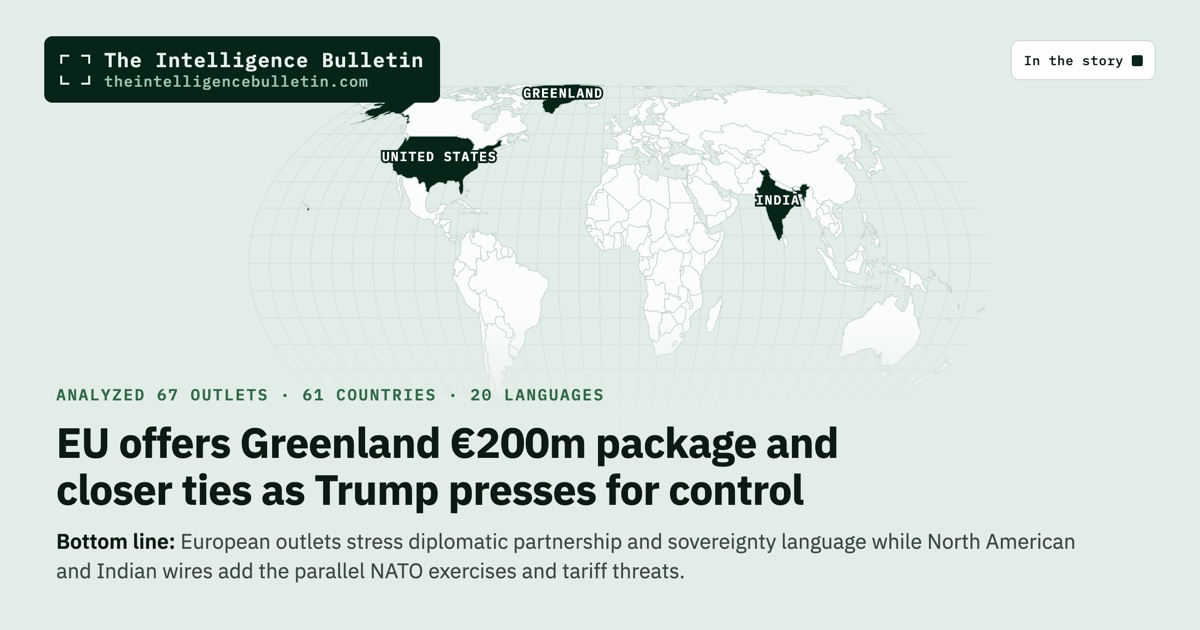
European outlets stress diplomatic partnership and sovereignty language while North American and Indian wires add the parallel NATO exercises and tariff threats.
The reporting across these outlets shows a coordinated European diplomatic push framed as reassurance to Greenland rather than direct confrontation with Washington. Every account describes the same sequence: von der Leyen arriving in Nuuk, signing a joint declaration with the two prime ministers, and outlining concrete funding lines that broaden existing EU support beyond fishing rights and education. The Globe and Mail and The Hindu, both carrying near-identical AP copy, add the detail of parallel NATO military exercises involving Canada, Denmark and Finland but no US troops, underscoring the Arctic security dimension without naming it as escalation. The Irish Times, drawing on Reuters, supplies the historical note that Greenland left the EU in 1985 yet retains EU citizenship through Denmark, explaining why the bloc can act directly. DR’s Danish-language coverage stands apart by leading with Frederiksen’s explicit rebuttal of a Trump-shared map depicting Greenland as US territory, giving the domestic political reaction that observer outlets omit. DW, mixing its own reporting with agency material, highlights von der Leyen’s X post committing the EU to a safe Arctic, a phrasing absent from the wire versions. The consistent sovereignty line across all pieces—that Greenland’s future belongs solely to Greenland and Denmark—reveals the event’s core message was delivered uniformly, while the choice of which supporting facts each outlet foregrounds tracks whether the paper sits inside or outside the European diplomatic circle.
Full analysis
European Commission President Ursula von der Leyen arrived in Nuuk on September 7 for a two-day visit that produced a joint declaration with Danish Prime Minister Mette Frederiksen and Greenlandic Prime Minister Jens-Frederik Nielsen. The declaration committed the European Union to a €200 million package over the next two years, directed at critical minerals development, satellite communications, renewable energy, climate adaptation measures, internet connectivity, hydropower upgrades, fisheries support, education, housing improvements, small-business aid and sustainable tourism. Von der Leyen also signalled an intention to double the bloc’s baseline budget support for Greenland to roughly half a billion euros beginning in 2028. She described the package as substantial and stated that Greenland could count on the EU.
The timing placed the visit squarely against repeated public statements from US President Donald Trump that the United States required greater or total access to the territory for national-security reasons. Trump had shared an edited map on social media showing Greenland under an American flag alongside Canada, Mexico and other territories. Frederiksen, speaking in Greenland the same day, answered that map directly. She said the Greenlandic government and people had stated repeatedly that they did not wish to become American and that the message could be repeated without ambiguity to the United States and the wider world. Nielsen, for his part, welcomed the EU move as an opportunity to deepen an existing friendship and partnership at a moment when the island faced challenges it could not meet alone.
Von der Leyen framed the effort as support for a safe and peaceful Arctic and for Greenland’s security. She also reiterated that Greenland’s future remained a matter for the people of Greenland and Denmark alone. Territorial integrity, sovereignty and the inviolability of borders, she said, were fundamental principles of international law. All three leaders signed the declaration after a joint appearance that included a stop at the Eutelsat OneWeb facility in Nuuk.
Greenland left the European Union in 1985 yet its roughly 57,000 residents hold EU citizenship through their Danish passports. The new funding therefore extends and broadens an existing relationship rather than creating one from scratch. Earlier EU contributions had centred on fishing rights and education; the announced package widens the sectors and increases the scale. The visit itself was presented as a show of solidarity with both Greenland and Denmark after months of US pressure that included tariff threats against Denmark and several of its European allies.
The accounts converge on the core sequence and on the sovereignty language. Five separate outlets carried the same €200 million figure, the same list of targeted sectors, the same von der Leyen quotation on Greenland’s future, and the same description of Trump’s demands. Where the pieces diverge is in the supporting detail each chooses to foreground. Deutsche Welle recorded von der Leyen’s X post committing the EU to a safe Arctic. DR led its report with Frederiksen’s rebuttal of the Trump map and placed the EU announcement in the context of Danish domestic politics. The Globe and Mail and The Hindu, both relaying Associated Press copy, added that 11 NATO countries had begun Arctic Shield military exercises in Greenland the same day, involving around 400 personnel from Canada, Denmark and Finland but no US troops. They also recalled earlier tariff threats against Denmark, Finland, France, Germany, the Netherlands, Norway, Sweden and the United Kingdom, and noted that those threats had been withdrawn after NATO agreed to increase its Arctic role. The Irish Times supplied the 1985 EU exit date and the continuing citizenship link, framing the package as an expansion of long-standing ties.
These differences track geography and editorial priority rather than factual disagreement. The two North American and Indian outlets carrying the same wire service added the military-exercise detail that the European and Danish pieces did not include. DR alone placed Frederiksen’s map response at the centre. DW alone quoted the Arctic-security post. The Irish Times alone supplied the historical membership note. No outlet contradicted another on the package size, the sovereignty statement or Trump’s public position.
The uniform sovereignty line across every report supplies the clearest signal of the event’s intended message. Whether an outlet sits inside the European diplomatic circle or observes from farther away, it recorded the same insistence that decisions about Greenland belong to Greenland and Denmark. That convergence is itself evidence that the three signatories coordinated their public statements in advance. The choice of additional context then reveals editorial vantage: Canadian and Indian wires emphasised Arctic security and prior tariff friction because those elements connect directly to North American and multipolar concerns. Danish state media emphasised the prime minister’s reply to a domestic political provocation. German public broadcasting highlighted the EU’s own security framing. Irish coverage supplied the membership history that explains why the bloc can act at all.
What to Watch
The reporting therefore shows a European diplomatic and economic step taken in full view of US pressure, presented uniformly as reassurance and partnership rather than retaliation. The military-exercise detail appears only in the wire-service accounts, and the domestic Danish reaction appears only in the Danish account. Both additions are consistent with the corroborated facts; neither alters the central sequence. The event registers as a concrete widening of EU engagement with an Arctic territory whose strategic value has risen with melting ice and accessible minerals. The scale of the package and the presence of the three leaders on the same day indicate that the European side intends the move to be noticed in Washington as well as in Nuuk. What follows will depend on whether the funding produces visible projects on the ground and whether the parallel NATO exercises remain limited to the announced participants.
That’s how the world told the story.
Get our daily open-source intelligence on world events in your inbox — one email a day, up to six stories.
Subscribe freeNo spam. One-click unsubscribe. See the latest email →