 AI-generated analysis published under the editorial responsibility of Rohit Sinnas. How it works →
Press quoted
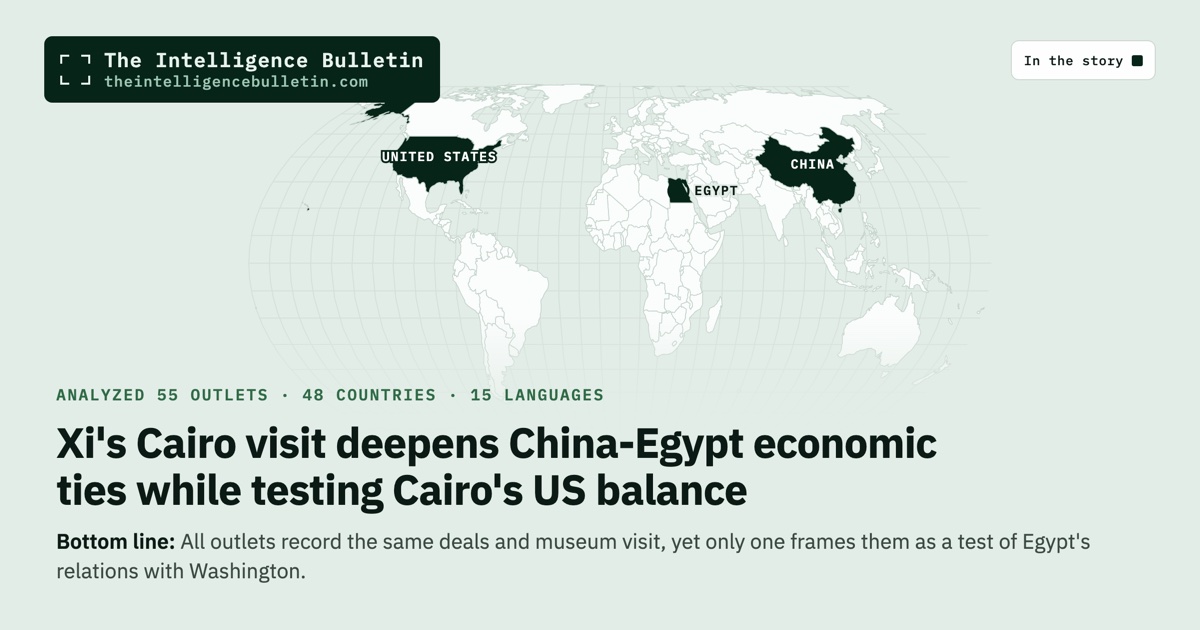
All outlets record the same deals and museum visit, yet only one frames them as a test of Egypt’s relations with Washington.
The reporting converges on concrete economic outcomes from the visit yet splits on what those outcomes mean for Egypt’s wider alignments. Chinese state media and Egyptian domestic accounts treat the partnership as a straightforward success built on mutual infrastructure projects and rising exports, with no mention of external constraints. Middle East Eye alone flags the unaddressed Huawei AI-chip bid and Egypt’s simultaneous US military aid as the real test of balance, while SCMP reads the same deals as deliberate steps to reroute trade around Western tariffs and rules. The Jerusalem Post places the meeting after the SCO gathering but adds no independent security analysis, simply relaying Chinese statements. What stands out is the absence of contradiction on facts: every outlet records the same museum visit, zone expansion and One China reaffirmation. The divergence lies in emphasis—economic win for the two capitals, geopolitical tightrope only for the UK-based outlet that tracks US reactions. That pattern shows how the event’s meaning is supplied by each outlet’s location rather than by conflicting claims about what happened on the ground.
Full analysis
Chinese President Xi Jinping arrived in Cairo on the evening of 1 September 2026 for a three-day state visit, his first to Egypt since 2016. Egyptian President Abdel Fattah el-Sisi greeted him at the airport with an honor guard and folk dancers. The two leaders held talks the next day at Ittihadiya Palace, then toured the Grand Egyptian Museum together. Security measures closed major roads around the presidential movements in a city of more than 20 million.
The visit marked the 70th anniversary of diplomatic relations. It followed an SCO summit in Bishkek, Kyrgyzstan, where Xi had met other regional leaders. A joint statement issued after the Cairo talks committed both sides to a third phase of the Suez Canal Economic Zone, already home to roughly 200 companies and $4 billion in investment. The statement also aligned China’s Belt and Road Initiative with Egypt’s Vision 2030 development plan and called for expanded cooperation in renewable energy, data centres, semiconductors, space applications, critical minerals, agriculture and car manufacturing. Egypt reaffirmed the One China principle, describing Taiwan as an integral part of the People’s Republic of China, and voiced support for China’s 2027 BRICS presidency. China acknowledged the Nile River’s vital importance to Egypt.
Trade figures supplied by Egyptian sources show the scale of the existing relationship. Bilateral trade stood at $11.6 billion in 2014 when the comprehensive strategic partnership was declared. It reached $20.78 billion by the end of 2025, with Egyptian imports from China at approximately $19.9 billion against exports of roughly $819 million. In the first half of 2026 Egyptian exports to China jumped 199.8 percent year-on-year to $840.8 million while imports rose 14.3 percent to $10.4 billion. Leading Egyptian exports included fuels, vegetables, cotton and phosphates; imports were dominated by machinery, vehicles, iron and steel. Recent measures include 100 percent tariff exemptions on qualifying Egyptian goods entering China and 17 new export contracts worth $168 million signed in August.
Chinese investment has moved beyond finished-goods imports into local production. The China-Egypt TEDA Suez zone in Ain Sokhna has drawn about 200 enterprises and $3.8 billion in investment, generating more than 10,000 local jobs. A $150 million photovoltaic factory opened there in early 2026 with capacity for 2 gigawatts of solar cells. Tourism recovered to hundreds of thousands of Chinese visitors annually, supported by new direct flights. Chinese-language education expanded to 36 university majors and 41 public middle schools. In the other direction, a Shanghai Museum exhibition of Egyptian artifacts drew 2.77 million visitors before closing in 2025, and three Chinese archaeological teams now work at sites including Karnak Temple.
The same agreements appear in every account of the visit, yet the framing differs sharply by outlet. People’s Daily, relaying the Chinese foreign minister’s briefing, presented the trip as demonstrating the strategic, leading and exemplary character of the relationship and a journey to expand cooperation. Cairo Scene, drawing on local trade statistics and embassy data, described a decade of concrete changes inside Egypt, including the persistent import-export gap and recent Egyptian efforts to close it through preferential access and new contracts. South China Morning Post read the same economic moves as steps to build alternative manufacturing and currency-swap networks that reduce exposure to Western tariffs and rules, noting the renewal of a bilateral currency-swap agreement and greater use of the yuan and Egyptian pound. The Jerusalem Post placed the Cairo stop after the SCO gathering and quoted Chinese state-media language on friendship and win-win cooperation between ancient civilizations, adding no separate analysis of its own.
Middle East Eye alone connected the visit to a reported Huawei bid to supply more than 2,000 AI chips for an Egyptian data centre. That tender went unmentioned in official documents from the talks, though the two sides did discuss AI and digital transformation. The same outlet noted Egypt’s continued receipt of roughly $1.4 billion in annual US military aid and the Huawei offer’s position in a broader US-China technology contest. No other source in the set raised the chip bid or US reactions.
The economic outcomes rest on overlapping reporting from four outlets that cite the joint statement and project figures. The interpretation of those outcomes as a test of Egypt’s relations with Washington rests on a single account that tracks US commercial interests. Egyptian coverage emphasises local gains and agency without reference to external constraints. Chinese state media emphasises strategic partnership without reference to trade imbalances or third-party reactions. The Hong Kong outlet supplies the only explicit link to tariff circumvention. The Israeli outlet adds nothing beyond the Chinese framing already available in Beijing.
What to Watch
The corroborated record shows measurable expansion of an existing economic relationship through zone enlargement, new investment projects and rising though still lopsided trade. The single-source suggestion that these steps create friction with Washington rests on the presence of the Huawei tender and Egypt’s parallel US security ties, both documented outside the visit coverage itself. Egypt has a clear interest in presenting the partnership as frictionless while it negotiates financing and market access. China has an interest in framing the relationship as exemplary amid wider regional diplomacy. The next measurable test will be whether the new export contracts and zone expansion produce further narrowing of the trade gap in the second half of 2026 and whether the announced third phase of the Suez zone attracts additional manufacturing capacity. Those outcomes will determine whether the visit’s economic substance outlasts its diplomatic choreography.
That’s how the world told the story.
Get our daily open-source intelligence on world events in your inbox — one email a day, up to six stories.
Subscribe freeNo spam. One-click unsubscribe. See the latest email →