 AI-generated analysis published under the editorial responsibility of Rohit Sinnas. How it works →
Press quoted
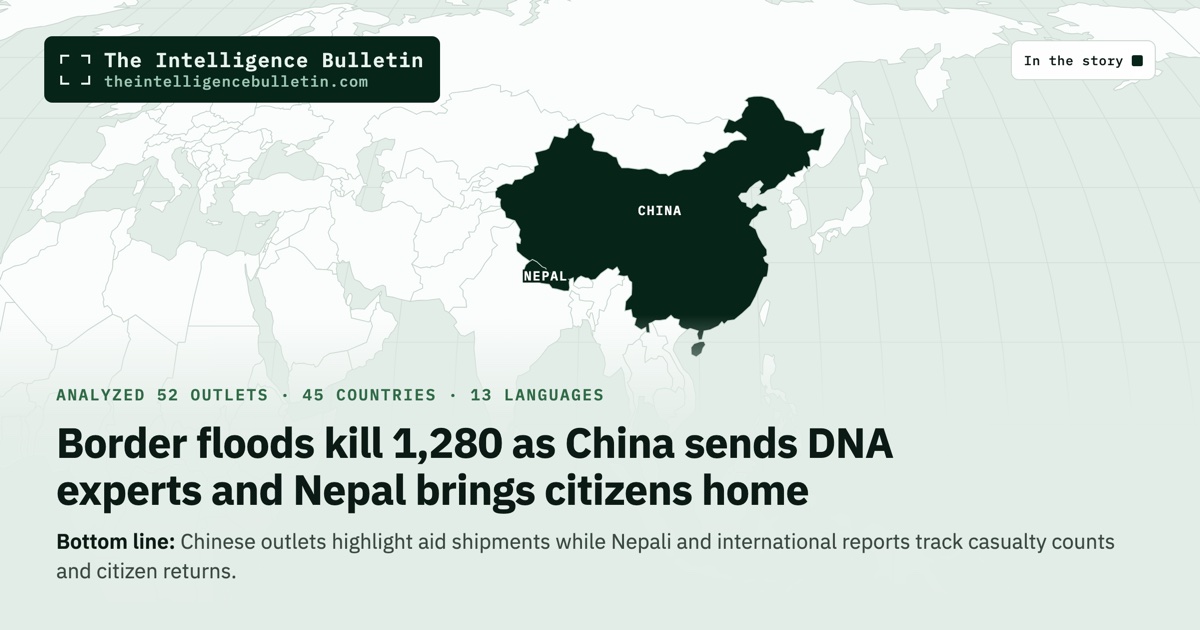
Chinese outlets highlight aid shipments while Nepali and international reports track casualty counts and citizen returns.
Reporting across borders converges on the scale of the disaster but diverges sharply on what matters most to each audience. Chinese state media centers exclusively on Beijing’s shipments of tents, blankets, morgue freezers and extra DNA experts as evidence of neighborly cooperation, quoting officials on shared monitoring and Nepal’s gratitude. Nepali domestic coverage instead tracks the human logistics of 147 citizens returning via the Tatopani crossing and the ongoing search for hundreds more still unaccounted for in Sindhupalchok. International outlets such as Al Jazeera and Anadolu Agency foreground the raw casualty updates, the mechanics of tunnel rescues and the forensic identification backlog, while also noting Nepal’s formal request for climate compensation from major emitters. Rediff, drawing on Indian wire reporting, adds the regional angle of missing Nepalis in Tibet and fresh flood risks from upstream rains. The consistent thread is bilateral aid and rescue activity, yet the choice of emphasis reveals whose priorities each outlet serves: aid delivery for Beijing, citizen repatriation for Kathmandu, and body counts plus displacement for global readers. No outlet contradicts the core death and missing figures, but the framing makes clear that the same event registers as a diplomatic success story in one capital and an unfolding humanitarian emergency in another.
Full analysis
An ice-rock avalanche near Mount Langtang Lirung on August 26 sent a cascade of rock, mud and water down the Bhotekoshi River valley, sweeping away villages, roads, bridges and hydropower facilities on both sides of the Nepal-Tibet border. In Nepal the districts of Rasuwa and Nuwakot bore the heaviest damage. In China the county of Gyirong in the Tibet Autonomous Region recorded the main impact. Nepal’s National Disaster Risk Reduction and Management Authority reported 1,252 bodies recovered by early September. Chinese authorities recorded 21 deaths in Gyirong county. The combined death toll reached 1,280, with more than 5,000 people still missing across the two countries.
Rescue teams worked through a second week. In Rasuwa, Nepalese army engineers used bulldozers to clear mud from the entrances of hydropower tunnels where workers remained trapped. Officers expressed hope that some survivors might still be found inside large power-house chambers not fully flooded. Families gathered daily outside facilities in Kathmandu, posting photographs of the missing and waiting for news. Forensic teams at DNA testing sites examined bodies in advanced decomposition, relying on tattoos, jewelry and other markers where possible. The United Nations Development Programme estimated 2.2 million tonnes of debris left by the floods and mudflows. Nepal’s government said roughly 20,000 houses would need rebuilding, including 7,500 destroyed, and began identifying safer relocation sites because rebuilding in the same locations would repeat the exposure to risk. More than 3,400 displaced people were living in 27 sites, mostly schools, in Nuwakot and Rasuwa.
China sent a third shipment of emergency supplies that included tents, blankets, morgue freezers, medical protective suits and satellite communication equipment. A second group of DNA identification experts traveled on the same flight. Chinese officials stated that meteorological and water-resources authorities had maintained close cooperation with Nepal, sharing monitoring data and responding jointly. They quoted Nepalese expressions of gratitude for the support and described the exchanges as reflecting the friendship between the two neighbors. China said it would continue aid according to Nepal’s needs.
On the Nepalese side of the border, district officials in Sindhupalchok prepared for the return of 147 citizens who had been stranded in the Kerung area of China. Chinese authorities supplied passport details and arranged road transport to the Tatopani crossing point. The border post remained open for travelers even though commercial trade stayed suspended. At the same time, 239 people from Sindhupalchok remained unaccounted for, and searches continued. Nepal’s Foreign Ministry reported that around 3,000 citizens who had been in Tibet for pilgrimage or business had already returned through Hilsa and Tatopani, with roughly 1,500 still at the Kerung point awaiting evacuation. Indian wire reporting added that approximately 100 Nepalese nationals were missing inside Tibet itself.
Nepal’s Prime Minister Balendra Shah told parliament that the disaster raised serious questions about growing risks in the Himalayan region linked to climate change. Foreign Minister Shisir Khanal said the government had filed a formal climate compensation claim letter with international partners, citing the historical responsibility of major greenhouse-gas emitters. Continuous rainfall upstream on the Bhotekoshi raised new flood warnings for Rasuwa, Nuwakot and downstream areas.
The same core numbers appear in reporting from Turkey, Qatar and India. Anadolu Agency, Al Jazeera and Rediff each cite Nepal’s disaster authority for the 1,252 figure in Nepal and Chinese statements for the 21 deaths in Gyirong, producing a consistent total near 1,280 and a missing count above 5,000. No independent chain disputes these aggregates. The accounts diverge instead on emphasis. Chinese state media presents the event as an occasion for demonstrated bilateral cooperation, listing the contents of aid shipments and quoting officials on shared monitoring and Nepalese appreciation. It contains no casualty updates and no mention of stranded citizens or climate claims. Nepali local reporting centers on the logistics of bringing citizens home across the Tatopani crossing and the continuing search for the unaccounted in specific districts. It does not detail Chinese aid shipments or the international climate request. International outlets track the mechanics of rescue, the forensic backlog, displacement numbers and the climate compensation filing. Indian coverage adds the regional dimension of Nepalese missing inside Tibet and fresh flood risks from upstream rains.
A reader limited to Chinese sources would see an orderly aid relationship and shared technical cooperation. A reader limited to Nepali domestic coverage would see returning citizens and local searches but miss the scale of Chinese material support and the formal climate claim. A reader limited to international or Indian reporting would receive the casualty totals, rescue details and displacement figures but would not encounter the precise contents of the latest Chinese shipment or the exact count of citizens scheduled to cross at Tatopani. The consistent thread across all accounts remains the delivery of aid and the conduct of rescue operations, yet the framing shows each outlet serving the priorities of its primary audience: diplomatic success for Beijing, citizen repatriation for Kathmandu, and body counts plus displacement for global readers.
What to Watch
The corroborated death and missing figures rest on multiple independent reporting chains that cite the same named authorities on each side of the border. The single-source claims about the exact contents of the Chinese shipment, the precise number returning at Tatopani, and the filing of the climate claim each trace to one outlet’s direct sourcing and carry that limitation. No outlet contradicts the core tolls, and no outlet supplies primary evidence that would allow a reader to reconcile the slight differences in missing-person counts reported by different Nepali agencies. The event registers as a diplomatic success story in one capital and an unfolding humanitarian emergency in another because those are the elements each press chose to place in the foreground.
That’s how the world told the story.
Get our daily open-source intelligence on world events in your inbox — one email a day, up to six stories.
Subscribe freeNo spam. One-click unsubscribe. See the latest email →