 AI-generated analysis published under the editorial responsibility of Rohit Sinnas. How it works →
Press quoted
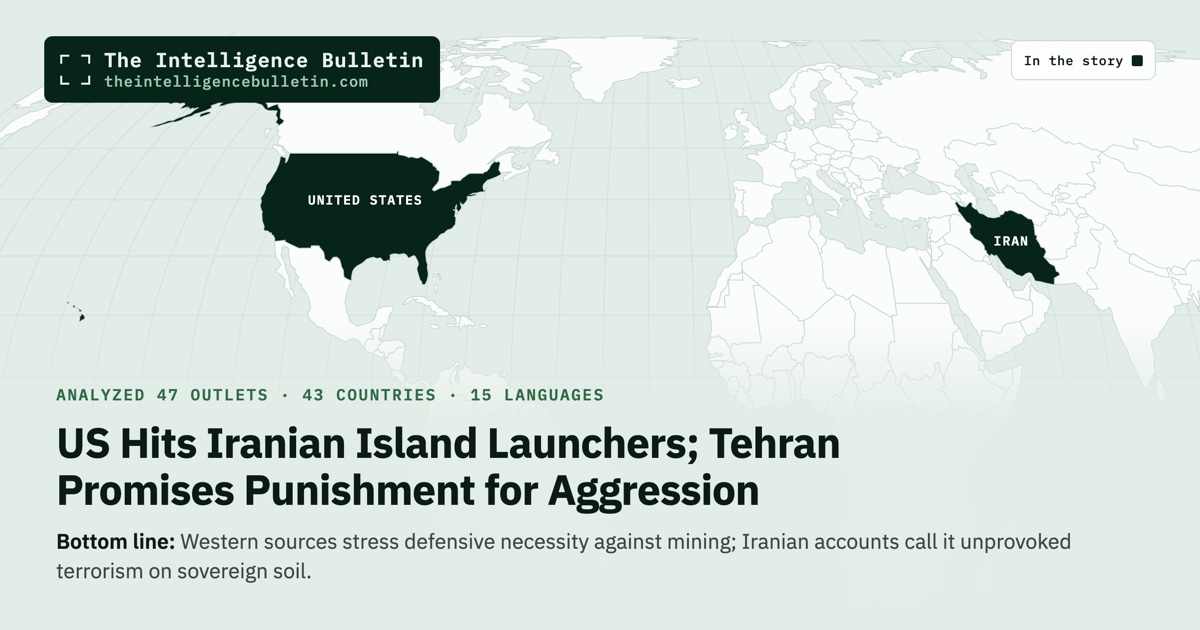
Western sources stress defensive necessity against mining; Iranian accounts call it unprovoked terrorism on sovereign soil.
Reporting across the set converges on the strike occurring and the IRGC’s immediate vow of response but parts sharply on motive and legitimacy. US-linked accounts frame the action as a targeted response to imminent mining threats in a vital shipping lane, with a Navy captain’s statement to AFP and anonymous officials supplying the operational detail. Iranian state media, by contrast, labels the same event a deliberate terrorist strike by an American-Zionist enemy acting from desperation, citing specific casualty figures from Tasnim and invoking Quranic language of vengeance. Regional and European outlets occupy the middle ground, noting the timing as the first escalation in weeks while embedding it in the larger Hormuz blockade dispute without endorsing either justification. Antiwar.com stands apart by relaying both the US targeting claim and the IRGC casualty report while recalling prior Iranian strikes on US positions, underscoring domestic skepticism. The consistent thread is IRGC confirmation of impact and intent to answer, yet the absence of any independent verification of launcher activity or exact tolls leaves each side’s narrative resting on its own sourcing chain. This pattern shows how the same bare sequence acquires entirely different political weight depending on whether the outlet treats Hormuz security or Iranian sovereignty as the primary stake.
Full analysis
US forces struck two rocket launchers on Larak Island in the Strait of Hormuz on the night of August 30, 2026. The island sits at the northern edge of the strait, a narrow passage through which much of the world’s oil traffic passes between the Persian Gulf and the open ocean. Iranian state media reported explosions near the site that evening. The Islamic Revolutionary Guard Corps later confirmed the attack, stating that it had martyred and wounded several of its combatants and civilians.
A US Navy captain, speaking to AFP, described the targets as launchers observed preparing to fire rockets equipped with sea mines into the strait. An unnamed US official told Al Jazeera the same. The strikes marked the first direct US action against Iranian territory in more than a month, according to accounts in both outlets. Iranian officials rejected the stated purpose. Press TV quoted the IRGC Public Relations Department calling the action a terrorist strike by the American-Zionist enemy, carried out in desperation over domestic failures and declining regional standing. The department added that the sons of Islamic Iran would answer the aggression and punish the aggressor, opening its statement with the Quranic verse that God will take vengeance upon the criminals.
IRGC spokesperson Hossein Mohebbi described the strike as a strategic and fatal error committed in the middle of Washington’s economic war on Iran. He warned that the United States would pay consequences in both economic and military arenas. Tasnim News Agency, cited in Press TV’s report, put the initial toll at two martyred and two wounded. Other outlets carried the IRGC’s broader statement that several soldiers and civilians had been killed or injured without specifying numbers.
The IRGC statement appeared across multiple accounts. Al Jazeera, Anadolu Agency, Deutsche Welle and Antiwar.com all quoted or summarized the vow that the act would be responded to and the aggressor punished. Antiwar.com added that during an earlier round of strikes last month the IRGC had damaged US bases and inflicted hundreds of casualties on American troops, mainly in Jordan. Deutsche Welle placed the Larak action inside the larger pattern of a US naval blockade imposed on Iran in April after Iran restricted most international shipping through the strait in late February. Al Jazeera noted that attacks on ships in the strait had continued almost daily even as the United States claimed to have cleared mines from international routes and to be protecting millions of barrels of oil moving through the waterway.
The accounts converge on the occurrence of the strike, the IRGC’s casualty claim, and its explicit threat of retaliation. They diverge on the motive and legitimacy attached to the same sequence of events. US-linked reporting presents the action as a narrow response to an imminent threat against a critical shipping lane. Iranian state media presents it as unprovoked aggression against sovereign territory that forms part of Iran’s front line in the defense of the Persian Gulf. A reader limited to one of those frames would miss the operational detail supplied by the Navy captain and the specific casualty figures supplied by Tasnim. A reader limited to the other would miss the explicit US assertion that the launchers were minutes from firing mines into the strait.
Regional and European coverage occupies a narrower middle position. Al Jazeera records the timing as the first escalation in weeks and embeds the event in the ongoing Hormuz blockade dispute without endorsing the US rationale or the Iranian characterization of terrorism. Deutsche Welle aggregates wire reporting to note both the captain’s statement on launcher preparations and the IRGC vow, while situating the strike inside US efforts to enforce the blockade and Iranian assertions that the strait remains under complete Iranian control. Anadolu Agency relays the IRGC casualty and vow language with little additional framing, foregrounding the human cost in a manner consistent with its neighbor-state perspective.
Antiwar.com differs from both the US official line and the Iranian state line by carrying the targeting claim alongside the IRGC casualty report and by recalling the earlier Iranian strikes on US positions. Its account therefore supplies the domestic American skepticism that state-aligned outlets on either side do not foreground. The consistent element across all five sources remains the IRGC’s on-record confirmation that the island was hit, that people were hurt, and that a response would follow. No independent verification of launcher activity or exact casualty toll appears in any of the published pieces.
The US claim that the launchers were preparing to mine the strait rests on statements from US officials alone. The IRGC’s description of the strike as a terrorist act and its specific casualty count rest on Iranian official statements alone. The shared facts—the strike itself, the reported injuries, and the vowed retaliation—appear in reporting chains that cross borders and editorial lines. A reader who encounters only the Iranian framing will conclude that Washington acted without provocation to damage Iranian sovereignty. A reader who encounters only the US framing will conclude that Tehran was on the verge of disrupting global energy flows and that the response was narrowly defensive. Both conclusions omit the corroboration the other side supplies for the bare sequence of events.
What to Watch
The most reliable account of what occurred is therefore the one that holds the strike happened, that the IRGC reported casualties, and that the IRGC committed itself to retaliation, while treating the stated US purpose as an unattributed operational claim and the Iranian characterization of terrorism as an official Iranian assertion. The interest on the US side is to present the action as protective of international shipping. The interest on the Iranian side is to present it as further evidence of aggression that justifies further resistance. The next development likely to matter is whether the IRGC follows through on its stated intent with strikes on US positions in the region, as it did after earlier exchanges. Such a response would test whether the current focus on sanctions and blockade can contain the confrontation or whether the direct military cycle resumes at higher intensity. The Strait of Hormuz remains the physical location where those choices intersect with global energy supply.
That’s how the world told the story.
Get our daily open-source intelligence on world events in your inbox — one email a day, up to six stories.
Subscribe freeNo spam. One-click unsubscribe. See the latest email →