 AI-generated analysis published under the editorial responsibility of Rohit Sinnas. How it works →
Press quoted
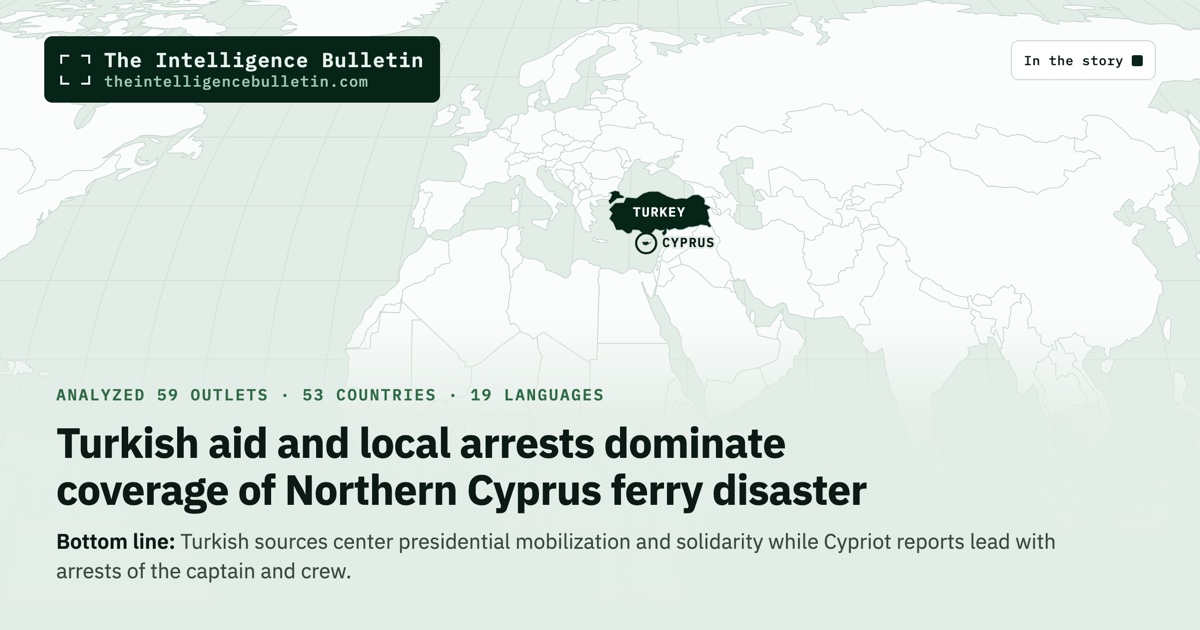
Turkish sources center presidential mobilization and solidarity while Cypriot reports lead with arrests of the captain and crew.
Turkish state-linked reporting consistently frames the disaster as a national emergency met with rapid mobilization from Ankara, quoting President Erdoğan directly on the deployment of coast guard, military aircraft and ships. Northern Cyprus outlets instead lead with local accountability, detailing Prime Minister Üstel’s statements that the captain and seven others were arrested and that every aspect of the incident will be investigated. English-language Cyprus Mail reporting stays close to the scene, tracking exact rescue counts and the cancellation of Victory Day events while noting Turkish Cypriot officials on site. The South China Morning Post aggregates casualty figures from Turkish sources and adds a passenger account of a possible explosion, giving the only mention of a potential cause. The pattern shows actor-driven narratives from Turkey emphasizing solidarity and resources while Cypriot coverage prioritizes immediate local consequences and arrests; both chains agree on the scale of the rescue effort and Turkish assistance but diverge sharply on what the story is primarily about.
Full analysis
On the afternoon of August 30 a catamaran passenger ferry named Filo Jet left the port of Kyrenia bound for the Turkish mainland port of Taşucu. The vessel carried 259 passengers and eight crew members. Roughly 15 minutes after departure and about four miles offshore it began taking on water in rough seas. The ferry later capsized. Northern Cyprus coast guard boats reached the scene within 15 to 20 minutes. Additional vessels already at the port, civilian boats in the area, helicopters and a second passenger vessel dispatched from Kyrenia joined the evacuation. Turkish coast guard units, Turkish military aircraft and helicopters, unmanned aerial vehicles, a Turkish naval patrol vessel and a Turkish assault boat also took part. Turkish Cypriot civil defense and police divers worked alongside them. Ambulances and a medical tent waited at the new Kyrenia port for arriving passengers. Events planned in Kyrenia to mark the anniversary of the 1922 Battle of Dumlupinar were cancelled.
Rescue teams brought 159 people ashore by mid-afternoon according to Kyrenia mayor Murat Senkul. Turkish Cypriot prime minister Unal Üstel later stated that 237 people had been rescued. At least eight people died and searches continued for 22 others still missing. One rescued passenger told local media a blast occurred at the bow before the vessel rolled over. Northern Cyprus transport minister Erhan Arıklı said investigators had not yet determined the cause and noted the rough sea conditions. Turkish Cypriot health authorities positioned ambulances at the port and warned bathers away from the area because of irregular sea movements.
Üstel described the incident as the largest maritime disaster in Cyprus history. He said the state had mobilized every available resource from the first moment and that search operations would continue without pause until all missing people were found. A search-and-rescue ship capable of operating at 1,000 meters depth was en route from Turkey. Üstel thanked President Recep Tayyip Erdoğan for a personal call of condolence and for pledging unlimited Turkish support. He also thanked Turkish vice president Cevdet Yılmaz for remaining in close contact and Nationalist Movement Party leader Devlet Bahçeli for expressions of solidarity. Üstel stated that an investigation had begun immediately and that the captain together with seven other crew members had been detained. He pledged that every aspect of the incident would be examined and that no one would be spared if negligence or responsibility were established.
Turkish state reporting centered on the scale of Ankara’s response. Anadolu Agency carried President Erdoğan’s statement that Turkey had mobilized all resources. Daily Sabah described the rapid dispatch of coast guard and civil defense teams and the mobilization of every vessel in the area. Both outlets quoted Arıklı on the timeline and the priority of bringing passengers ashore without loss of life. Cyprus Mail reporting stayed with the local response: the exact number of people brought ashore at each stage, the presence of Üstel and Arıklı at the port, the fleet of ambulances and the cancellation of public events. Kıbrıs Postası published Üstel’s full statement, including the arrest announcement and the description of the event as Cyprus’s worst maritime disaster. South China Morning Post aggregated casualty totals from Turkish sources and added the passenger account of an explosion at the bow.
The accounts converge on several concrete points. Multiple independent reporting chains record the same passenger and crew total, the same approximate distance offshore when the vessel began taking water, the same composition of the rescue force that included both Northern Cyprus and Turkish units, and the same announcement that the captain and seven crew members had been detained. Turkish assistance appears in every account that reached the afternoon hours. The divergence lies in emphasis rather than in disputed facts. Turkish state-linked outlets foreground Erdoğan’s direct involvement and the breadth of Turkish assets deployed. Northern Cyprus coverage, especially in the Turkish-language press, foregrounds the immediate opening of a local criminal investigation and Üstel’s explicit commitment to pursue any negligence without regard to rank. The English-language Cyprus Mail tracks operational details on the ground without quoting the Turkish president. The single international outlet in the set supplies the only published passenger description of a possible mechanical or explosive trigger.
A reader limited to Turkish state sources would conclude that the story is primarily one of coordinated state response and bilateral solidarity. A reader limited to Northern Cyprus outlets would conclude that the story is primarily one of local accountability and the opening of an investigation into possible crew failures. Both conclusions contain elements that are corroborated across chains, yet neither captures the full picture that emerges only when the reports are placed side by side. The same prime minister both thanked Ankara for military and coast guard support and ordered the detention of the captain and seven crew members. The same rescue operation that brought most passengers to safety also produced the first arrests. The passenger account of a blast appears only in the single observer report and remains unconfirmed in any official statement from either side.
The most firmly supported elements are therefore the ones that appear in both the Turkish and the Northern Cyprus reporting chains: the vessel’s departure and capsizing details, the composition and scale of the rescue force, the approximate casualty range, and the fact that Turkish units participated alongside local teams. The arrest announcement originates in Üstel’s own public statement and is carried by both local and international outlets. The Turkish mobilization statement originates in Erdoğan’s public remarks and is carried by Turkish state outlets. Each side therefore supplies primary sourcing for the element it chooses to lead with, and the two elements are not in conflict on the record.
The divergence in framing reflects the institutional positions of the outlets rather than any factual contradiction in the underlying events. Northern Cyprus authorities face direct responsibility for regulating the ferry service and for the safety of residents and visitors. Turkish authorities face the political task of demonstrating support for the Turkish Cypriot administration without appearing to override local jurisdiction. The resulting coverage pattern shows each side foregrounding the dimension that aligns with its immediate institutional interest. The record as published supplies no basis for choosing one emphasis over the other as more accurate; it supplies instead the concrete record that both emphases rest on the same corroborated sequence of departures, capsizing, rescue and detention.
What to Watch
What happens next will be determined by the investigation Üstel announced. The final casualty count, the technical findings on the vessel’s condition, and any charges that follow the detentions will test whether the local accountability narrative or the solidarity narrative receives the stronger confirmation in the coming days. The reporting already available makes clear that both the rescue operation and the criminal inquiry are running in parallel from the same set of authorities.
That’s how the world told the story.
Get our daily open-source intelligence on world events in your inbox — one email a day, up to six stories.
Subscribe freeNo spam. One-click unsubscribe. See the latest email →